


A medical emergency in the Bahamas can turn a relaxing stay into a complex transport and billing decision. So, is air ambulance membership worth it for Bahamas travel? The answer depends on how long you’ll be there, what your insurance covers, and how much financial uncertainty you’re prepared to carry.
It’s sensible to weigh membership before a trip, especially if your health or travel insurance includes evacuation benefits. Coverage terms vary, and membership isn’t a replacement for insurance. It affects access to Tropic Air Rescue’s service and how member transports are billed: the company bills health insurers directly and accepts insurance payouts as full payment for members.
This guide helps you compare membership with your existing coverage and the risk of self-funding emergency transport. You’ll learn how your length of stay can shape the choice between short-term and annual membership, what to look for in your insurance policy, and how to weigh service access against potential financial exposure. The goal is a decision that fits your Bahamas plans, not a one-size-fits-all answer.
Key Takeaways
- To decide “is air ambulance membership worth it for Bahamas” travel, weigh your stay length, insurance arrangements, and tolerance for unexpected expenses.
- Review your health and travel insurance terms to understand what they cover and how claims are handled.
- Compare membership, insurance, and self-funding by service access, billing process, policy dependence, and potential financial exposure.
- Use your anticipated time in the Bahamas to assess whether short-term or annual membership better fits your plans.
- Tropic Air Rescue requires membership to access its helicopter emergency and interhospital transport benefits. Understand how the membership requirement and direct insurer billing fit with your coverage.
Is Air Ambulance Membership Worth It for a Bahamas Stay?
Emergency transport is easier to evaluate before you need it. Membership may seem unnecessary when a trip is going smoothly, but trying to sort out service access and possible bills during a medical crisis is harder. Start by understanding what membership does: it is a subscription that provides access to Tropic Air Rescue’s air-medical service benefits.
Membership isn’t a promise that transport will be dispatched, and it doesn’t replace health or travel insurance. It’s one part of an emergency plan. To decide whether it fits, weigh three factors: how long you’ll be in the Bahamas, what your existing policies say about emergency medical transport, and what financial consequences you could face if transport is needed. For background on the broader role and structure of air medical services, see the Air Medical Services Overview.
What does “worth it” mean for a Bahamas visitor?
“Worth it” should be more than a feeling of peace of mind. Ask whether membership provides access to a service you want included in your plan, how its benefits fit alongside your insurance, and how the billing arrangement affects your potential out-of-pocket costs. Compare those practical benefits with the membership terms and your travel plans. Don’t assume an emergency will happen, or that the same choice is right for every traveller.
A short visit and recurring stays can lead to different conclusions. For a brief trip, compare your travel or health insurance benefits with the length of a short-term membership. If you return regularly, own a second home, or spend extended periods in the country, weigh an annual option against your expected stays. Neither pattern makes membership automatically worthwhile. The terms and your circumstances determine the fit.
Who should assess membership before travelling?
Visitors, residents, second-home owners, and people who return regularly can all benefit from reviewing their emergency transport arrangements before travel. This is particularly useful if you’re unsure whether your insurance covers air medical transport in the Bahamas, how it handles payment, or what limits and exclusions apply. Uncertainty is a reason to read the policy carefully, not to assume you are covered or uncovered.
Plan for your time in the Bahamas as a whole rather than making assumptions about a particular location. Focus on the transport benefits you’re considering, your expected length of stay, and the actual wording of your insurance policy and membership terms.
Before deciding, write down your expected stay length, identify which policies may apply, and mark any terms you don’t understand. Then consider how comfortable you are with the financial uncertainty that remains. This gives you a grounded way to answer is air ambulance membership worth it for Bahamas travel without relying on accident predictions or unverified evacuation-cost estimates.
How Air Ambulance Membership and Insurance Billing Work
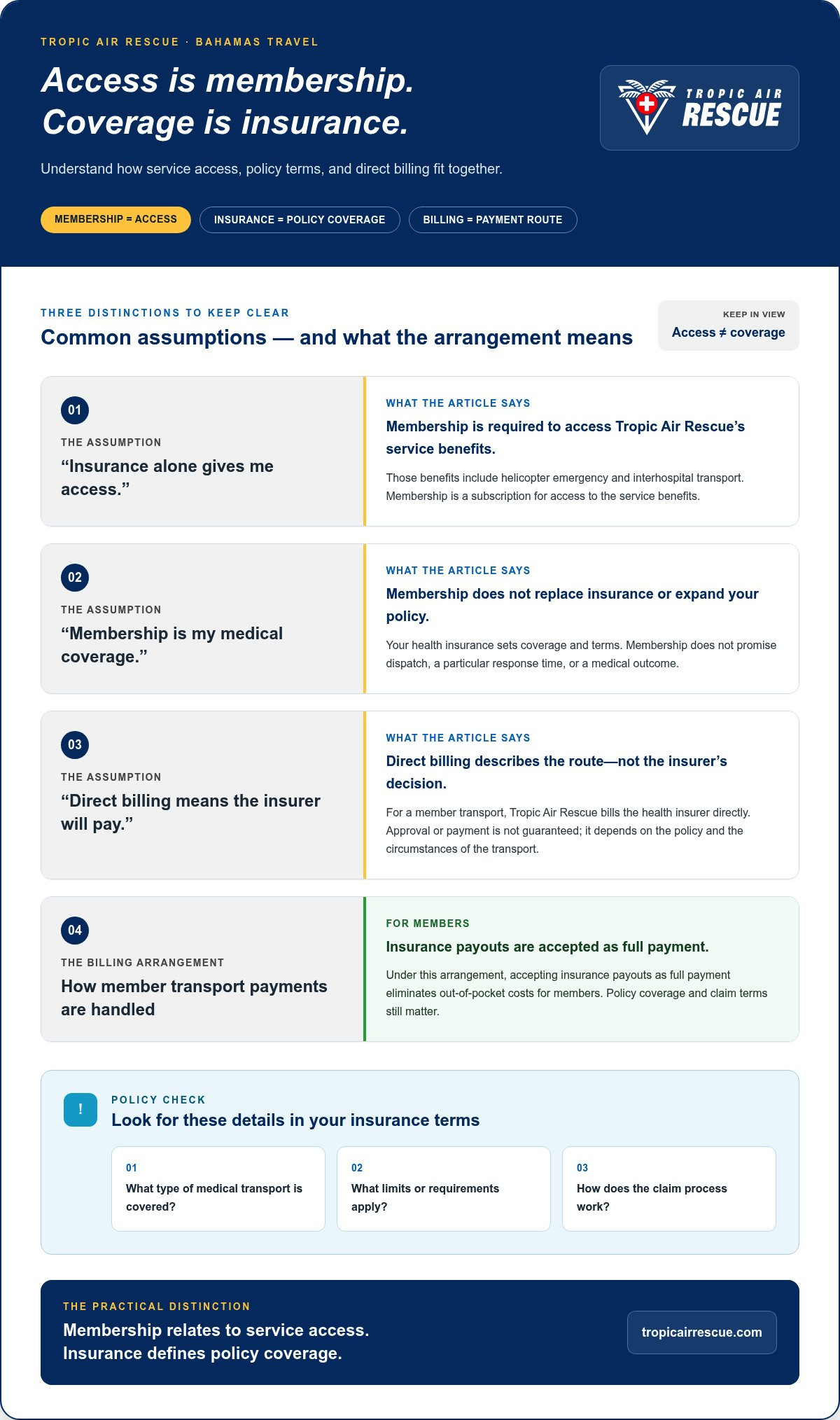
Membership is required to access Tropic Air Rescue’s service benefits. For member transports, the company bills health insurers directly and accepts insurance payouts as full payment for members, eliminating out-of-pocket costs under this arrangement.
Membership provides access to service benefits; your health insurance remains the policy that sets your coverage and terms. This distinction matters. Membership doesn’t expand your insurance policy, and insurance alone doesn’t meet the membership requirement for accessing Tropic Air Rescue benefits. If you’re asking, “is air ambulance membership worth it for Bahamas?”, consider how both arrangements fit your plans.
What does direct insurance billing change?
Direct billing means Tropic Air Rescue submits the bill to a member’s health insurer for a member transport. It doesn’t guarantee that the insurer will approve or pay a claim. Coverage depends on the member’s policy and the circumstances of the transport, so don’t assume every policy or claim will be treated identically. Review the relevant policy terms before travelling.
For example, if your policy has limits or requirements for medical transport, direct billing doesn’t change them. It describes the billing route, not the insurer’s decision. Check the policy for the type of transport covered, any applicable limits, and the claim process. Keep the policy details accessible during your stay so you can refer to them if needed.
What membership does, and does not, mean
Membership is the required way to access Tropic Air Rescue benefits. It isn’t travel insurance or comprehensive medical coverage, and it doesn’t promise dispatch, a particular response time, or a medical outcome. Keep your insurance in place and assess membership alongside it, not as a substitute for your policy’s protections and limits.
This distinction helps answer “is air ambulance membership worth it for Bahamas” travel in your circumstances. Membership relates to access; insurance defines policy coverage. The direct-billing arrangement connects the two: Tropic Air Rescue bills health insurers and accepts insurance payouts as full payment for members. Review your coverage and membership information together to understand how the arrangement fits your travel plans.
Compare your anticipated stay with the membership duration that fits it, then review your health insurance terms for emergency transport. Explore Tropic Air Rescue membership as part of that assessment, keeping service access, policy coverage, and billing distinct.
Membership, Insurance, or Self-Funding: Compare the Trade-Offs
These approaches address different parts of emergency planning. Membership concerns access to specified service benefits. Insurance is governed by the policy’s coverage and claims terms. Self-funding means relying on personal resources to pay costs that arise. Compare them by process and financial exposure, rather than assuming one approach fits every traveller.
| Approach | Access arrangement | Billing process | Policy dependence | Potential expense exposure |
|---|---|---|---|---|
| Membership | For Tropic Air Rescue, membership is required to access its benefits. | The company bills health insurers directly for member transports and accepts insurance payouts as full payment for members. | Health insurance remains separate from membership. | The stated billing arrangement avoids out-of-pocket costs for members, but membership isn’t a substitute for insurance. |
| Existing insurance | Access depends on the policy and the arrangements it provides; insurance alone does not establish membership access to Tropic Air Rescue benefits. | Follow the billing or claim process in the policy. | Coverage depends on the specific policy wording. | Potential exposure depends on the policy’s terms and how they apply. |
| Self-funding | Payment planning does not itself create access to a particular transport service. | You rely on personal funds to pay applicable expenses. | No insurance policy is being relied on for those expenses. | Your financial exposure depends on the costs incurred and resources available. |
Does existing travel or health insurance make membership unnecessary?
Not automatically. Read the policy wording for air-medical transport and evacuation benefits, including the billing or claim process. Insurance terms differ, so a broadly described benefit may not answer every practical question about transport or payment. Keep the roles distinct: insurance sets policy coverage; membership provides access to specified service benefits. For the billing mechanics, refer to the earlier section, How Air Ambulance Membership and Insurance Billing Work.
What should you compare before deciding?
Start with the length of your planned stay. Compare it with the available short-term and annual membership options, then review your policy language and billing arrangements. Consider how much uncertainty you’re comfortable carrying if emergency transport becomes necessary. A brief visit and recurring stays may lead to different choices, but neither pattern decides the question on its own.
Use the comparison to answer is air ambulance membership worth it for Bahamas travel in your circumstances. If your policy addresses the transport needs you’re considering and its billing process is clear, that may weigh into your decision. If questions remain about service access or potential expenses, include membership in the comparison rather than treating insurance and membership as automatic substitutes. The aim is a deliberate plan that fits your stay, coverage, and tolerance for financial uncertainty.
A Practical Checklist for Deciding Before Your Bahamas Trip
A review before departure can turn a vague concern into a clear decision. Set aside your travel dates and insurance documents, then work through the questions below. If you return regularly, consider your expected travel pattern across the year rather than assessing only one visit.
Five questions to answer before choosing
- How long will you be in the Bahamas, and how often will you return? Record the dates for this stay and any recurring visits. Use that information to compare a short-term option with an annual membership.
- What does your current health or travel policy say about air-medical evacuation? Look for the exact provisions, limits, and claim or billing process. If the wording is unclear, note the specific questions you need answered before relying on it.
- How would unexpected transport expenses affect your household finances? Consider what resources you could access and how comfortable you are with uncertainty. Don’t assume a policy pays every expense or that self-funding is manageable for every household.
- Are you planning for emergency transport or routine travel? Air-medical transport is an emergency medical service, not a substitute for ordinary passenger travel or a non-emergency journey. Keep those needs separate when comparing membership with other travel arrangements.
- What role would membership play alongside your insurance? Identify whether you’re assessing access to specified service benefits, insurance coverage, or both. Keeping those roles distinct helps prevent membership from being mistaken for a comprehensive insurance policy.
Match membership duration to your travel pattern
Short-term and annual membership options address different anticipated stay lengths. A single planned visit may lead you to assess a short-term option, while recurring or extended stays may make it useful to compare an annual option. The right fit depends on your travel pattern and the relevant membership terms, not on an assumed eligibility rule or benefit.
Keep your notes together: planned dates, policy wording, billing steps, and your tolerance for potential expenses. This gives you a focused basis for deciding is air ambulance membership worth it for Bahamas travel in your circumstances. For a closer look at coverage for a defined trip, consult the Short-Term Medevac Guide; if you expect recurring stays, the Annual Membership Guide can help frame that comparison.
Once you’ve reviewed those factors, explore membership options for your Bahamas stay and compare the available duration with your travel plans.
What Tropic Air Rescue Membership Means for Your Decision
The decision comes down to whether the service arrangement fits your travel pattern, insurance position, and comfort with financial uncertainty. Tropic Air Rescue provides concierge helicopter emergency and interhospital medical transport throughout the Bahamas. Membership is required to access its benefits. For member transports, the company bills health insurers directly and accepts insurance payouts as full payment for members.
These details give you concrete points to compare with your plans: whether you want access to this service, how your insurance handles emergency transport, and whether the membership duration fits your stay. Membership doesn’t replace insurance or remove medical risk. It also doesn’t guarantee dispatch, transport, or a particular medical outcome.
When the membership model may fit
This model may suit people who value a defined air-medical service arrangement while in the Bahamas and want the provider to bill their health insurer directly for member transports. A short-term option may align with a planned visit, while an annual option may be relevant for recurring or extended stays. Base the comparison on your actual travel pattern and the applicable terms, not assumptions about eligibility or outcomes.
For someone visiting once, the central question may be whether the membership period corresponds to the trip and complements their existing policy. For a second-home owner or frequent visitor, the assessment may involve comparing the annual option with repeated stays over time. In either case, review how service access and insurance billing fit together. Keep the policy itself in view, since membership isn’t comprehensive health or travel insurance.
Explore membership before your stay
Before deciding, bring together your planned dates, policy details, and a realistic view of what unexpected expenses could mean for you. If the service arrangement and membership duration fit your needs, review Explore Tropic Air Rescue membership. You can also use the Concierge Air Medical Service Guide to understand the service context as you consider your options.
There’s no universal answer to whether air ambulance membership is worth it for Bahamas travel. A well-grounded choice reflects your length of stay, your insurance terms, and the value you place on having access to specified air-medical service benefits. Compare the membership arrangement with your existing coverage and choose the next step that suits your circumstances.
Make Your Travel Plan Before You Depart
Settle your emergency transport plan before travel, while you have time to review your documents and make a considered choice. Ask yourself one final question: is air ambulance membership worth it for Bahamas travel given your stay, insurance terms, and comfort with financial uncertainty? Your answer should reflect your circumstances, not an assumption about what every visitor needs.
Tropic Air Rescue membership is required to access service benefits. For members, insurance payouts are accepted as full payment. Short-term and annual options can be matched to anticipated stay length. Keep membership distinct from your insurance policy, and choose the option that aligns with your plans.
When you’re ready, explore Tropic Air Rescue membership and review the information as you finalise your travel preparations. A clear decision before departure can help you begin your Bahamas stay with a more deliberate plan.
Frequently Asked Questions
Is air ambulance membership worth it for a short stay in the Bahamas?
It may be, depending on your trip and existing protection. Whether air ambulance membership is worth it for a short Bahamas visit depends on how the membership period aligns with your dates, what your insurance covers, and your comfort with financial uncertainty. Even a brief stay may warrant a closer look if your policy’s evacuation provisions are unclear. Don’t use trip length alone to make the decision.
Does health insurance cover air ambulance transport in the Bahamas?
It depends on your specific policy, so don’t assume it includes air-medical transport in the Bahamas. Check for wording on emergency evacuation, air ambulance, or medically necessary transport, and note any limits or claim procedures. If a clause is unclear, ask your insurer how it applies to your travel. Keep your policy details and insurer contact information accessible during your stay.
Can travel insurance replace air ambulance membership?
Not automatically. Travel insurance may provide evacuation or medical benefits, but it doesn’t satisfy a membership requirement for access to a particular service. Insurance is governed by its policy terms; membership concerns access to specified service benefits. Compare the evacuation wording in your travel policy with the membership arrangement. Treat them as potentially complementary, and don’t assume either covers every situation or removes the need to understand the other’s terms.
Is air ambulance membership the same as travel insurance?
No. Travel insurance is a policy with defined coverage, conditions, and claims procedures. Air ambulance membership is an access arrangement for specified air-medical service benefits. One doesn’t automatically replace the other. Keep your insurance documents and membership information separately accessible so you can refer to the relevant policy or service details if needed.
How does direct insurance billing work for a member?
For a member transport, Tropic Air Rescue bills the member’s health insurer directly. The insurer processes the claim under the member’s policy. Tropic Air Rescue accepts insurance payouts as full payment for members, eliminating out-of-pocket costs under this arrangement. Direct billing describes the payment process, not an insurer’s approval decision. Keep your policy information accessible and understand that coverage decisions depend on your plan’s terms.
Can air ambulance membership help with an interhospital transfer?
Yes. Tropic Air Rescue provides interhospital medical transport, and membership is required to access its service benefits. If a treating medical team determines that a transfer is needed, membership is relevant to service access, while the clinical decision and circumstances guide the situation. Membership shouldn’t be understood as a guarantee that transport will be dispatched or that a particular medical outcome will follow.
When should I arrange air ambulance membership for a Bahamas trip?
Review your options before travelling, while you have time to compare membership duration with your itinerary and read your insurance terms. If you return regularly, consider how an annual option fits your expected stays; for a defined visit, assess whether a short-term option aligns with your dates. Deciding whether air ambulance membership is worth it for Bahamas travel is easier before departure, when you can make a calm, informed choice.