


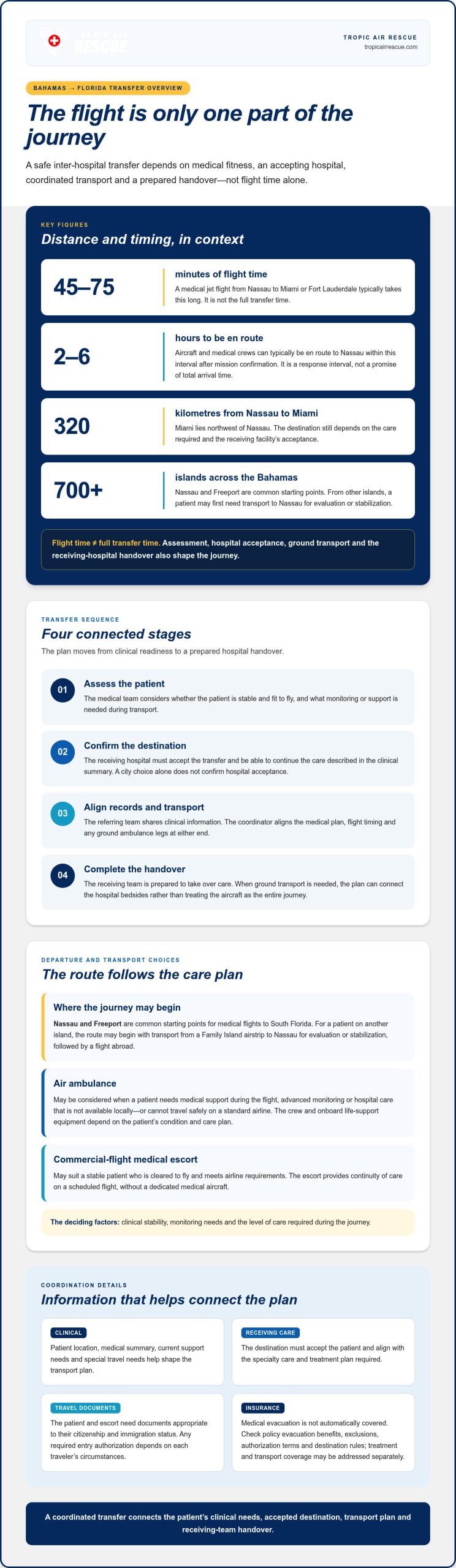
A patient can travel directly from a hospital in Nassau to an accepting hospital in Florida when the medical team determines the patient is fit to fly and the receiving facility is ready. A medical jet flight from Nassau to Miami or Fort Lauderdale typically takes 45 to 75 minutes. An inter-hospital transfer from the Bahamas to Florida also depends on the patient’s condition, the departure location and coordination between hospitals.
An inter-hospital transfer from the Bahamas to Florida may seem straightforward, but the flight is only one part of the journey. The care plan, medical supervision and handover at the receiving hospital all shape how the transfer is arranged.
This article explains how hospital coordination works, what medical fitness to fly involves, which Bahamas locations may serve as departure points and how flight time fits into the wider timeline. You’ll see what can affect a transfer from the first hospital assessment through arrival in Florida, so you can understand the decisions involved and what information helps the process move forward.
Key Takeaways
- Transfers to Florida may depart from Nassau or Freeport, while patients on other islands may first need transport to a larger medical centre.
- A receiving hospital’s acceptance and a clear exchange of medical records help align the care plan with the flight and arrival arrangements.
- Air ambulance transport may be considered when a patient needs specialist evaluation, advanced monitoring or hospital care that isn’t available locally.
- Fitness to fly depends on the patient’s stability and the level of medical support needed during transport, not simply the distance to Florida.
- Understand how membership can connect eligible patients with interhospital transfer services when arranging medical transport in the Bahamas.
Which Bahamas locations are most often involved in medical flights?
Nassau and Freeport are common starting points for medical flights to South Florida. Higher-level hospitals are concentrated in these centres, while the Bahamas spans more than 700 islands. For patients elsewhere, the route may begin with transport from a Family Island airstrip to Nassau for evaluation or stabilization, followed by a flight abroad.
From Nassau, Miami or Fort Lauderdale may be the destination when the required specialty care is available there. Miami lies 320 kilometres northwest of Nassau, and a medical jet flight from Nassau to Miami or Fort Lauderdale typically takes 45 to 75 minutes. That is flight time, not the full transfer time: medical assessment, hospital acceptance, ground transport and handover also shape the journey.
Freeport on Grand Bahama can also be a departure point for South Florida. A transfer to Fort Lauderdale may be arranged when it is the closest appropriate destination for the patient’s needs. The departure airport, receiving hospital and ground ambulance arrangements depend on where care is available and how the patient can be moved safely.
Air ambulance transport and a commercial-flight medical escort serve different clinical needs. An air ambulance may be considered when a patient needs medical support during the flight or cannot travel safely on a standard airline. A commercial-flight escort may suit a stable patient who is cleared to fly and meets airline requirements. The choice depends on clinical stability, monitoring needs and the level of care required during the journey.
For entry into the United States, the patient and escort need travel documents appropriate to their citizenship and immigration status. Passport details are part of coordinating international travel. Any required entry authorization depends on each traveler’s circumstances.
Health insurance does not automatically cover medical evacuation from the Bahamas to Florida. Coverage depends on the policy’s evacuation benefits, exclusions, authorization terms and destination rules. Review those terms alongside the proposed route and receiving hospital, since coverage for treatment and coverage for transport may be addressed separately.
Booking and receiving-hospital coordination
A transfer depends on more than aircraft timing: the Bahamian hospital, medical team and Florida receiving facility must align the plan. Clinical records, destination acceptance and transport arrangements all shape the handover.
Arranging the Air Ambulance Transfer
An air ambulance transfer is a coordinated medical journey from the referring hospital to an accepting hospital in Florida. The flight plan must match the patient’s condition and the receiving team’s ability to continue care.
Coordination can begin with the patient’s location, preferred destination, medical summary, special travel needs and passport details. The referring team shares clinical information so the transport plan reflects current needs, including monitoring and support during the flight. Clear, consistent patient records help the teams coordinate the transfer and handover.
Next, the coordinator aligns the medical plan, flight timing and receiving-facility acceptance. Ground ambulances may be arranged at both ends when needed, creating a bedside-to-bedside journey rather than treating the aircraft as the entire transfer. Aircraft and medical crews can typically be en route to Nassau within 2 to 6 hours of mission confirmation. That is a response interval, not a promise of total arrival time.
Patients and families benefit from a clear sequence: confirm the destination’s acceptance, prepare clinical records, coordinate transport legs, then complete the hospital handover. A focused transfer coordination plan helps keep these elements connected.
Receiving Hospitals in Florida
Florida receiving hospitals are selected according to the patient’s clinical needs and the facility’s acceptance of the transfer. No single hospital receives every international patient from the Bahamas. The destination must be able to continue the care described in the medical summary.
The referring hospital and transfer coordinator align the destination with the required specialty care, medical plan and receiving-facility acceptance. Miami and Fort Lauderdale are common South Florida destinations for flights from Nassau or Freeport, but a city name alone does not mean a particular hospital has accepted the patient.
For example, a patient needing specialist evaluation requires a destination able to receive the referral and continue the planned treatment. The clinical summary helps the receiving team understand the patient’s condition, treatment and support needs. Acceptance must then align with flight timing and ground transport, so the hospital handover is prepared before arrival.
Families can focus on three updates: which facility has accepted the patient, when departure is planned and when the receiving team expects the handover. The referring hospital is a key source for clinical details, while the transfer coordinator connects those details with transport arrangements. This keeps the patient’s care plan central from departure through arrival.
Reasons for air ambulance transfers in the Bahamas
An air ambulance transfer is considered when a patient needs urgent evaluation, specialist treatment or hospital-level support beyond local capacity. The Bahamas spans more than 700 islands, so the distance between a patient and suitable care can make transport a clinical issue, not simply a travel choice. A patient at a smaller island clinic may need referral to New Providence or onward care in Florida.
Critical care needs account for approximately 70% of air ambulance missions from Nassau. Examples include severe breathing problems, serious infection or a condition requiring intensive care. The referring team considers the patient’s current stability, the treatment available locally and the level of monitoring required during the journey. If a patient needs continuous clinical support, a standard commercial flight may not meet those needs.
Suspected stroke, serious neurological symptoms and heart-related symptoms can prompt transfer for advanced evaluation or procedures. Time matters in stroke care: a six-hour delay in reaching a stroke centre can reduce a patient’s chance of meaningful recovery by approximately 30%. A medical team assesses the symptoms, current findings and destination options to determine whether an air ambulance is appropriate.
Serious falls and other injuries may require transfer when complex imaging or surgery is unavailable nearby. For example, a patient on a Family Island with a significant injury may first need assessment and stabilization before referral to a higher-level hospital. If the required specialist care is in South Florida, the plan must also account for safe movement from the island to the aircraft and onward to the receiving facility.
Transfers may also follow surgery. A patient who needs a higher level of monitoring after an operation may be moved to a hospital equipped to continue that care. The decision depends on the patient’s postoperative condition, the support needed in transit and the receiving hospital’s ability to take over treatment.
Not every referral requires an air ambulance. A stable patient cleared to fly may be suitable for a medical escort on a commercial flight. The practical considerations are stability, monitoring needs, available local care and the receiving facility’s capabilities. That is why two patients with similar diagnoses may need different transport plans.
Fitness-to-fly assessment
Fitness to fly means assessing whether a patient can be transported safely by the proposed aircraft and medical team. For a transfer from the Bahamas to Florida, the assessment compares the patient’s current condition with the support available during travel. It also helps determine whether an air ambulance or a commercial flight with a medical escort is appropriate.
An initial review is not always the final transport decision. Approximately 15% to 20% of initially screened patients require an air ambulance instead of a commercial flight because of unrecognized clinical instability. That figure highlights why the assessment must use current clinical information, rather than relying only on an earlier screening or diagnosis.
The clinical team reviews the medical summary, recent changes in condition and care provided at the referring facility. It then considers the monitoring and medical support needed during the journey. For example, a patient whose condition has changed since the initial review may need a different transport plan from one who remains stable.
Fitness to fly also means matching the patient’s needs to the entire journey. The route includes movement from the hospital to the departure point, the aircraft segment and transfer to the receiving facility. Each leg matters: the assessment accounts for how the patient will move and what support must continue before, during and after the flight.
For a stable patient cleared for commercial travel, a medical escort may be appropriate. If the patient needs a higher level of in-flight support, an air ambulance may be considered instead. The distinction is not simply the diagnosis, but the patient’s current stability and the care required throughout transport.
Families can help the assessment move efficiently by ensuring the referring team has an accurate medical summary and current updates. They should also share relevant travel needs and passport details for international coordination. These details help align clinical planning with the route and receiving hospital, but do not replace medical assessment.
Fitness-to-fly decisions can change as a patient’s condition changes. A review before a procedure, after surgery or following new symptoms may lead to a revised transport plan. The medical team uses the latest clinical information to determine the appropriate level of care during transfer, then coordinates the plan with the receiving facility in Florida.
How do hospitals arrange an air ambulance transfer from the Bahamas to Florida?
Hospitals arrange an air ambulance transfer by aligning the patient’s clinical plan, flight, ground transport and receiving-facility acceptance. Each part must connect, from the referring bedside in the Bahamas to the handover in Florida.
Coordination starts with a focused exchange of information. The transfer coordinator may request the patient’s location, preferred destination, medical summary, special travel needs and passport details for international travel. This information helps define the route and care requirements. The referring team’s records should reflect the patient’s current condition and treatment so the transport plan is based on accurate clinical information.
The receiving hospital’s acceptance shapes the destination and timing. The coordinator aligns the medical plan with flight timing and the facility’s ability to continue care. The route is planned as a complete journey, not just an aircraft segment. Ground ambulances can be arranged at both ends when needed, supporting bedside-to-bedside transport between hospitals.
A typical coordination sequence includes:
- Share the patient’s location, clinical summary and travel requirements.
- Align the medical plan with the receiving facility’s acceptance.
- Coordinate aircraft timing and ground transport at each end, as needed.
- Transfer the patient’s records and care details during the hospital handover.
After mission confirmation, aircraft and medical crews can typically be en route to Nassau within 2 to 6 hours. This describes the response interval, not the full time from the first hospital assessment to arrival in Florida. Departure location, patient condition, receiving-hospital coordination and ground transport all influence the overall timeline.
The care plan can also change transport arrangements. For example, a patient transferred after surgery may need closer monitoring during the journey. The clinical summary helps the transport team understand the required support, while the receiving hospital prepares to continue care after arrival.
Communication continues through departure and arrival. The AMC PSO framework recommends notifying the patient’s family when the patient leaves the referring hospital and arrives at the accepting hospital. These updates mark key handover points and keep relatives informed as the patient moves between facilities.
For a Bahamas-to-Florida transfer, coordinate an interhospital transfer around the medical plan, destination acceptance and transport legs.
Tropic Air Rescue: Short-term Membership
Tropic Air Rescue provides Interhospital Transfer Services for patients who need medically coordinated transport between hospitals in the Bahamas and Florida. When a transfer is being considered, its Short-term Membership offers a membership option for people who need coverage for a shorter period; Annual Membership is another option for ongoing needs.
Membership is required for service and allows Tropic Air Rescue to bill health insurers directly. Its services also include Organ Transport. The appropriate next step is to consider membership alongside the patient’s clinical plan and the hospitals’ transfer coordination, so transport arrangements fit the case.
For details about membership and transfer arrangements, contact Tropic Air Rescue or visit tropicairrescue.com.
Plan the Next Conversation
The next useful step is to bring the care team and family together around one shared plan. Keep the patient’s current medical summary, receiving-hospital details and travel documents together, and identify who will relay updates. This gives each conversation a clear starting point and keeps decisions focused on the patient’s needs.
For an inter-hospital transfer from the Bahamas to Florida, the right transport plan starts with the patient’s clinical needs and coordination between facilities. Tropic Air Rescue provides Interhospital Transfer Services, with Short-term Membership and Annual Membership options. Review the membership details and contact the company to discuss the next step in planning the transfer.
Discuss transfer planning with Tropic Air Rescue and take the next step with a clear, coordinated plan.
Frequently Asked Questions
Can a patient be transported directly from a Nassau hospital to a hospital abroad?
Yes, a patient can be transferred directly from a Bahamian hospital to an accepting hospital abroad when the care plan and transport arrangements support the journey. The receiving facility must be prepared to take over care, and the patient’s clinical information must accompany the transfer. Passport details are part of international coordination. The route also accounts for ground transport between the hospital, departure point and receiving facility.
How do booking and timing work for Air Ambulance Bahamas?
Booking begins with sharing the patient’s location, medical summary, preferred destination, special travel needs and passport details. The coordinator uses this information to align clinical requirements, flight timing and the receiving facility’s acceptance. Timing depends on mission confirmation, departure location, patient needs and ground transport arrangements. A planned transfer also involves hospital-to-hospital coordination, so the flight is only one part of the schedule.
How quickly can an air ambulance be arranged from Nassau?
Aircraft and medical crews can typically be en route to Nassau within 2 to 6 hours of mission confirmation. This is not the total time from the first call to hospital arrival. Medical review, destination acceptance and ground transport affect the overall timeline. Flights may also be limited by aircraft use, maintenance, regulations, patient condition or weather; FAA restrictions prohibit most Tropic Air Rescue aircraft from flying in inclement weather.
Is an air ambulance safe for elderly or critically ill patients?
Age alone doesn’t determine whether an elderly patient can fly; the patient’s condition and required in-flight support matter. Critically ill patients need an assessment of their current stability and medical needs. Tropic Air Rescue’s medical command physician and attending medical professionals determine whether a patient is flown. Patient age, size, condition, equipment limits and weather can affect service availability, so transport planning must account for these factors.
Is an air ambulance the only option, or can a medical escort work?
A medical escort on a commercial flight can suit a stable patient cleared to travel that way. An air ambulance may be considered when the patient needs support that commercial travel cannot provide. For example, a patient requiring closer monitoring may need dedicated medical transport. The key distinction is the patient’s stability and support needs throughout the journey, including transfers at either end.
What medical conditions typically require an air ambulance from Nassau?
Conditions that may prompt consideration of an air ambulance transfer include suspected stroke, serious neurological symptoms, heart-related symptoms requiring advanced evaluation, major injuries and severe breathing problems. A serious infection may also require transfer if the patient needs intensive care unavailable locally. The diagnosis alone does not determine the transport plan. The clinical team considers the patient’s current condition, available treatment at the referring facility and support needed during the journey.
What medical situations commonly lead to an air ambulance from the Bahamas?
Common situations include a patient on an island needing higher-level evaluation, someone requiring complex imaging or surgery, and a patient needing closer monitoring after surgery. Severe infection or breathing problems can also lead to transfer when intensive care is required. The care gap drives the decision: teams consider what the local facility can provide and whether the patient needs a different level of hospital care.
What medical transport options are available for inter-hospital transfers from the Bahamas to Florida?
Options include air ambulance transport for patients needing medical support in flight, or a commercial-flight medical escort for stable patients cleared to travel that way. Ground ambulances can connect the referring hospital and departure point, then the arrival point and receiving facility. Tropic Air Rescue provides helicopter air-medical services and interhospital transfers. The patient’s condition, route and required level of care shape the transport plan.