

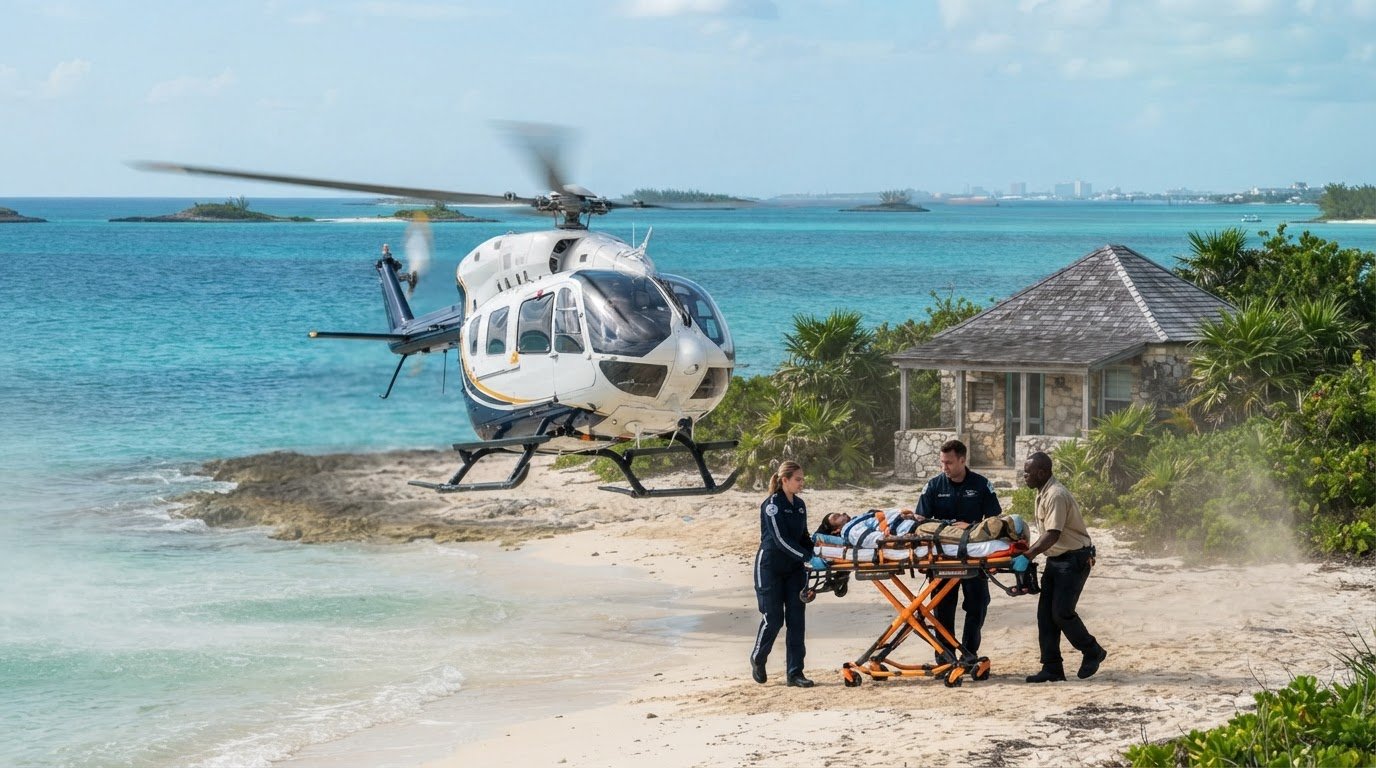
Nassau may be a transfer point rather than the final destination. For guests staying on the smaller islands, emergency medevac for Bahamas vacation rentals can start with a helicopter evacuation to Nassau. If the care needed isn’t available locally, onward transport to a hospital abroad may be considered. Yes, a patient in Nassau can be transported abroad when the medical and logistical arrangements support the transfer.
Island evacuations require coordination, not just an aircraft. The patient’s condition, the care available in Nassau, and arrangements with the receiving hospital all shape the next steps. This guide explains how evacuation from smaller islands is coordinated, what helicopter crews can provide, and how onward transport from Nassau may be arranged. It also covers the key decisions that affect the journey from a vacation rental to appropriate care.
Key Takeaways
- Understand why an evacuation from a smaller island may involve transfer to Nassau before onward care can be arranged.
- See how patient condition, receiving-hospital acceptance, and transport logistics shape the evacuation plan.
- Learn how helicopter crews and onboard life-support equipment support medical transfers from remote locations.
- Explore how membership options can help vacation rental guests prepare for emergency medical transport in the Bahamas.
Emergency medical evacuation for visitors staying on smaller islands
Medical evacuation from a smaller Bahamian island depends on the patient’s condition, available local care, and access to transport. The route may lead to Nassau or, when needed, to a hospital in the United States.
Evacuation Destinations and Transport Modes
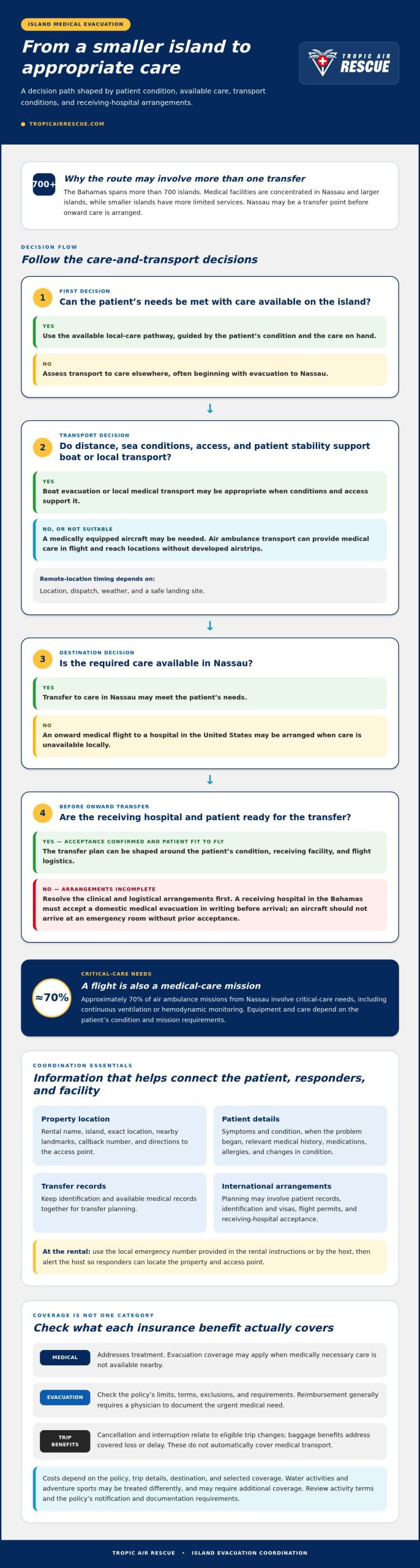
Evacuation destinations and transport modes describe how a patient moves from an island location to appropriate medical care. The Bahamas spans more than 700 islands, and medical facilities are concentrated in Nassau and larger islands; smaller islands have more limited services.
Air ambulance transport can provide medical care during flight and reach locations without developed airstrips. Boat evacuation and local medical transport depend on distance, sea conditions, access to a suitable landing area or dock, and the patient’s stability. These factors help determine whether boat transport is appropriate or a medically equipped aircraft is needed. How quickly an air ambulance can reach a remote rental also depends on location, dispatch, weather, and a safe landing site.
From Nassau, an onward medical flight to the United States may be arranged when the patient needs care unavailable locally. The receiving hospital’s acceptance and the patient’s fitness to fly shape the transfer plan.
Coverage Types and Comparisons
Travel insurance may combine emergency medical care, evacuation, trip cancellation, baggage protection, and activity-related benefits. Compare these categories carefully: cancellation or baggage coverage does not automatically cover medical transport.
Emergency medical coverage addresses treatment, while evacuation coverage may apply when medically necessary care isn’t available nearby. Cancellation and interruption benefits relate to eligible changes to a trip; baggage benefits address covered loss or delay. Policies may treat water activities and adventure sports differently, so review the activity terms alongside evacuation limits.
Medevac Insurance Costs and Exclusions
Medevac insurance costs depend on the policy, trip details, destination, and selected coverage.
What does emergency medevac insurance cover? Depending on the policy, it may cover medically necessary evacuation when suitable care isn’t available locally. Exclusions and limits vary. Adventure sports may require additional coverage, and reimbursement generally requires a physician to document the urgent medical need.
The amount of emergency medical evacuation coverage depends on policy limits and terms. Before travelling—whether relaxing on remote Bahamian cays or arranging an East African safari journey with Tamu Adventures—compare medical and evacuation benefits with cancellation, baggage, and activity provisions to understand what each category covers.
Emergency medevac booking and coordination
Arranging an evacuation involves medical information, transport planning, and coordination with the receiving facility. For vacation rental guests, accurate location details and a clear handoff can help avoid preventable delays.
Emergency Contact Options
Emergency contact options are the ways guests reach responders and coordinate help. Call the emergency services number provided in the rental’s instructions, then alert the host so responders can locate the property and access point.
What emergency number should guests call in the Bahamas? Use the local emergency number provided in the rental’s instructions or by the host. Keep it with the property address and directions, since an island name alone may not identify a remote rental precisely.
Information for Hosts and Responders
Responders need the location, an overview of the patient’s condition, and a way to coordinate access. Share the rental’s name, island, exact location, nearby landmarks, callback number, and the patient’s symptoms and condition with the host and responders.
Share when the problem began, relevant medical history, medications, allergies, and any immediate change in condition. For example, the host can guide responders from the nearest dock or landing area while the caller relays the patient’s details. Keep identification and available medical records together for transfer planning.
Once medical evacuation is considered, coordinators need to align the patient’s condition with transport and destination facilities. A receiving hospital in the Bahamas must be informed and accept the patient in writing before a domestic medical evacuation arrives. An aircraft should not arrive at an emergency room without that prior acceptance.
International transport planning may involve gathering patient records, confirming identification and visas, and arranging flight permits. Travel insurance policies may have their own notification and documentation requirements, so keep policy details accessible and report an emergency promptly. A complete plan accounts for the patient, receiving facility, and flight, not just the departure point.
For a planned interhospital transfer, medical transfer coordination connects the clinical handoff with transport arrangements. Clear records and facility acceptance help keep the transfer plan organized, while weather, patient condition, and flight logistics can affect timing.
Helicopter crews and advanced life-support equipment
A medical helicopter combines flight capability with onboard medical equipment for patient transport. Across the Bahamas, this can matter when an island location is remote or lacks access to a suitable runway.
Advanced avionics support navigation between islands and help crews manage flight operations. Onboard life-support equipment allows medical care to continue during transport. The equipment used and care provided depend on the patient’s condition and the mission’s clinical requirements.
Some air ambulance missions involve critical-care needs, including continuous ventilation or hemodynamic monitoring. In the Bahamas, approximately 70% of air ambulance missions from Nassau involve such needs. This illustrates why medical evacuation is more than arranging a flight: the patient’s condition informs the equipment and clinical support required onboard.
At a remote vacation rental, the pickup location also shapes the operation. The crew needs accurate directions and a safe, accessible landing area; the host can help identify clear access points and guide responders to the patient. Helicopters can land at remote locations that fixed-wing aircraft cannot reach, which may be important on islands without developed airstrips.
For guests, the practical distinction is continuity of care. A patient who needs monitoring during the journey may require a medical aircraft rather than ordinary transport. The receiving hospital and the care needed after arrival also influence how the flight is coordinated. When arranging transport, describe the symptoms, changes in condition, and destination facility’s needs.
Helicopter transport can support urgent travel between an island location and medical care, but the aircraft is only one part of the response. Accurate location details, clinical information, safe access, and coordination with the receiving facility all help shape the mission from dispatch through handoff.
What emergency medical evacuation services are available in the Bahamas for vacation rental guests?
Guests may need local emergency care, helicopter evacuation to another island, or onward transport abroad. Planning emergency medevac for Bahamas vacation rentals starts with matching the response to the patient’s condition and the care available at the destination.
Healthcare facilities are available on Nassau and larger islands, while smaller islands have more limited medical services. A patient may receive an initial assessment locally, then transfer to Nassau if the required care isn’t available nearby. Helicopter evacuation can connect remote locations with medical facilities and landing sites that fixed-wing aircraft cannot reach. Each stage has a distinct purpose: initial response, transport to suitable care, and clinical handoff.
When a patient is already in a hospital, interhospital transfer services coordinate transport to another facility that can provide the required care. For a domestic medical evacuation, the receiving hospital must be informed and accept the patient in writing before arrival. This step links the transfer to a specific destination and planned handoff.
Some serious illnesses or injuries require care outside the country. From Nassau, a medical jet flight to Miami or Fort Lauderdale typically takes 45 to 75 minutes. International transport also involves flight planning and coordination with the destination hospital. Patient records, identification, visas, and flight permits can factor into arrangements.
For guests and hosts, emergency medevac for Bahamas vacation rentals involves sharing accurate location and medical details, then coordinating with the destination facility. Travel insurance may help cover eligible medical transport, subject to policy terms and documentation requirements. Clear records help care teams prepare for each transfer.
For a transfer between hospitals, review medical transfer coordination as part of the plan. The destination, required care, and patient handoff all shape the arrangements.
Tropic Air Rescue: Short-term Membership
Tropic Air Rescue offers Short-term Membership for visitors seeking medical evacuation coverage during a stay in the Bahamas. Membership options are tailored to the anticipated length of stay, whether the visit is brief or extended.
Membership is required for its helicopter air-medical service. For a required medical evacuation, Tropic Air Rescue bills health insurers directly, so members incur no out-of-pocket costs. This can help guests and hosts understand how transport support fits into emergency planning across the islands.
Annual Membership is available for ongoing travel, while Inter-hospital transfer services support movement between medical facilities. Tropic Air Rescue also provides organ transport and transportation for people awaiting organ donations.
To explore Short-term Membership for a Bahamas stay, visit Tropic Air Rescue.
Build Readiness Into Your Next Stay
Before guests arrive, prepare a response card with the rental’s exact location, island, access instructions, host contact, and nearby landmarks. Keep it somewhere guests can find quickly. Include space for emergency contacts and relevant travel insurance details, so essential information is ready to share in a stressful moment.
If you’re planning emergency medevac for Bahamas vacation rentals, match your preparation to the trip. Tropic Air Rescue offers Short-term Membership and Annual Membership, along with interhospital transfer services. Membership provides access to its helicopter air-medical system, with health insurers billed directly for flight expenses. Review the membership terms and arrange enrollment before travel.
Discuss your travel plans and membership options directly with Tropic Air Rescue. Contact Tropic Air Rescue to continue the conversation. A clear plan helps guests and hosts face an unexpected medical emergency with greater readiness.
Frequently Asked Questions
Can a patient be transported directly from a Nassau hospital to a hospital abroad?
Yes. A patient in a Nassau hospital can be medically transferred to a hospital abroad when the receiving facility, clinical team, and flight arrangements are coordinated. The plan accounts for the patient’s condition during travel and the care needed after arrival. The sending team prepares relevant records, while the receiving hospital arranges acceptance and a suitable handoff.
How quickly can an air ambulance be arranged from Nassau?
Aircraft and medical crews can typically be en route to Nassau within 2 to 6 hours of mission confirmation. This is the time to mobilize, not a promise of arrival at a specific hospital or departure time. Patient assessment, destination coordination, flight permissions, aircraft readiness, and weather all factor into arranging the mission and onward transport.
What medical conditions typically require an air ambulance from Nassau?
An air ambulance may be considered when a patient needs urgent medical care that cannot be provided locally or clinical support during transport. Examples include critical-care needs such as continuous ventilation or hemodynamic monitoring. The care team evaluates the patient’s stability, required equipment, and destination treatment needs. Physician documentation of urgent medical need may also matter for insurance reimbursement.
Does travel insurance cover air ambulance evacuation from the Bahamas to the United States?
Coverage depends on the policy’s evacuation terms, limits, exclusions, and documentation requirements. Insurers may assist when a physician documents urgent medical need and the required care isn’t available locally. Before travelling, review whether the policy covers medically necessary transport to the United States, which destinations qualify, and whether insurer approval or notification is required.
Which Bahamian islands have hospitals, clinics, or air ambulance access?
Healthcare facilities are available on Nassau and larger islands, while smaller islands have more limited medical services. Air ambulance access depends on the pickup location, safe landing conditions, aircraft capability, and weather. An island name alone may not pinpoint a rental, so keep its exact location, access instructions, and nearby landmarks ready for responders.
How do emergency medevac transfers from the Out Islands to Nassau or Florida work?
A transfer typically begins with clinical assessment and coordination with the destination facility. For a domestic evacuation, the receiving facility must be informed and accept the patient in writing before arrival. A transfer to Florida also requires international flight planning, patient records, identification, visas, and permits. The patient’s condition and the receiving hospital’s requirements shape the handoff and transport plan.