


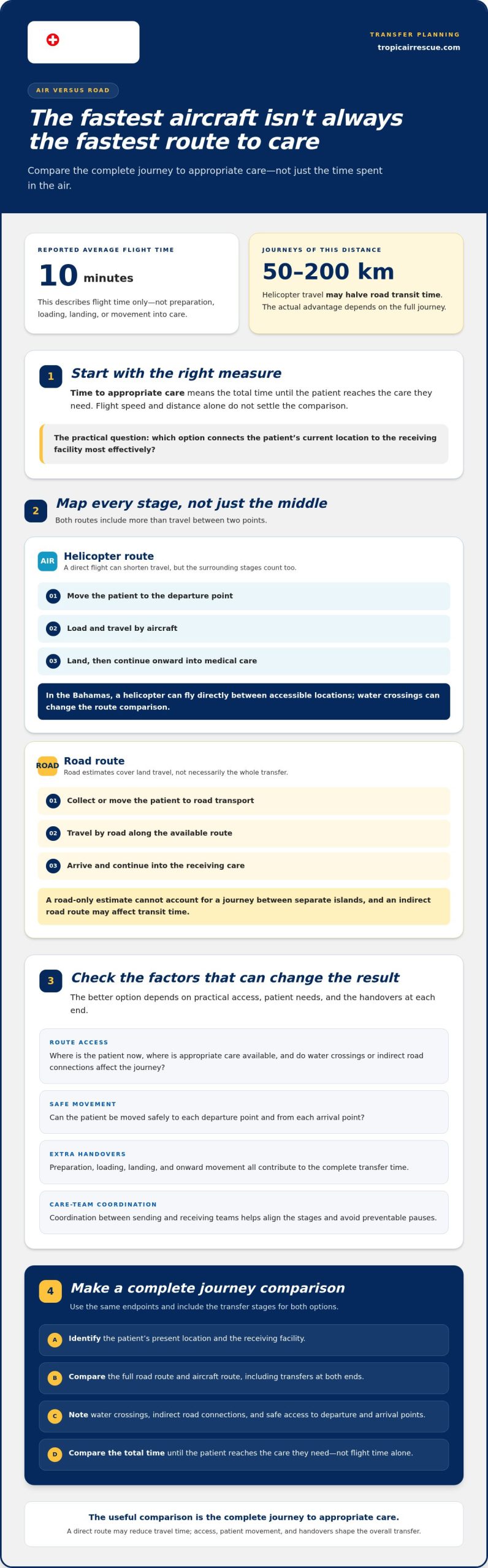
The fastest aircraft is not always the fastest route to care. An emergency helicopter patient transfer has a reported average flight time of 10 minutes, and on journeys of 50-200 km, helicopter travel may halve road transit time. The useful comparison is total time to appropriate care, shaped by route access, the patient’s condition and safe landing options.
Speed matters, but so does what a flight means for the patient. Altitude can reduce inspired oxygen pressure and cause gas in the body to expand, so the patient’s clinical condition is an important part of transfer planning. Distance alone does not determine whether air transport is the better option.
This guide explains when helicopter transport may be faster than road travel in the Bahamas, how altitude and patient factors affect care, and which medical limits and operational risks matter. It also covers what safe transfer involves, from preparing a landing area to coordinating care en route. The aim is to make the trade-offs clear so families and care teams can assess the decision with realistic expectations.
Key Takeaways
- Compare total time to appropriate care, not flight time alone; helicopter transport may halve road transit times on journeys of 50-200 km.
- Altitude can affect oxygen availability and gas volume, so a patient’s condition and blood haemoglobin level matter in transfer planning.
- Recent bowel surgery or vascular anastomosis can affect whether air transport is appropriate; timing is a key consideration.
- Safe transfers depend on landing-zone preparation, clear crew instructions and keeping people and vehicles away from the aircraft.
- Understand how membership and interhospital transfer services fit into planning air-medical transport in the Bahamas.
Air versus road transfer speed
Flight time is the time an aircraft spends travelling between departure and arrival points. A reported average helicopter transfer time is 10 minutes, but that figure describes the flight, not every step surrounding it. Patient preparation, movement to the aircraft, loading, landing, and arrival at medical care all contribute to the overall transfer. In the Bahamas, the distinction matters because the shortest route between two locations may cross water rather than follow a road.
Road transit time is the time spent travelling by land between locations. For journeys of 50-200 km, helicopter travel may halve road transit times. That comparison is most useful when a road route is lengthy or indirect. It is less informative for a short trip where reaching a suitable landing site and transferring the patient could take longer than driving directly. Compare the complete journey, not just distance on a map.
Door-to-door time covers every stage from the patient’s current location to the receiving facility. Map each step for a practical comparison: moving the patient to the departure point, loading, travel, landing, and onward movement into care. Then compare that sequence with road collection, travel, and arrival. A helicopter’s direct route may reduce travel time, while extra handovers at either end can add time.
Inter-island transfer means moving a patient between islands for medical care. In the Bahamas, the water between locations changes the comparison: a road-only estimate cannot account for a journey between separate islands. Consider the patient’s location, where appropriate care is available, and how each transport option connects the two. A helicopter can fly directly between accessible locations, while road transport covers only the land portions.
Use these steps to compare options clearly:
- Identify the patient’s present location and the receiving facility.
- Compare the full road route with the aircraft route, including transfers at both ends.
- Note whether water crossings or indirect road connections affect the journey.
- Consider whether the patient can be moved safely to each departure and arrival point.
Time to appropriate care is the total journey time until the patient reaches the care they need. It is the central measure, rather than the aircraft’s speed alone. For example, a direct flight may shorten a 50-200 km journey, but the advantage depends on how quickly the patient can reach the landing area and continue to the receiving facility. Clear coordination between the sending and receiving teams helps align those stages and avoid preventable pauses.
Altitude effects on patients
Altitude is the height above sea level reached during flight. It matters because inspired oxygen pressure falls as altitude increases. In normal patients, reduced inspired oxygen pressure has little effect below an altitude of 2500 m when SaHb is above 90%. This describes a specific condition, not a universal threshold for every patient. SaHb means oxygen saturation measured in arterial blood; the stated value is above 90%.
Inspired oxygen pressure is the pressure of oxygen available in the air a person breathes. As altitude rises, this pressure decreases, so a patient’s starting condition becomes relevant to air transport. A patient with reduced oxygen saturation may respond differently from a normal patient with SaHb above 90%. Clinical teams consider the patient’s oxygenation alongside the planned flight profile and available care during transport.
Haemoglobin is the oxygen-carrying component of red blood cells. A haemoglobin level below 75 g/L may affect a patient’s response to reduced inspired oxygen pressure during air transport. This makes the blood result important in assessing the likely effect of flight. It should be considered with the patient’s overall condition, rather than treated as an isolated measure. The threshold identifies a factor that may influence response, not a standalone decision rule.
Gas expansion is an increase in gas volume as surrounding pressure falls. At an altitude of 5000 m, gas volume doubles. This matters in air transport because gas already present in body spaces can expand during ascent. The figure describes the altitude effect; it does not mean every helicopter flight reaches 5000 m. The planned altitude and a patient’s medical history help frame this consideration before transport.
For an altitude-focused review, the care team can organize the relevant details:
- Record SaHb and compare it with the above-90% condition described for normal patients below 2500 m.
- Review haemoglobin, noting that a level below 75 g/L may affect response to reduced inspired oxygen pressure.
- Consider how gas expansion could matter if the flight profile includes altitude changes.
- Relate each finding to the patient’s condition and the care needed during transfer.
In the Bahamas, these principles help frame clinical planning without assuming every route has the same altitude profile. A short, low-altitude flight and a higher-altitude flight present different pressure conditions. The 2500 m and 5000 m figures explain physiological mechanisms; they are not a substitute for assessing oxygenation, haemoglobin, and individual risk together.
Contra-indications to air transport
A contraindication is a medical factor that weighs against a particular transport option. For air transport, recent procedures can affect the risk assessment. The available guidance advises avoiding air transport for 10 days after bowel surgery if possible. It also lists vascular anastomosis within the last 14 days as a contraindication to helicopter transport. These time periods refer to different procedures and should not be combined into one rule.
Bowel surgery is an operation involving the bowel. After this procedure, air transport should be avoided for 10 days if possible. The wording matters: it advises avoidance where possible, rather than defining an unconditional prohibition. The timing of the operation is therefore a key detail in planning. For example, a patient who recently had bowel surgery needs that history considered before choosing air travel.
Vascular anastomosis is a surgical connection between blood vessels. A vascular anastomosis within the last 14 days is listed as a contraindication to helicopter transport. The relevant detail is the time since the procedure, not simply whether the patient has had vascular surgery at some point. The surgical history should clearly identify the procedure and its timing for the transfer assessment.
These cautions matter because air transport changes the pressure conditions around the patient. As covered in the altitude discussion, gas volume doubles at an altitude of 5000 m. That fact helps explain why recent surgery and internal gas considerations can be relevant to flight planning. It does not establish that every helicopter flight reaches 5000 m, or that the same risk applies to every patient.
To organize the information before transport planning, record:
- The type of recent procedure, such as bowel surgery or vascular anastomosis.
- The procedure date, so the 10-day or 14-day period can be considered accurately.
- The patient’s current condition and the reason transfer is being considered.
- The receiving care team’s needs, so transport planning addresses the destination and patient together.
Clinical assessment is the review of a patient’s condition and relevant medical history to inform a transport decision. The two listed time periods are specific considerations, not a complete list of factors affecting flight suitability. For example, a patient with bowel surgery and a separate urgent need for transfer presents a different decision from someone whose only concern is a past procedure. Discuss the procedure, timing, current condition, and destination together. Clear details help the care team weigh the cautions without treating either period as a substitute for an individual assessment.
Helicopter ambulance coverage and response times
Coverage describes the locations a helicopter service can reach for patient transport. Response time is the interval between a request and the aircraft’s arrival.
Service Coverage
Service coverage is the geographic area and landing locations a helicopter can serve. In the Bahamas, island geography makes the patient’s location and destination central to planning. Helicopters can land at remote locations inaccessible to fixed-wing aircraft, but each flight still depends on a suitable landing site and operational conditions. For inter-island care, the route must connect the patient’s location with the receiving facility and its onward transport arrangements.
Response Times
Response time is the time between a transfer request and the aircraft’s arrival at the pickup location. It differs from flight time and the full journey to hospital. Dispatch coordination, aircraft positioning, weather, access to the patient, and landing arrangements all affect the timeline. An island route also requires careful coordination between the pickup point and receiving facility.
What rules and permissions apply to emergency medical helicopter flights? Flights must account for aviation clearances, airspace, weather, and safe landing arrangements. Requirements depend on the route and landing location, so the flight team coordinates around those conditions before departure. FAA restrictions prohibit most Tropic Air Rescue aircraft from flying in inclement weather.
What medical equipment and staff are available on an air ambulance helicopter? Air-medical helicopters used for these transfers have advanced avionics and life-support equipment. The clinical team and equipment required for a particular patient depend on the care needed during transport.
Does health insurance cover emergency helicopter transport? Insurance coverage depends on the member’s plan and the transport arrangement. With membership, the service can bill health insurers directly, and members incur no out-of-pocket costs.
How can someone request an emergency helicopter transfer in an emergency? For an immediate emergency, contact local emergency services or the patient’s treating hospital team. For a hospital-to-hospital transfer, the treating team can coordinate the patient’s clinical needs, pickup location, and receiving facility with Tropic Air Rescue.
Before arranging an inter-island transfer, have the patient’s location, destination, and current clinical information ready. A precise pickup point helps the flight team assess access and landing arrangements. The receiving facility’s ability to continue care is also part of coordination. For organ transport, timing and handoff arrangements must align with the receiving team’s requirements.
Keep the patient’s current location, receiving facility, reason for transfer, and treating team’s contact details together. This gives coordinators a clear starting point for assessing the route, landing access, and patient-care needs. It also distinguishes an emergency response from an interhospital transfer, where the sending and receiving teams can coordinate directly.
Helicopter transport risks
Transfer risk is a potential hazard to the patient, crew, or people near the aircraft during transport. A safe flight depends on preparation, clear roles, and a suitable landing area. Risks can arise during loading, flight, or handover, so the care team and aircrew need to coordinate each stage. The landing site, patient’s condition, and equipment must be considered together.
Pre-flight preparation means agreeing on safety actions before departure. Before the aircraft arrives at a landing zone, staff should know what they and their colleagues need to do to protect themselves and the patient. For example, establish who moves the patient, who manages equipment, and how the receiving team will take over. Defined responsibilities reduce confusion during a time-sensitive transfer.
Rotor safety covers precautions around a helicopter’s rotating blades. Staff who need to approach or board while the rotors are turning must first receive a safety briefing from an aircrew member. Turn off personal mobile phones around the helicopter because they may interfere with navigational equipment. Follow crew instructions, keep the patient transfer controlled, and do not approach independently.
Landing-zone safety means keeping the designated landing area clear and suitable for the aircraft. People and vehicles should remain outside the area identified by the flight crew, and bystanders should follow crew directions. Brief staff on their positions and tasks before the aircraft arrives. A clear site helps the crew assess the landing and supports a controlled patient transfer.
At night, the landing area must be visible and clearly defined. Portable floodlighting or vehicle headlights can illuminate the site; if neither is available, use another form of lighting to mark the area. Position lights so they identify the site without confusing the flight crew. The crew directs the approach and landing, while ground staff keep the perimeter clear and stay out of the aircraft’s path.
How do emergency medical helicopter transfers work, step by step? The sending team shares the patient’s condition, location, and destination; flight and clinical teams coordinate the transfer. Staff prepare the patient and landing area, follow the crew briefing, and complete the handover at the receiving facility.
Who can request an emergency helicopter patient transfer? For interhospital transfers, the sending hospital’s clinical team can coordinate with the receiving facility and transport team. In an immediate emergency, contact local emergency services so responders can assess the situation and initiate appropriate care.
For a hospital-to-hospital transfer, coordinate interhospital transfer planning with the clinical team. Share the patient’s location, destination, and care needs so transfer coordination can address patient safety alongside aircraft operations.
Tropic Air Rescue: Short-term Membership
Tropic Air Rescue provides a membership-based option for arranging helicopter medical transport in the Bahamas. Membership is required, and members incur no out-of-pocket costs because health insurers are billed directly.
Short-term Membership may suit someone seeking membership for a limited period, while Annual Membership is another option. For patients moving between hospitals, Interhospital Transfer Services can support transfer coordination. Organ Transport addresses time-sensitive transport needs involving organs.
Consider these options when a care team is planning an interhospital transfer or organ transport, or when membership is needed for a short or longer period. The right next step depends on the transfer need and membership choice. Contact Tropic Air Rescue to discuss the relevant membership or transport service.
Plan the Next Step with Clarity
Clear decisions begin with a shared plan. In the Bahamas, patients and families can discuss transport needs with the treating team, while hospitals coordinate directly when a transfer between facilities is required. Knowing who is leading the coordination helps keep the patient’s needs central.
An emergency helicopter patient transfer involves more than choosing a route. It also requires coordination between clinical teams, the receiving facility, and transport arrangements. Tropic Air Rescue offers Short-term Membership and Annual Membership, as well as Interhospital Transfer Services. These options provide a clear starting point for discussing membership or a hospital transfer.
For a current transfer need, keep the patient’s location, destination, and care requirements ready for the discussion. For future planning, consider which membership option fits your circumstances. Taking that step can make the next conversation more focused and practical.
Explore Tropic Air Rescue membership and transfer options, and move forward with a clear plan.
Frequently Asked Questions
What is an emergency helicopter patient transfer and when is it needed?
This transfer moves a patient by helicopter when air transport is clinically and operationally appropriate. An emergency helicopter patient transfer may be considered for urgent movement between islands or hospitals when geography makes a direct air route useful. For example, a hospital team may arrange an interhospital transfer when a patient needs care at another facility. The treating team shares the patient’s condition and destination during planning.
How quickly can a medical helicopter reach a patient and transfer them to hospital?
Total journey time includes dispatch coordination, travel to the pickup point, patient loading, flight, and movement into the receiving hospital. For an emergency helicopter patient transfer, flight time alone does not show when the patient will reach care. Coordinators need the pickup location, destination, landing access, and patient-care requirements. A patient located away from a suitable landing area, for example, also needs a ground connection.
What are the risks and limitations of helicopter patient transfers?
Risks include aircraft and landing-zone hazards, while operational limits can affect whether a flight proceeds. Weather is a critical constraint: FAA restrictions prohibit most Tropic Air Rescue aircraft from flying in inclement weather. Aircraft use, maintenance, equipment limits, regulations, and the patient’s condition, age, or size can also affect service. The medical command physician and attending medical professionals hold the decision-making authority on whether a patient is flown.
How does helicopter transfer compare with ground ambulance transport?
Helicopter transport can provide a direct route across water or difficult-to-reach terrain, while a ground ambulance travels by road and carries the patient between locations on land. In the Bahamas, a transfer may involve both modes, such as a ground trip to a pickup site followed by a flight. Compare the complete route, including handovers and access to the receiving facility, rather than judging by distance alone.
What emergency helicopter patient transfer services are available locally?
Tropic Air Rescue offers Short-term Membership, Annual Membership, Interhospital Transfer Services, and Organ Transport in the Bahamas. Membership is required for access, and it isn’t an insurance policy or secondary insurance coverage. It activates 48 hours after purchase, so purchase must be completed at least 2 days before arrival to ensure coverage. Members must maintain medical insurance and are responsible for costs their insurance doesn’t cover.