

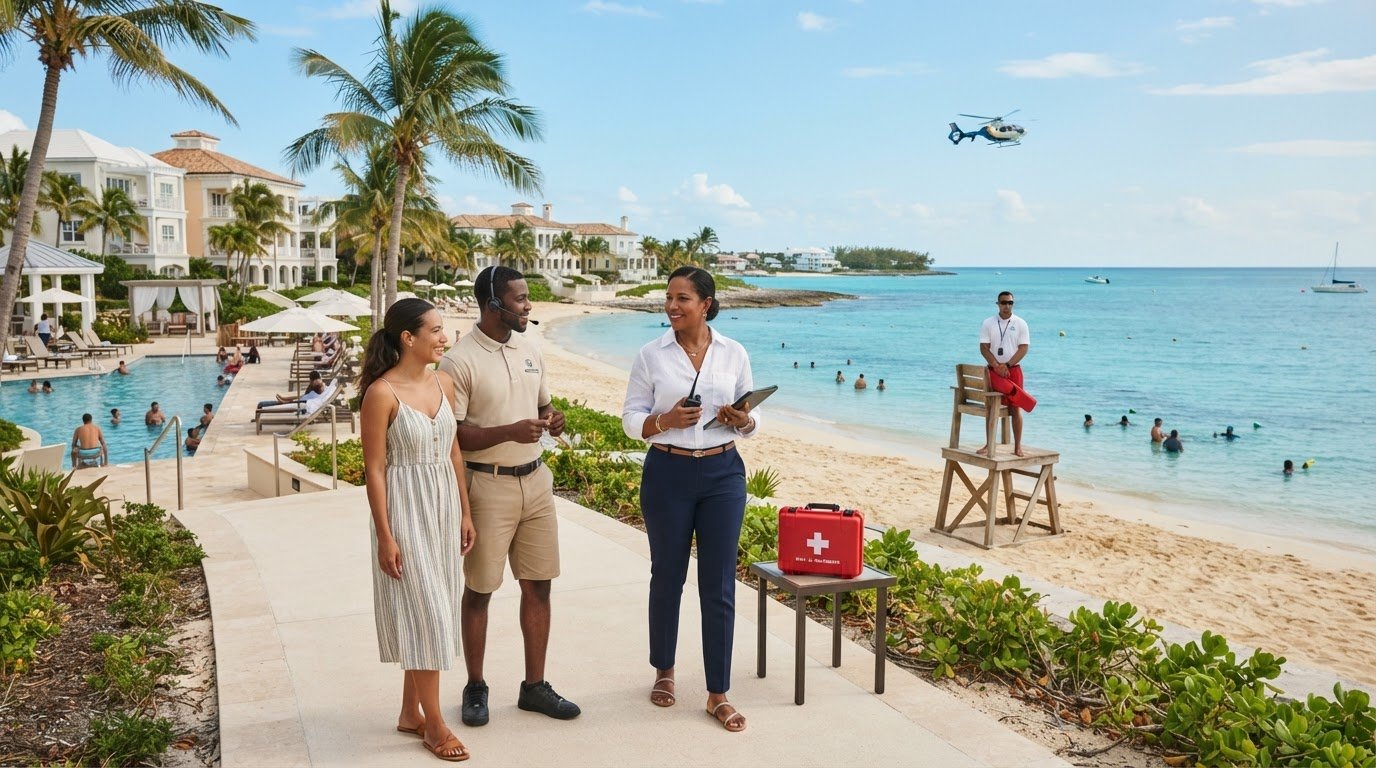
Guest safety depends on more than written policies; it also depends on who oversees them. For hotels certified under The Bahamas’ Clean & Pristine Program, the duty of care for hospitality guests in the Bahamas includes having a manager or designate oversee the hotel’s health and safety program. Certified hotels must also keep records of preventive measures, provide ongoing employee training, and have access to a healthcare provider.
Clear staff responsibilities and attentive guest relations matter when a concern arises. A prompt, orderly response helps guests understand what to do and enables staff to address issues consistently.
This guide explains how supervision, training, health and safety procedures, and guest communication shape hospitality responsibilities in the Bahamas. You’ll learn what Clean & Pristine-certified hotels must put in place, how staff can respond to guest concerns, and when medical emergencies may require interhospital transport.
Key Takeaways
- Identify the safety responsibilities that apply to the property, including any obligations tied to Clean & Pristine certification.
- Use clear staff supervision and guest communication procedures to address hazards around pools, beaches, and water activities.
- Report missing or stolen property promptly and keep a clear record of what happened and how the hotel responded.
- Read waivers and liability notices carefully, and consider them alongside the circumstances of an incident and the hotel’s own responsibilities.
- After an injury, notify hotel staff, seek appropriate medical care, and preserve relevant records and evidence.
Which Bahamian laws and regulations govern hotel guest safety and liability?
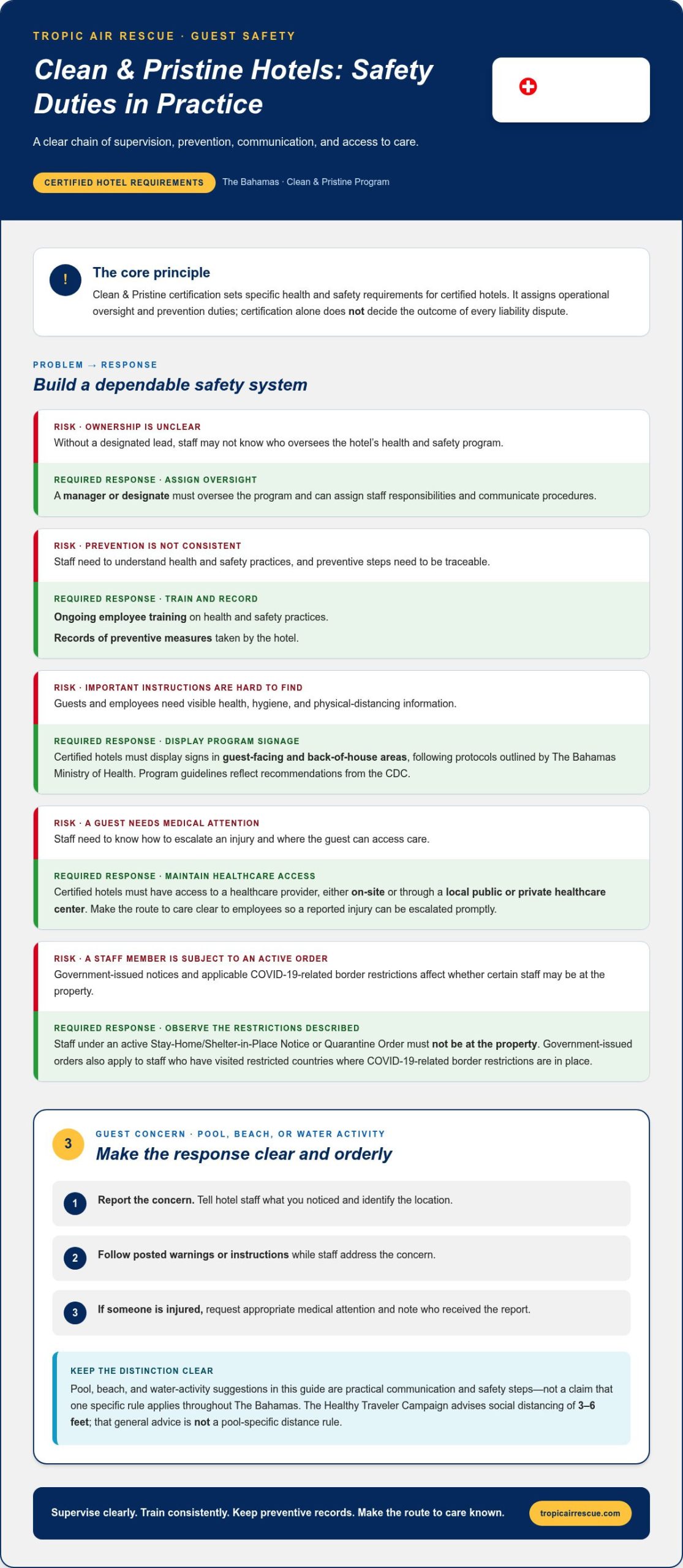
Duty of care means taking reasonable steps to protect guests from foreseeable harm. In the Bahamas, the specific safety requirements described here apply to hotels certified under the Clean & Pristine Program. Certification requires a manager or designate to oversee the hotel’s health and safety program. This assigns operational responsibility within the property, but does not by itself determine the outcome of every liability dispute.
Clean & Pristine certification is a program status for hotels that meet its health and safety protocols. Certified hotels must provide ongoing employee training on health and safety practices and keep records of preventive measures. They must also display health, hygiene, and physical-distancing signs in guest-facing and back-of-house areas, following protocols outlined by The Bahamas Ministry of Health. The guidelines reflect recommendations from the Centers for Disease Control and Prevention.
These requirements make supervision and documentation practical priorities. A hotel manager or designate can assign staff responsibilities, communicate procedures, and keep records showing preventive steps. For example, if a guest reports a hazard, staff can record the concern, response, and follow-up. That record supports consistent handling; it does not automatically determine legal responsibility. The hotel must also ensure staff under an active Stay-Home/Shelter-in-Place Notice or Quarantine Order are not at the property. Government-issued orders also apply to staff who have visited restricted countries where COVID-19-related border restrictions are in place.
Healthcare access means having a route to a healthcare provider when a guest needs medical attention. Clean & Pristine-certified hotels must have access to a provider, either on-site or through a local public or private healthcare center. This requirement is separate from staff training and recordkeeping. Hotels should make the route to care clear to employees so a guest’s reported injury can be escalated promptly.
Hotel classification for VAT is a tax definition, not a guest-safety standard. The Bahamas VAT Regulations define a hotel to include an establishment where lodging is regularly or normally provided to five or more persons for a periodic charge. Holiday accommodation generally means furnished sleeping accommodation for short-term stays of less than 45 days. These definitions help describe accommodation for tax purposes; they should not be treated as a complete statement of safety law or liability. For guests, the practical step is to report hazards promptly and note how staff respond. For operators, clear supervision, training, signage, healthcare access, and preventive records are central Clean & Pristine requirements.
What safety standards must Bahamian hotels follow for pools, beaches, and water activities?
Pool safety controls are steps that help identify and manage hazards around swimming areas. Guests can look for posted instructions, visible warnings, and clear information about access. Staff can address reported hazards, communicate temporary restrictions, and record their response. These are practical safety steps, not a claim that a particular pool rule applies throughout The Bahamas.
Beach safety information helps guests understand local conditions before entering the water. Ask hotel staff where current beach notices are posted and how they communicate changes. For example, a notice may identify a temporarily restricted area. Staff should be able to receive a concern, pass it to the responsible team, and explain the next step clearly.
Water-activity briefings are instructions given before guests take part in an activity on or in the water. A practical briefing can explain activity boundaries, equipment use, and how to alert staff if someone needs help. Guests should listen, follow posted conditions, and raise questions before participating. These are sound communication practices, not a specific Bahamian legal standard for every water activity.
Clean & Pristine signage means the health, hygiene, and physical-distancing notices required in specified hotel areas under the program. Certified hotels must display signs in guest-facing and back-of-house areas, following protocols outlined by The Bahamas Ministry of Health. The program’s guidelines reflect recommendations from the Centers for Disease Control and Prevention. The Bahamas’ Healthy Traveler Campaign advises travelers and residents to practice social distancing of 3-6 feet. That general advice should not be mistaken for a pool-specific distance rule.
Incident escalation is the process of bringing a safety concern to the staff member responsible for responding. If a pool, beach, or activity area appears unsafe, take these practical steps:
- Tell hotel staff what you noticed and identify the location.
- Follow any posted warning or instruction while staff address the concern.
- For an injury, request appropriate medical attention and note who received the report.
Clean & Pristine-certified hotels must have access to a healthcare provider, either on-site or through a local public or private healthcare center. This requirement concerns access to healthcare; it does not establish a separate pool, beach, or water-activity standard. Guests should report hazards promptly and follow the hotel’s stated response process.
What are the rules for hotel liability for guests’ lost or stolen property in The Bahamas?
Hotel liability means legal responsibility for a loss connected with a guest’s stay. The information here does not establish a specific Bahamian rule, compensation limit, or automatic hotel responsibility for lost or stolen belongings. Separate the fact of a loss from the question of who may be responsible. A missing watch and a reported room break-in, for example, are different events that require different evidence. The duty of care for hospitality guests in the Bahamas must be considered in light of the circumstances and incident records.
Lost property is an item a guest cannot locate, without clear evidence that someone took it. Start with a written description of the item, its last known location, and when it was last seen. Tell hotel staff promptly and ask them to record the date, time, room or public area, and the staff member who received the report. A clear account helps distinguish an item left behind from one that disappeared during the stay.
Stolen property is property a person believes was taken without permission. Report suspected theft to hotel management and describe who had access, if known. Preserve booking details, messages, receipts, photographs, and any relevant access or storage records you already have. Avoid presenting speculation as fact. For example, say, “the bag was missing after housekeeping visited,” rather than accusing a named employee without evidence. Careful records also help show how the duty of care for hospitality guests in the Bahamas relates to the hotel’s handling of the concern.
Proof of ownership is information linking a guest to a missing item and its value. Examples include a purchase receipt, photograph, warranty record, or description of distinctive features. Record the brand, colour, condition, and identifying marks. For a passport, phone, or payment card, note identifying details securely and take appropriate steps to protect the account or document.
Incident documentation is a dated record of what happened and how it was handled. Ask hotel staff to acknowledge the report and keep a copy of any written response. Note whether staff searched a room, checked a lost-property log, or explained the next step. If the item is later found, update the record. Keep original receipts and messages, and send copies when providing supporting documents.
Responsibility assessment means examining the circumstances rather than assuming a loss automatically proves liability. Relevant details may include where the item was kept, who had access, whether the hotel accepted it for safekeeping, and what the hotel’s written policy says. Read any safe-use instructions and property notices provided at check-in. Keep a copy of those terms, especially if they address valuables or reporting procedures.
For a practical record, write a brief timeline while details are fresh. Include the last confirmed sighting, discovery of the loss, report to staff, and each response received. An organized account helps you describe the incident clearly and consider next steps without treating suspicion alone as proof.
How do guest waivers and liability disclaimers affect hotel responsibility under Bahamian law
A guest waiver is a document setting out risks or terms a guest accepts. In The Bahamas, don’t assume the word “waiver” fully explains its effect. Read the wording and identify the activity, risks, and responsibilities it describes. A form covering a boat excursion, for example, may address different matters from a notice about a hotel room safe.
A liability disclaimer is wording that seeks to limit or explain responsibility for specified losses or injuries. Its placement and language matter to the guest’s understanding. A notice beside a pool may address pool use, while a booking term may discuss property loss. Keep a copy or photograph of the exact notice, including its location and any linked or referenced terms.
An assumption-of-risk statement describes risks associated with an activity, such as uneven ground on a guided excursion. Read which risks and activity it covers, along with any instructions. Compare them with what happened. If a waiver describes risks during a water activity, record whether the incident occurred during that activity or elsewhere on hotel grounds.
An acknowledgment records that a guest received or understood information; it is not necessarily the same as a release of responsibility. Check the verbs and commitments in each paragraph. “I received safety instructions” records receipt. “I release” uses different language. Don’t infer a document’s legal effect from its title, signature box, or a staff explanation alone.
Before signing or relying on a notice, use this practical review:
- Identify who issued the document and which hotel service or activity it names.
- Mark the specific risks, exclusions, reporting instructions, and guest actions stated.
- Ask staff to explain unclear wording, and keep the document with booking records.
Incident records are documents and details that preserve what happened. If an injury follows an activity covered by a waiver, note the time, location, instructions received, and staff members present. Photograph the notice or retain the signed copy. Keep messages and any incident report together. These steps preserve the wording and circumstances for later review.
Responsibility review means comparing the document’s language with the event and the hotel’s actions. A waiver alone does not tell the whole story. Note whether staff gave the stated briefing, whether conditions changed, and whether the incident involved a different hazard. Keep observations factual, distinguish what you saw from what someone told you, and don’t treat a disclaimer as an automatic answer to every question of responsibility.
What steps should an injured hotel guest take to report an incident and preserve evidence in The Bahamas
Incident reporting means promptly telling hotel staff about an injury. First, move away from immediate danger and seek appropriate medical attention. Then notify a manager or designated staff member, stating where and when it happened. Identify the pool entrance, walkway, or restaurant area, for example, rather than saying only “near the hotel.”
A written incident record is a dated account of the event and response. Ask staff to record your description and provide a copy or acknowledgment. Note when you reported it, the staff member’s name or role, and any actions taken. Keep your account factual and distinguish what you saw from what another guest later told you.
Photographic evidence is an image documenting a relevant scene or condition. If it’s safe, photograph the location, visible hazard, lighting, warning signs, and surrounding area. Capture both context and detail. For a wet floor, for instance, take one image showing its location and another showing the condition. Don’t disturb a hazard or delay medical care to take photographs.
Witness details can help identify people who saw the incident. Ask witnesses for their names and preferred contact details, if they’re willing to share them. Record where each person stood and what they observed. Don’t coach anyone or ask them to agree with your account. A companion can also write down observations while details are fresh.
Medical documentation is a record of assessment and care following an injury. Keep discharge papers, treatment notes, receipts, and instructions together. Tell healthcare staff how and where the incident occurred, and note the date of each visit. If hotel staff arrange transport or accompany you, record those details and keep any related messages.
Evidence preservation means keeping relevant records in their original form. Save booking confirmations, messages with hotel staff, photographs, and copies of incident reports. Write a timeline noting when the incident, report, and response occurred. If cameras may have recorded the area, promptly ask hotel management in writing to preserve relevant footage. Keep the request and any reply; don’t assume footage will remain available.
The Bahamas Ministry of Tourism’s Visitor Relations Unit was established in 1972 to handle visitor complaints. It works with tourism industry partners to monitor customer interactions and identify corrective measures. A guest may document an unresolved service complaint for this process, while keeping injury records separate. For an injury requiring transfer between hospitals, explore medical transfer support as part of coordinating next steps.
Tropic Air Rescue: Short-term Membership
Tropic Air Rescue’s Short-term Membership is relevant when a guest needs air-medical transport during a stay in the Bahamas. If an injury leads to a hospital admission and a transfer between hospitals is needed, its Interhospital Transfer Services address that transport requirement. Membership is required for service and enables direct billing to health insurers, so members incur no out-of-pocket costs.
This is a medical transport option, not a substitute for reporting the incident to hotel staff or arranging initial medical assessment. For guests planning ahead, Annual Membership is also available. The appropriate membership depends on the traveler’s circumstances and expected needs.
For details about Short-term Membership and interhospital transfers, visit Tropic Air Rescue’s website.
Make the Next Step Part of the Plan
Preparation should continue after a guest reports an injury. Hospitality teams can clarify who communicates with the guest, who maintains incident records, and who coordinates care if a hospital transfer becomes necessary. A sound duty of care for hospitality guests in the Bahamas depends not only on written procedures but also on staff understanding their roles when circumstances change.
For medical transport needs, Tropic Air Rescue offers Short-term Membership, Annual Membership, and Interhospital Transfer Services. These options address a different need from hotel incident reporting: coordinating transport between hospitals. Recognizing the distinction helps guests and hospitality teams identify the appropriate next step without confusing guest relations with medical transport.
To discuss membership or interhospital transfer services, contact Tropic Air Rescue. Clear preparation helps everyone move forward with greater confidence.
Frequently Asked Questions
What is the legal duty of care owed by hotels and resorts to guests in The Bahamas?
The specific safety requirements described here apply to hotels certified under The Bahamas’ Clean & Pristine Program. The program requires a manager or designate to oversee the hotel’s health and safety program, alongside employee training and records of preventive measures. These operational requirements do not, by themselves, answer every question about a hotel’s legal responsibility. For guests, the practical distinction is between program standards and the facts surrounding a particular incident.
What are hotel operators’ responsibilities for guest security, crime prevention, and emergency response in The Bahamas?
For Clean & Pristine-certified hotels, the program requires a manager or designate to oversee health and safety and access to a healthcare provider. To raise a security concern, report it promptly to hotel management, describe the location and circumstances, and request a record of the report. In an emergency, give staff clear information about the guest’s condition and location so they can coordinate an appropriate response and medical care.
When can a hotel in The Bahamas be liable for guest injuries caused by unsafe premises or negligence?
Evidence about the hazard, notice, and response helps explain how an injury occurred. Relevant details may include where a spill or broken fixture was located, whether a warning sign was present, and what staff did after a guest reported it. Preserve photographs, witness details, medical records, and hotel communications. For Clean & Pristine-certified hotels, records of preventive measures and assigned safety oversight can also provide context about the property’s procedures.
What deadlines and procedures apply to filing a personal injury claim against a hotel in The Bahamas?
After an injury, notify hotel staff, seek appropriate medical care, and preserve relevant records and evidence.
What duties do hotels owe guests regarding food safety, sanitation, and illness prevention in The Bahamas?
Clean & Pristine-certified hotels must provide ongoing employee health and safety training, keep records of preventive measures, and display health and hygiene signs in guest-facing and back-of-house areas. They must also have access to a healthcare provider.