

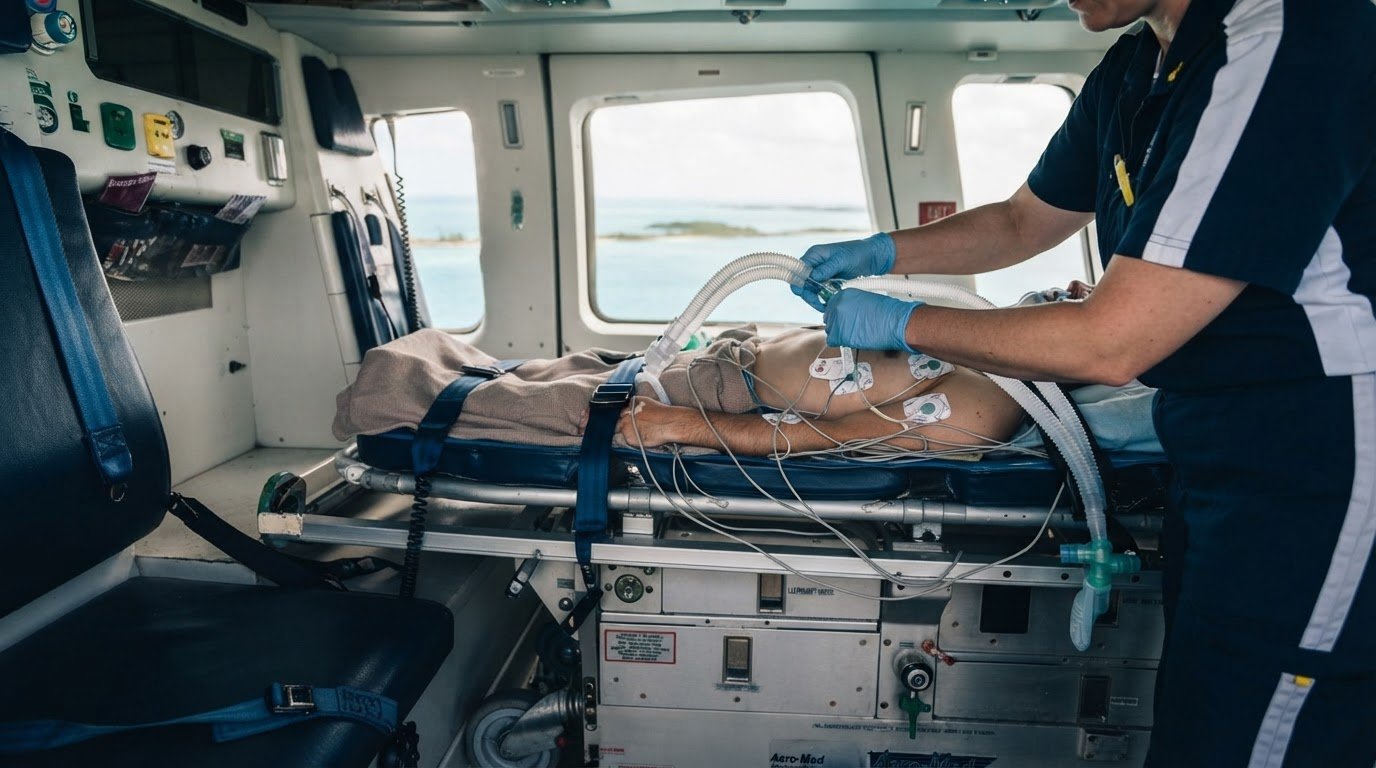
Speed matters, but clinical capability shapes the flight. Critical care helicopter transport capabilities can include ECG interpretation, in-flight transmission of a 12-lead ECG, and advanced respiratory support tailored to a patient’s needs. The aircraft option also affects how the transport is planned and what care can continue en route.
For patients with cardiac or respiratory emergencies, reaching the receiving hospital quickly is only part of the picture. Critical care helicopter transport capabilities also include assessing changes in a patient’s condition, communicating clinical information, and supporting breathing during the journey.
This article explains how transport teams use ECGs, including 12-lead transmission, and how respiratory support fits into critical care. It also explores aircraft considerations through practical case examples, so you can see how clinical needs and transport decisions come together in the Bahamas.
Key Takeaways
- Understand how ECG interpretation and in-flight 12-lead transmission can support cardiac care during transport.
- See how respiratory support is matched to a patient’s changing condition while in transit.
- Learn which equipment and patient needs shape critical care helicopter transport decisions.
- Explore how membership and interhospital transfer services can support medical transport needs in the Bahamas.
Critical care helicopter and aircraft transport
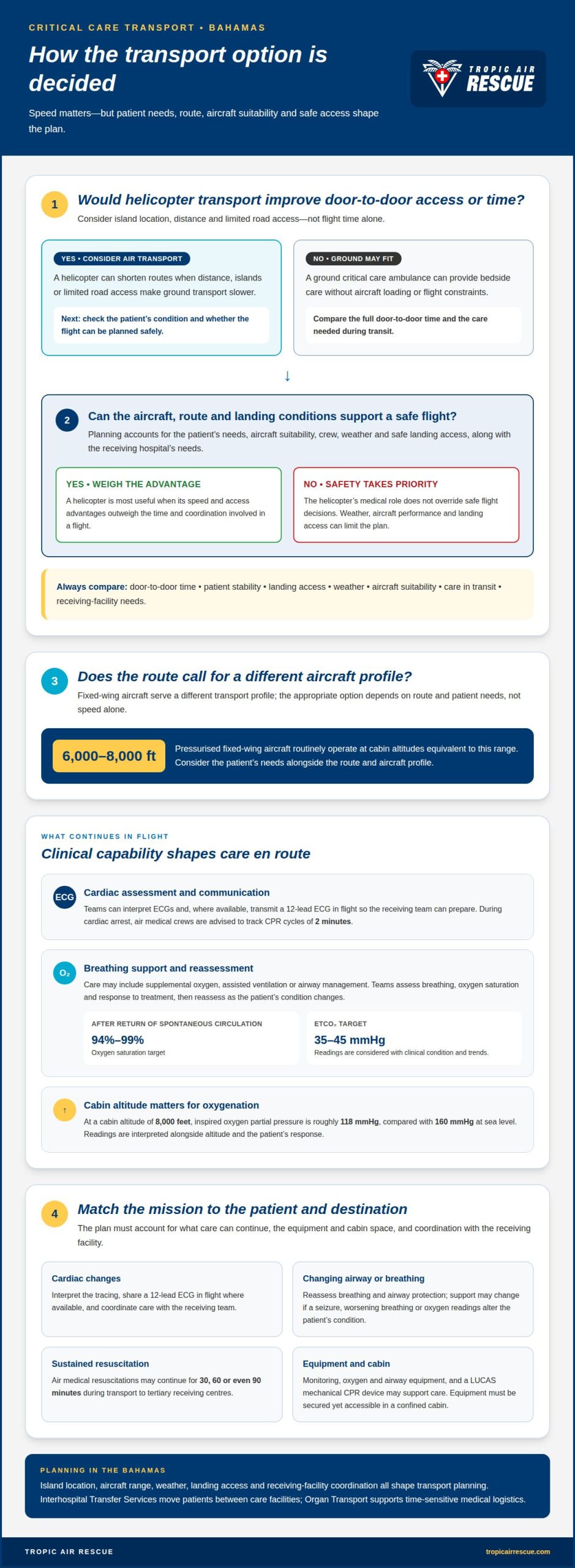
Helicopters can shorten routes when islands, distance, or limited road access make ground transport slower. Ground critical care ambulances can provide bedside care without aircraft loading or flight constraints. Compare door-to-door time, the patient’s stability, landing access, weather, and the receiving hospital’s needs.
Dispatch decisions balance clinical urgency with the realities of transport. Teams consider the patient’s condition, the care needed in transit, distance to an appropriate facility, aircraft suitability, weather, and safe landing access. A helicopter is most useful when its speed and access advantages outweigh the time and coordination involved in a flight.
Illustrative cardiac case: A patient develops chest pain and concerning ECG changes on an outer island. The transport team interprets the tracing and can transmit a 12-lead ECG in flight, helping the receiving team prepare. During cardiac arrest, air medical crews are advised to track CPR cycles of 2 minutes. The result is coordinated care while transport continues, not a substitute for clinical assessment.
Aviation safety and clinical care follow separate standards. Flight operations must meet applicable aviation requirements, while patient care follows the crew’s clinical protocols. Dispatch and flight planning account for the aircraft, crew, weather, landing conditions, and patient’s needs. The helicopter’s medical role does not override safe flight decisions.
Limits include weather, aircraft performance, landing access, cabin space, and the clinical resources available during flight. Fixed-wing aircraft serve a different transport profile; pressurised fixed-wing aircraft routinely operate at cabin altitudes equivalent to 6,000 to 8,000 feet. The appropriate option depends on route and patient needs, not speed alone.
In the Bahamas, transport planning depends on island location, aircraft range, weather, landing access, and coordination with the receiving facility. Interhospital Transfer Services move patients between care facilities, while Organ Transport supports time-sensitive medical logistics. Each mission requires planning around its destination and operational needs.
Air medical resuscitations may continue for 30, 60, or even 90 minutes during transport to tertiary receiving centres. This can make sustained treatment an important part of the mission, with crews continuing resuscitation while the patient is transported toward specialised care.
Advanced respiratory support
Respiratory care during flight focuses on oxygenation, ventilation, and airway stability. The team assesses breathing, oxygen saturation, and the patient’s response to treatment. Depending on the clinical presentation, support may include supplemental oxygen, assisted ventilation, or airway management. These measures help maintain respiratory support while the aircraft is moving and access to the patient is constrained.
After return of spontaneous circulation, post-arrest targets include oxygen saturation of 94% to 99% and end-tidal carbon dioxide (EtCO2) of 35 to 45 mmHg. These readings guide ongoing assessment. Crews track trends alongside the patient’s clinical condition rather than treating one measurement as the full picture. Changes can inform adjustments to respiratory support during transport.
Illustrative airway case: A patient begins seizing five minutes from the receiving hospital. The team identifies an urgent airway need and performs intubation during transport. Establishing the airway before arrival allows care to continue through handover. The example shows why teams assess airway risk even when the destination is close.
Aircraft conditions also matter. At a cabin altitude of 8,000 feet, inspired oxygen partial pressure is roughly 118 mmHg, compared with 160 mmHg at sea level. This difference makes oxygenation assessment important, particularly for a patient already struggling to breathe. The crew interprets readings alongside altitude and the patient’s response, then adjusts care as needed.
For a respiratory emergency, the team assesses breathing and oxygenation, determines whether the airway is protected, applies appropriate support, and reassesses during transit. A seizure, worsening breathing, or changing oxygen readings can shift immediate priorities. Ongoing assessment helps the team recognize changes and respond before arrival. Clear communication with the receiving team supports a coordinated handover.
A Cleveland Clinic transport nurse recalled intubating a patient who seized five minutes from the receiving hospital. The account underlines why airway decisions remain active throughout a journey, even when the hospital is close. If a seizure changes the patient’s condition, the crew reassesses breathing and airway protection, maintains support, and prepares for handover. A change in condition may make intervention necessary despite the short distance remaining.
What equipment is carried on a critical care helicopter?
Equipment supports assessment, stabilisation, and care during flight. The critical care helicopter transport capabilities include cardiac monitoring and, where available, transmission of a 12-lead ECG to the receiving team. Advanced avionics support aircraft operation, while life-support equipment supports patient care. The aircraft configuration and transport mission shape which tools are most relevant.
- Monitoring: ECG equipment tracks cardiac rhythm and informs clinical assessment.
- Airway and breathing: Oxygen and airway equipment support respiratory care when needed.
- Resuscitation: A LUCAS mechanical CPR device can provide automated chest compressions.
- Flight systems: Avionics support navigation and communication during the mission.
Equipment must be secured yet accessible in a confined cabin. Crews plan how patient care, movement, and aircraft operations interact. Devices used at bedside need to be positioned for in-flight access, with cables and supplies arranged so they do not obstruct care or safe movement. These practical details are part of the critical care helicopter transport capabilities required for a mission.
Illustrative cardiac-arrest case: A patient needs ongoing chest compressions during an air transfer. The crew positions a LUCAS device, which takes approximately 30 to 60 seconds to place. Once applied, it provides mechanical compressions while the team continues other care. The example shows why deployment time, cabin access, and equipment placement matter together.
Before departure, the crew matches equipment to the patient’s needs, secures it, checks essential devices, and plans where each item will be accessible. For a cardiac concern, ECG monitoring and resuscitation equipment may be priorities. For respiratory distress, airway and oxygen equipment take precedence. The mission determines which tools matter most, while safe arrangement keeps them within reach throughout the flight.
What types of patients qualify for helicopter critical care transport?
Transport suitability depends on clinical urgency, the care needed en route, and whether flying offers a practical advantage. A diagnosis alone does not determine the transport method. Teams consider the patient’s condition, distance to appropriate hospital care, aircraft access, weather, and the receiving facility’s capabilities.
Patients with time-sensitive emergencies may need rapid transfer when local care cannot meet their needs. For suspected stroke, early recognition and rapid transport to a certified stroke treatment centre are two key steps. The National Institutes of Health estimates that a typical patient loses 1.9 million neurons per minute while an ischemic stroke goes untreated. The urgency makes destination and coordination central to planning.
Illustrative stroke case: A patient on an island develops sudden signs of stroke. The transport team considers the patient’s condition, route, and access to an appropriate receiving centre. Coordinated air transport can move the patient toward specialist evaluation while the receiving team prepares for arrival.
Cardiac emergencies may also require critical care transport, particularly when a patient needs continued assessment or intervention during transfer. A patient in cardiac arrest presents different operational needs from someone whose condition is stable and does not require intensive care en route. Clinical acuity, not the diagnosis alone, shapes the transport plan.
Illustrative interfacility case: A hospital patient needs care beyond the facility’s capabilities. The sending and receiving teams coordinate the patient’s clinical requirements, destination, and handover before transfer. This planned move connects the patient with the next level of care.
Other deciding factors include whether the patient can be safely secured in the aircraft, whether the flight environment supports the required care, and whether a suitable landing site is accessible. For time-sensitive medical logistics involving donated organs, transport planning centres on coordination and destination rather than bedside treatment. To discuss transport planning for an urgent medical journey, connect with the transport team.
Tropic Air Rescue: Short-term Membership
Tropic Air Rescue provides Short-term Membership for people who need coverage for a limited period, along with helicopter air-medical transport in the Bahamas. Membership is required to access the service. Tropic Air Rescue bills health insurers directly, so members have no out-of-pocket flight expenses at the time of transport.
Membership may be relevant when an urgent transport need arises or a patient requires transfer between hospitals. Tropic Air Rescue also provides Interhospital Transfer Services and Organ Transport, coordinated around the patient or transport mission. Short-term Membership is an option for people who do not need an annual membership.
For a medical transport decision, the patient’s clinical needs, destination, and coordination between facilities remain central. Contact Tropic Air Rescue to discuss Short-term Membership and the relevant transport service.
Plan the next step with clarity
A critical care transport decision should align the patient’s needs, destination, and transport plan. Understanding critical care helicopter transport capabilities can help families and care teams identify useful questions, but it does not replace coordination between the sending and receiving clinicians.
Tropic Air Rescue offers Short-term Membership and Annual Membership, along with Interhospital Transfer Services. These options can support medical transport planning in the Bahamas, whether the need is temporary or involves a transfer between care facilities. Contact Tropic Air Rescue to discuss the membership and transport service relevant to your situation.
For information about membership or an interhospital transfer, contact Tropic Air Rescue. A clear next step makes a complex transport decision easier to approach.
Frequently Asked Questions
What medical capabilities do critical care helicopters provide?
Critical care helicopters can carry equipment for cardiac monitoring, defibrillation, oxygen delivery, and other life-support needs. These capabilities allow the crew to provide medical care while transporting a patient, with interventions guided by the patient’s condition. For example, a patient experiencing a serious heart rhythm problem may need continuous monitoring and access to a defibrillator during transfer. The receiving team can then continue care after handover.
How are critical care helicopter teams staffed and trained?
The team combines flight and clinical expertise. Tropic Air Rescue’s crew includes a pilot and a critical-care paramedic with an extensive critical-care background. The pilot operates the aircraft, while the paramedic provides medical care during transport. This division supports coordinated flight and patient care, communication with the receiving facility, and a structured clinical handover on arrival.
Which critical care helicopter services operate regionally, and what areas do they cover?
In the Bahamas, Tropic Air Rescue offers short-term membership. Interhospital Transfer Services move patients between care facilities, while Organ Transport supports time-sensitive medical logistics. Transport planning depends on island location, aircraft range, weather, landing access, and coordination with the receiving facility, showcasing advanced critical care helicopter transport capabilities.