


The cost of an emergency helicopter from the Bahamas to Florida isn’t a fixed fare. It depends on the patient’s medical needs, the aircraft and crew required, the destination, and the flight arrangements; the price depends on the case and is provided after a quote request. From Nassau, arranging an evacuation involves more than the time in the air: medical coordination and operational logistics also matter.
In an emergency, it’s natural to focus on how quickly help can be arranged and what insurance may cover. This guide explains the factors that shape the cost, how pre-authorization fits into an insurance claim, and what can affect the timeline for a medical evacuation from Nassau.
It also explains how interhospital transfers and membership fit into these decisions, so you can identify practical next steps while keeping the focus on the patient’s care.
Key Takeaways
- Understand which flight and medical-care factors shape the overall evacuation cost before reviewing a quote.
- Learn how insurer pre-authorization and policy terms can affect coverage, payment, and timing.
- See how patient condition, aircraft arrangements, and ground transfers influence the evacuation process from Nassau.
- Compare the role of interhospital transfers and membership when planning medical transport in the Bahamas.
Insurance coverage and pre-authorization
The cost of an emergency helicopter from the Bahamas to Florida depends on the patient’s condition, destination, aircraft requirements, and transport arrangements. Insurance coverage is a separate matter: policy terms determine whether evacuation expenses are eligible. Review the policy’s emergency medical transport and evacuation wording, not just its general medical-benefits summary.
An insurer may review a proposed transport before deciding whether it is covered. That review can consider the medical reason for transfer, the recommended destination, and whether the transport meets the policy’s medical-necessity terms. Authorization and payment are separate decisions, and a final claim may require medical records and itemized documentation.
For a transfer, identify the insurer’s assistance contact and have the patient’s policy details ready. The treating team can provide clinical information explaining why air transport is being considered. Ask the insurer what documents it needs, how it communicates its decision, and whether the policy requires a particular receiving facility.
- Locate the policy: Find the insurer’s emergency assistance number, coverage territory, evacuation language, and exclusions.
- Provide case details: Share the patient’s location in Nassau, treating facility, medical condition, and proposed destination.
- Record the decision: Keep the authorization reference, approval scope, and any conditions stated by the insurer.
- Retain claim records: Save medical reports, transport documentation, and insurer correspondence for the claim.
Insurance review and clinical coordination can happen at the same time, but an insurer’s decision may depend on information from the treating facility. For example, a transfer request should explain why the receiving hospital is appropriate and why the patient’s condition calls for the proposed transport. Clear records help the insurer assess the request.
The transport plan is based on the case, including medical care needs, aircraft and crew requirements, destination, and ground transfers. Tropic Air Rescue bills health insurers directly for member flights. Before relying on insurance coverage, review the insurer’s authorization and the policy terms. Members are responsible for any costs that insurance does not cover.
Medical evacuation and repatriation process
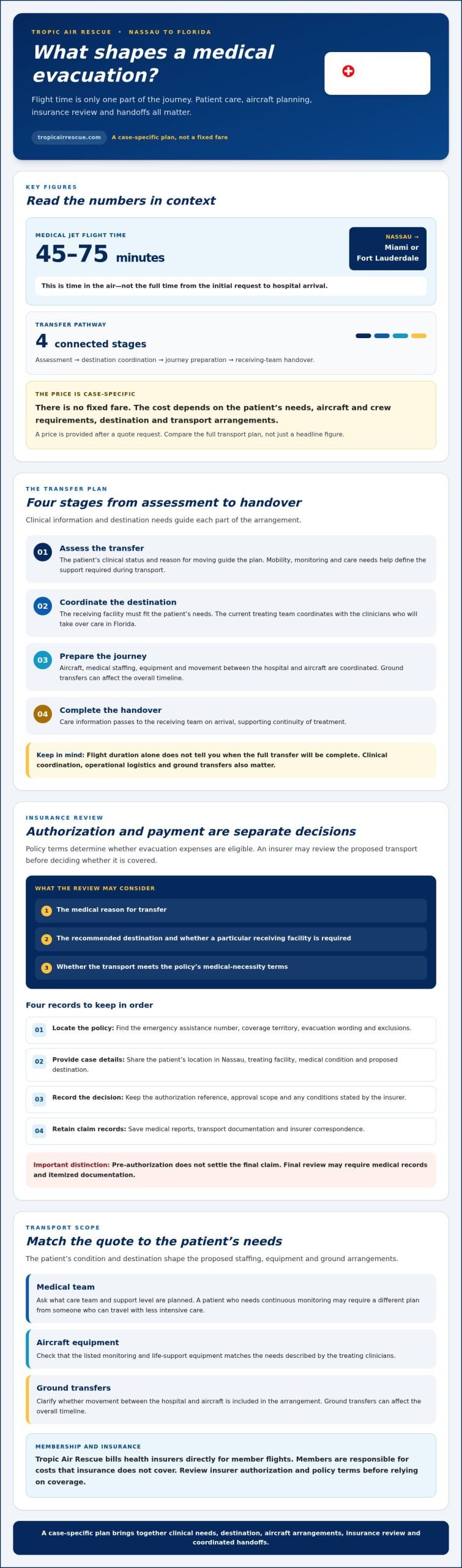
From Nassau, an evacuation involves clinical coordination, aircraft planning, and a handover at the receiving facility. A medical jet flight from Nassau to Miami or Fort Lauderdale typically takes 45 to 75 minutes. That is flight time, not the full time from the initial request to hospital arrival.
The process starts with the patient’s location and current condition. The treating team shares clinical information, including mobility, monitoring, and care needs during transport. These details help determine whether air transport is appropriate and what medical support the journey requires. The receiving hospital and destination also shape the arrangements.
- Assess the transfer: The patient’s clinical status and reason for moving guide the transport plan. For example, a patient who needs continuous monitoring has different requirements from someone who can travel without that support.
- Coordinate the destination: The receiving facility must fit the patient’s needs. The transfer plan connects the current treating team with the clinicians who will take over care in Florida.
- Prepare the journey: The transport team coordinates aircraft, medical staffing, equipment, and movement between the hospital and aircraft. Ground transfers can affect the overall timeline.
- Complete the handover: On arrival, the patient’s care information passes to the receiving team. This closes the transport phase and supports continuity of treatment.
Repatriation means returning a patient to their home country or usual place of care after treatment abroad. It differs from an urgent transfer to a Florida hospital, where the immediate priority is reaching a facility suited to the patient’s condition. The destination and purpose of the transfer guide the coordination.
Families can help by keeping the patient’s identification, medical documents, and insurance details accessible. A clear point of contact helps relay updates between the treating facility, receiving hospital, and family. Each handoff takes coordination, so flight duration alone does not indicate when the full transfer will be complete.
Does the cost include medical staff, equipment, and ground ambulance transfers?
The transport plan depends on the patient and the care required. Clarify which medical staffing, onboard equipment, and ground ambulance transfers are part of the arrangement. For a Bahamas-to-Florida transfer, the patient’s condition and destination shape the plan. Compare the full scope of transport arrangements, not just a headline figure.
Medical staffing depends on the care required during transit. A patient who needs continuous monitoring may require a different team and support plan from someone who can travel with less intensive care. The treating facility’s clinical information helps define those needs. Ask for the proposed staffing level and how it relates to the patient’s condition.
Equipment also follows the clinical plan. The transport team considers which monitoring and life-support equipment the patient needs for the journey. For example, a patient requiring support during transfer needs equipment suited to that care. The key cost question is whether the quote reflects the patient-specific equipment and its use during transport.
- Medical team: Check whether the quote identifies the care team and the level of support planned for the patient.
- Aircraft equipment: Confirm that the listed equipment matches the needs described by the treating clinicians.
- Ground ambulance: Establish whether transport from the Nassau facility to the aircraft, and from the Florida arrival point to the hospital, is included.
- Transfer coordination: Check whether each handoff and ground leg appears in the transport scope, rather than assuming the flight covers door-to-door movement.
Ground transfers can affect the overall plan because the patient may need transport at both ends of the flight. A transfer from the treating facility to the aircraft and a transfer from the arrival point to the receiving hospital are separate legs. Their requirements depend on the patient’s mobility, care needs, and locations involved.
An interhospital transfer connects the sending facility, aircraft, ground transport, and receiving hospital. Review the plan as a whole. A clear breakdown distinguishes flight arrangements from bedside care and ground movement, and helps identify which parts may be addressed through insurance authorization.
What alternatives are available if a helicopter flight is unavailable or too expensive?
A helicopter is not the only consideration when deciding how a patient can reach appropriate care. The options depend on clinical stability, the receiving facility, and the urgency of the transfer. The treating team can weigh continued care locally against transport to Florida. Cost matters, but it should not replace assessment of the patient’s medical needs.
For a patient stable enough to travel commercially, a commercial flight may be considered only when the clinical team determines it is appropriate. It is not interchangeable with an air ambulance: cabin conditions, monitoring, and the ability to respond to a change in condition differ. A medical assessment should establish whether the patient can safely tolerate that travel plan.
Some patients require an air ambulance rather than commercial travel. Approximately 15-20% of patients initially screened require an air ambulance because of unrecognized clinical instability. That figure underscores why a lower-cost travel mode cannot be chosen on price alone. Patient status can change, so the transport plan must reflect current clinical information.
- Continue treatment in the Bahamas: The treating facility can assess whether care locally is appropriate before transfer.
- Consider commercial travel: This option depends on the patient’s stability and clinical suitability for the journey.
- Compare medical aircraft options: The patient’s condition, destination, and care requirements determine the appropriate transport category.
- Review the full route: Include movement to the departure point and onward transfer to the receiving hospital.
An option that appears less costly may involve additional coordination or ground transport. Compare the complete journey, including the care required before departure and after arrival. Insurance terms also matter, so distinguish eligible transport from expenses the policy excludes.
If the patient needs an interhospital transfer, align the transport plan with the sending and receiving facilities. Discuss interhospital transfer planning to understand how a coordinated transfer fits the patient’s needs.
Tropic Air Rescue: Short-term Membership
Tropic Air Rescue provides Short-term Membership for people who need medical transport coverage while in the Bahamas. Membership is required for its air-medical service and allows the company to bill health insurers directly, so members incur no out-of-pocket costs for that service.
This can be a relevant next step when an emergency or interhospital transfer makes medical transport a concern. Short-term Membership suits temporary needs, while Annual Membership is another option for longer-term coverage. Tropic Air Rescue also provides Interhospital Transfer Services and Organ Transport.
Membership and insurance are distinct: review your policy’s terms and pre-authorization process alongside membership details. This helps clarify how insurer coordination fits your circumstances before transport planning proceeds.
For information about Short-term Membership and medical transport in the Bahamas, contact Tropic Air Rescue.
Make the Next Decision With a Clear Plan
In an urgent medical situation, the decision is not simply whether to fly. It is how to align the patient’s care needs, destination, transport plan, and financial arrangements. Consider the cost of an emergency helicopter from the Bahamas to Florida in that context, rather than as an isolated figure. The appropriate plan depends on the patient’s circumstances and the care required during transfer.
Prepare a concise summary of the patient’s location, treating facility, and immediate transport needs. This gives the discussion a practical starting point and keeps decisions focused on the patient. If you are arranging medical transport in the Bahamas, contact Tropic Air Rescue to discuss membership options and transfer services.
Contact Tropic Air Rescue to discuss the next step. Clear coordination can help you move forward with purpose and keep attention on the patient’s care.
Frequently Asked Questions
How quickly can an air ambulance be arranged from Nassau?
There is no fixed arrangement time for a Nassau evacuation; clinical and operational coordination determine the timeline. The treating team’s information, receiving facility, aircraft status, and required transport plan all matter. Flights may be limited by another mission, maintenance, equipment limits, regulations, patient condition, age, size, or weather. FAA restrictions prohibit most Tropic Air Rescue aircraft from flying in inclement weather.
How much does an emergency medical helicopter flight from the Bahamas to Florida cost?
The cost of an emergency helicopter from the Bahamas to Florida is determined by the individual transport plan, not a universal fare. The patient’s medical needs, aircraft and crew requirements, destination, and ground transport arrangements can affect the quote. A price is provided after a quote request. For a meaningful estimate, the patient’s location and clinical transport needs are important starting details.
What is the typical price range for air ambulance transport from the Bahamas to Florida?
There is no single price range that applies to every Bahamas-to-Florida evacuation. The transport plan varies with the patient’s care requirements, staffing, destination, and ground transfers. Membership is required for Tropic Air Rescue’s helicopter air-medical service, and the company bills health insurers directly for member flights. Review your policy to understand what it covers and what costs may remain your responsibility.
Does travel insurance or health insurance cover air ambulance transport from the Bahamas?
Coverage depends on the policy’s evacuation benefits, exclusions, and authorization terms. Tropic Air Rescue membership is not an insurance policy or secondary coverage; it gives members access to the air-medical service and allows the company to bill health insurers directly for member flights. Members must maintain current medical insurance, and any uncovered costs are their responsibility. Review the policy wording to understand the limits and conditions that apply to air-medical transport.
What affects the price of an emergency air ambulance from the Bahamas to Florida?
The patient’s clinical needs are central because they determine the medical crew and equipment required. Destination, aircraft arrangements, and ground transfers also shape the transport plan. For example, a patient needing specialized monitoring may require different onboard support from someone with less intensive care needs. A case-specific plan reflects the full scope of transport, not simply the distance between departure and arrival.
How quickly can an air ambulance be arranged from the Bahamas to Florida?
Timing varies with the patient’s location in the Bahamas, clinical assessment, receiving hospital coordination, and aircraft readiness. A transfer from an island outside the departure point also requires arranging the patient’s movement to the aircraft. Weather and operational limits can affect flight plans. The treating team’s current clinical information helps establish appropriate transport and a suitable receiving destination.