


Insurance may cover an air ambulance in the Bahamas when the transport meets the plan’s medical-necessity requirements, but coverage depends on the policy and any required authorization. Coordinating insurance for air ambulance transport means matching the clinical reason for the flight with the insurer’s approval process and the policy’s geographic limits. Travel insurance may provide a separate emergency evacuation benefit, often limited to the nearest appropriate medical facility.
It’s understandable to expect health insurance to cover an urgent medical flight, but coverage can depend on the type of transfer, where it takes place and whether advance approval is required. This article explains how medical necessity and authorization affect coverage, what can influence flight costs, and how health insurance, travel insurance and air ambulance membership fit together. It also explains why emergency transport and a planned interhospital transfer may be treated differently under a policy.
Key Takeaways
- Compare your policy’s distance limits and aircraft terms with the type of transfer being considered.
- Medical necessity and insurer authorization can shape whether a flight qualifies for coverage.
- Flight costs depend on factors such as distance, aircraft type and medical support needs.
- Understand how travel insurance and air ambulance memberships differ before deciding how to prepare for a medical transfer.
Does insurance cover air ambulance?
Insurance may cover air ambulance transport in the Bahamas, but benefits depend on policy terms, medical need and authorization. The patient’s location and destination also help determine which coverage applies.
Coverage Limits by Distance and Aircraft
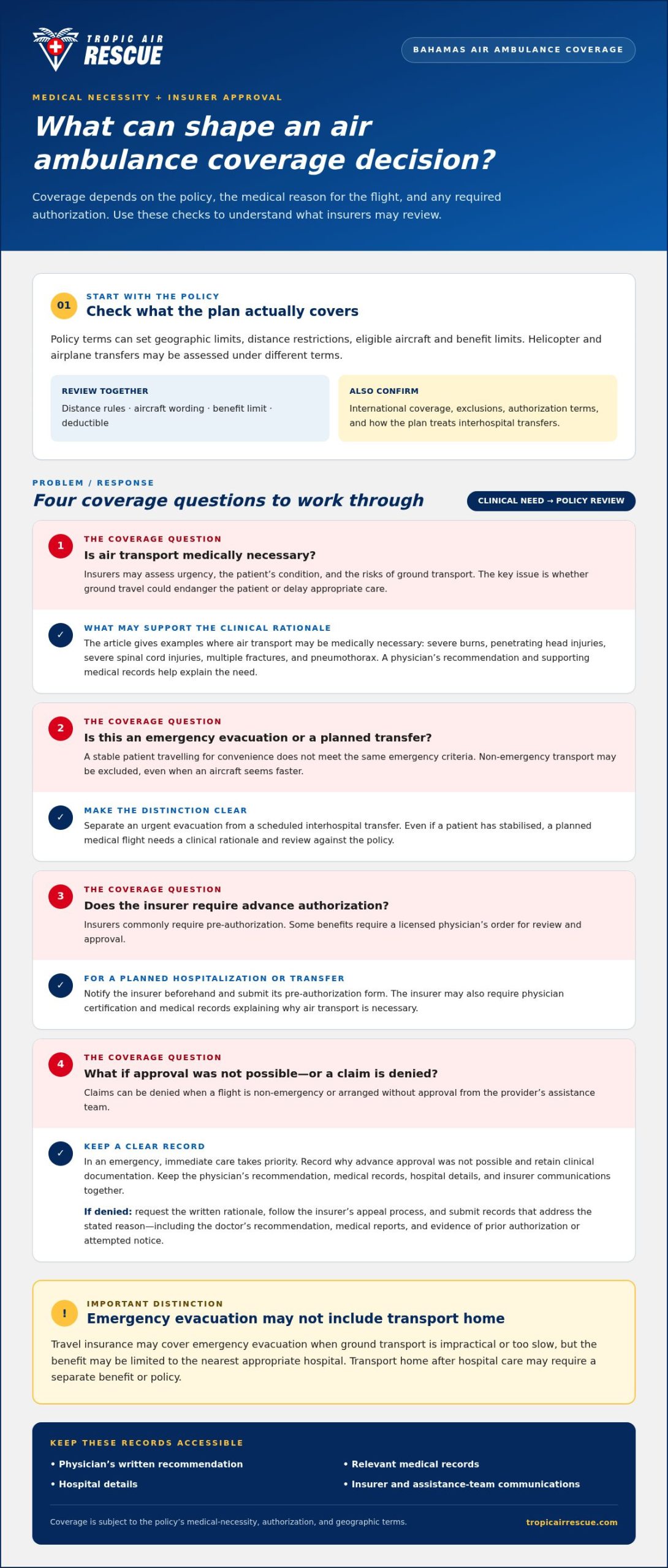
Distance and aircraft limits are policy rules that determine which flights qualify and how much the insurer may pay. Some policies restrict coverage by distance, while benefit limits and eligible transport types vary between plans. Helicopter and airplane transfers may be assessed under different terms. This matters in the Bahamas, where a patient may need transport between islands or to a facility equipped to provide appropriate care. Review the distance rules, aircraft wording, benefit limit and deductible together.
Insurance Sources for Air Ambulance Coverage
Private health insurance, government health benefits and travel insurance may each cover emergency medical transport, but not necessarily in the same situations. Private plans may cover air ambulance transport when local hospitals cannot provide adequate treatment, subject to limits and approval requirements. Government benefits follow the rules of the relevant programme and may not extend to every location or transport type. Travel insurance may cover emergency evacuation when ground transport is impractical or too slow. For visitors to the Bahamas, the policy’s international coverage terms are especially relevant.
Travel evacuation benefits may be limited to the nearest appropriate hospital. Transport home after hospital care may require a separate benefit or policy. For example, a patient travelling between islands should distinguish an urgent evacuation to suitable care from a later transfer or repatriation.
Reviewing and Supplementing Coverage
Review coverage by matching the policy’s exclusions, limits and authorization terms to the transport that may be needed. Before travelling, find out whether the policy covers emergency air ambulance flights in the Bahamas, whether it limits distance or aircraft type, and whether it pays the full eligible amount or only up to a stated benefit. Check how the plan treats interhospital transfers, which may differ from emergency evacuation. Reviewing these details can reveal gaps before a medical event.
If existing health coverage excludes international evacuation or has a restrictive limit, travel insurance with emergency medical evacuation benefits may help fill the gap. Compare destination rules, eligible transport, the approval process and whether onward travel home is included. Keep policy documents and assistance contact details accessible during the trip.
Medical necessity and authorization requirements
Medical necessity means the patient’s condition requires transport that ground travel cannot safely or promptly provide. If an insurer denies a claim, appeal in writing, address the reason given, and include the physician’s recommendation and supporting medical records.
Medical Necessity for Air Transport
Insurers assess urgency, the patient’s condition and the risks of ground transport when deciding whether an air ambulance is medically necessary. The central question is whether immediate transport is needed and ground travel could endanger the patient or delay appropriate care. Severe burns, penetrating head injuries, severe spinal cord injuries, multiple fractures and pneumothorax are examples where air transport may be medically necessary. A stable patient travelling for convenience does not meet the same emergency criteria.
Even when a patient’s condition has stabilised, a planned medical flight needs a clinical rationale and policy review. Non-emergency transport may be excluded, even if an aircraft transfer appears faster. Distinguish an urgent evacuation from a scheduled transfer between hospitals before arranging transport.
Insurer Approval Criteria
Authorization is the insurer’s advance review of a proposed flight against the plan’s requirements. Insurers commonly require pre-authorization, and some benefits require a licensed physician’s order for review and approval. For planned hospitalisation or an interhospital transfer, notify the insurer beforehand and submit its pre-authorization form. The insurer may also require a physician’s certification and medical records explaining why air transport is necessary.
Keep the physician’s written recommendation, relevant medical records, hospital details and communications with the insurer together. Claims can be denied when a flight is non-emergency or arranged without approval from the provider’s assistance team. In an emergency, immediate care takes priority; record why advance approval was not possible and retain the clinical documentation.
For an appeal, request the denial’s written rationale and follow the insurer’s stated appeal process. Submit records that answer the specific reason for denial, including the doctor’s recommendation, medical reports and evidence of prior authorization or attempted notice. For planned transfers, interhospital medical transfer coordination can help connect transport planning with the patient’s clinical requirements.
Air ambulance costs
Air ambulance charges vary according to the route, aircraft and medical support required. For a flight in the Bahamas, the patient’s insurance terms determine whether eligible charges are paid or become out-of-pocket costs.
Costs Without Insurance
Without air ambulance coverage, the patient may be responsible for transport charges. The price depends on the circumstances and is provided after a quote request. Distance, aircraft, clinical crew, equipment and destination all affect it. A short helicopter transfer between islands and a longer flight requiring specialised medical support have different operational needs, so a single general cost estimate is not a reliable way to plan for a specific flight.
Aircraft type also matters. Helicopters can reach locations where ground access is difficult, while fixed-wing aircraft suit different routes and operational requirements. Flight distance, the patient’s condition, onboard care and the receiving hospital all affect the resources involved. These are cost factors, not a quote for a particular Bahamas transfer.
Out-of-Pocket Costs
Out-of-pocket costs are amounts the patient must pay when insurance excludes the flight, applies a limit or leaves a deductible or coinsurance amount. For example, a policy may cover only part of an eligible transfer, leaving the patient responsible for the uncovered balance. The insurer’s approval and the policy’s benefit limit both affect the amount owed.
Keep the insurer’s decision, medical records and transport invoice together. If reimbursement is required, the claim may need a policy form, physician’s certificate, medical reports, receipts and hospital admission or discharge summaries. These documents link the flight to the patient’s medical need and help explain the transport charges.
In-Network and Out-of-Network Billing
Network status indicates whether an air ambulance provider has a contract with the patient’s insurer. Being out of network does not necessarily prevent transport, but it can affect coverage and payment. A plan may pay according to its own terms, leaving a difference between the eligible benefit and the billed charges. Distinguish the insurer’s approved amount from the total invoice.
For a flight in the Bahamas, don’t assume that protections or payment rules from another country apply. The U.S. No Surprises Act concerns U.S. billing protections, not a general rule for medical transport in the Bahamas. Review the relevant plan’s network terms, authorization decision and out-of-pocket provisions to understand the likely billing process.
Insurance, memberships, and travel insurance
For travel in the Bahamas, health insurance, travel insurance and an air ambulance membership serve different roles. Health insurance may cover emergency transport under its own medical-necessity and authorization rules. Travel insurance may provide a separate evacuation benefit. Membership is a separate arrangement for eligible transport, not a replacement for either policy.
Start with the traveller’s health plan. Domestic health plans often don’t extend abroad, and deductibles may still apply. The benefit limit alone doesn’t establish what a policy covers: its terms may restrict evacuation to the nearest appropriate hospital.
Read the travel policy’s destination, emergency medical and evacuation wording together. An urgent flight to the nearest suitable facility differs from transport home after further hospital care. Repatriation may require a separate benefit. Some plans also cover a companion, an escorted child or someone travelling to the patient’s bedside. These benefits depend on the policy’s terms and authorization process.
Air ambulance memberships address a different coordination need. A Short-term Membership or Annual Membership can provide a membership option for individual needs, while B2B Membership Plans address business arrangements. Membership is required for the service described here, and it allows health insurers to be billed directly so members incur no out-of-pocket costs. That arrangement is distinct from a travel policy’s evacuation limit or a health plan’s deductible.
For coordinating insurance for air ambulance, keep the membership terms, health policy and travel policy distinct. Match each one to the situation: emergency evacuation, interhospital transfer or travel-related medical support. For a Bahamas medical transport, explore short-term membership options as part of your preparation.
Tropic Air Rescue: Short-term Membership
Tropic Air Rescue offers Short-term Membership for people planning for medical transport in the Bahamas. Membership is required for its concierge helicopter air-medical service and allows the company to bill health insurers directly, eliminating out-of-pocket flight expenses for members at the time of flight. This gives members a clear way to coordinate insurance billing for an urgent transport need.
Annual Membership is an option for longer-term preparation. Interhospital Transfer Services support transfers between medical facilities, while Organ Transport supports time-sensitive medical logistics, including transport for people awaiting organ donations. These services are relevant when care requires movement between hospitals or an organ needs transport, rather than for routine travel.
Review your insurance terms alongside the membership details to understand how each applies to a medical flight. For information about Short-term Membership, visit tropicairrescue.com or contact Tropic Air Rescue.
Prepare for the Next Decision
Planning ahead means deciding how insurance information and transport decisions will be handled if a medical situation changes quickly. Keep policy details accessible, identify who can speak for the patient, and make sure essential information can reach the treating team. This preparation gives family members a clearer role when attention needs to stay on care.
For travel in the Bahamas, consider whether Short-term Membership or Annual Membership suits your circumstances. If a patient needs to move between facilities, Interhospital Transfer Services may be relevant. Coordinating insurance for air ambulance transport is one part of a broader readiness plan, along with deciding who will manage communication and decisions during a transfer.
Take the next step by discussing your transport needs with Tropic Air Rescue. Contact Tropic Air Rescue to explore the available membership and transfer options. Thoughtful preparation can help you approach a complex medical transport with greater clarity.
Frequently Asked Questions
Do I need pre-authorization for an air ambulance flight?
Often, yes. Insurers commonly require pre-authorization, particularly for a planned transfer or hospitalisation. An emergency may leave little time for advance paperwork, so notify the insurer or its assistance team as soon as circumstances allow. Keep a record of whom you contacted and when. For a planned flight, get the authorization decision and any conditions in writing before transport is arranged.
How Can I Avoid Unexpected Air Ambulance Bills?
Read the policy’s evacuation exclusions, benefit limits, deductible and destination terms before travelling. Confirm whether it covers transport in the Bahamas and whether it pays for onward travel after the patient reaches a hospital. Keep the insurer’s assistance contact and policy number accessible. Membership is not an insurance policy or secondary coverage, so understand which costs remain your responsibility under the membership terms.
What if I need an air ambulance while traveling internationally?
Contact the travel insurer’s emergency assistance team and explain the patient’s location, condition and treating facility. Domestic health plans often don’t work abroad, so confirm whether the travel policy covers emergency medical evacuation in the Bahamas. A benefit may cover transport to the nearest appropriate hospital, while repatriation after treatment may fall under separate terms. Keep policy details accessible to the person coordinating care.
How does insurance coordination work for air ambulance transport?
Coordinating insurance for air ambulance transport means matching the patient’s coverage and medical reason for flight with the insurer’s claim requirements. The insurer reviews eligibility and applicable limits, while transport records and medical documentation support the claim. With Tropic Air Rescue membership, the company bills health insurers directly. Membership is not insurance or secondary coverage, and members are responsible for any costs not covered by health insurance.
How do primary and secondary insurers coordinate air ambulance claims?
The primary insurer processes the claim first under its plan terms. The secondary insurer may then review the remaining eligible balance. The order and payment depend on the policies’ coordination-of-benefits provisions. Send the secondary insurer the primary insurer’s claim decision or explanation of benefits, along with any requested supporting records. Don’t assume the second plan will pay every amount the first plan excludes.
What pre-approval or medical documentation is required for air ambulance coverage?
For planned transport, insurers commonly require advance notice and a pre-authorization form. Supporting records may include a physician’s written recommendation, a certification of medical necessity, medical reports, prescriptions and hospital admission or discharge summaries. Requirements vary by plan. Keep copies of submitted documents and the insurer’s response so the treating team and the person handling the claim can refer to the same information.