


What matters most in a helicopter medical evacuation Bahamas to Florida: the aircraft or the coordination behind it? Planning a transfer involves more than arranging a flight. The medical team assesses the patient, the medical director determines the appropriate facility, and the transport team coordinates with the receiving hospital. In an emergency, it’s natural to have questions about reaching a remote location, membership, and insurance billing.
This guide explains the key steps, from care coordination and aircraft access to the hospital handoff. You’ll see when helicopters can reach places without runways, how that differs from fixed-wing transport, and why the patient’s needs and location shape the plan. We’ll also explain that membership is required to access Tropic Air Rescue benefits and how direct billing to health insurers works for active members. The central point is simple: a successful evacuation depends on coordinated medical care, not flight alone.
Key Takeaways
- A helicopter medical evacuation Bahamas to Florida involves clinical decisions and flight logistics, not just arranging an aircraft.
- The medical director determines the appropriate facility, while the transport team coordinates the transfer and hospital handoff.
- Helicopters and fixed-wing aircraft have different access requirements. The right option depends on the patient’s location and transfer needs.
- Membership is required to access Tropic Air Rescue benefits. Short-term and annual options suit different travel durations, and active members are billed through their health insurer.
- In an urgent situation, share clear patient details and accurate membership information with the response team.
When Does Helicopter Medical Evacuation from the Bahamas to Florida Become Necessary?
A medical evacuation moves a patient to another facility for emergency or higher-level care. The need to transfer and the choice of transport are related, but they’re separate decisions. A patient may need care elsewhere without a helicopter being the right way to get there.
A helicopter medical evacuation Bahamas to Florida is a medically coordinated transfer by helicopter from the Bahamas to an appropriate Florida healthcare facility. The patient’s condition, care needs, and transport requirements guide the plan. It isn’t simply a flight to a preferred destination. The patient’s clinical needs inform the destination, while the transport plan must account for the pickup location and receiving facility.
The broader concept of Medical evacuation (Medevac) includes different transport methods. A helicopter can be valuable when runway access is limited or the pickup location is remote. That capability doesn’t make a helicopter the automatic choice in every case. The medical team’s assessment and practical transport requirements both matter.
Emergency evacuation and interhospital transfer are different needs
An emergency evacuation responds to a patient who needs urgent transport from their current location. An interhospital transfer begins with a patient already receiving care at one facility who needs continued or specialized care elsewhere. Both involve moving a patient, but the circumstances and care arrangements differ. Organ transport is a separate service, not a patient evacuation.
The distinction helps clarify the first question: what care does the patient need next? A patient may need urgent transport because their current setting can’t provide the required level of care. In another case, clinicians may determine that a transfer is needed to continue treatment or access specialized services. The reason for the transfer informs the destination and care coordination, but doesn’t determine the aircraft by itself.
Why the receiving facility matters
The destination must suit the patient’s medical needs, not simply be the closest or most familiar option. Tropic Air Rescue’s medical director determines the appropriate healthcare facility, and the helicopter is directed to the selected hospital heliport. This ties the transport plan to the care the patient needs, rather than treating the flight as an isolated step.
For example, if a patient needs a level or type of care that isn’t available where they are, the receiving facility must be selected with that need in mind. The patient’s condition can also affect how the transfer is arranged. Coordination between the medical team and the receiving facility helps align the destination with the purpose of the transfer.
In short, evacuation becomes a consideration when a patient needs urgent transport or care beyond what their current facility can provide. The decision to transfer, the choice of destination, and the selection of transport each answer a different question. Keeping them distinct helps explain why helicopter transport can be an important option across the Bahamas, without assuming it is right for every patient.
How a Bahamas-to-Florida Helicopter Medical Transfer Is Coordinated
A helicopter medical evacuation Bahamas to Florida brings together clinical decisions and operational arrangements. The medical team assesses the patient and shares relevant information, the medical director determines the appropriate receiving facility, and the transport plan is organized around that destination. Knowing who makes each decision helps families follow the process.
Clinical assessment and destination coordination
The patient’s condition and care needs guide the clinical plan. Information from the patient’s current care setting helps the medical team understand the situation, while the medical director determines the appropriate healthcare facility. The team coordinates with the receiving Florida trauma center so the transfer is directed toward the care the patient needs.
The medical director selects the appropriate facility. The receiving facility coordinates the care handoff, while aviation logistics support transport to its hospital heliport.
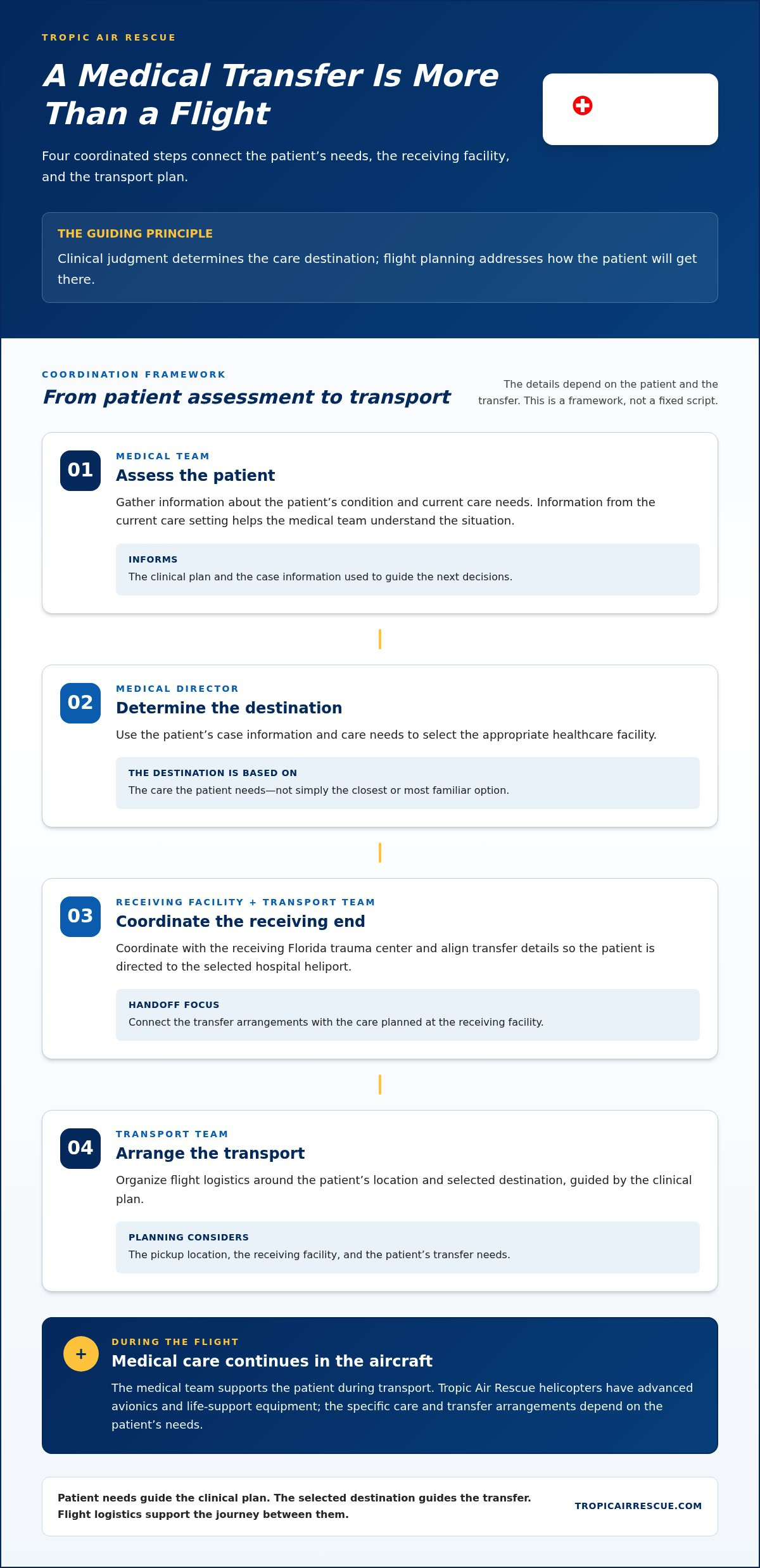
The process can be understood in four parts:
- Assess the patient. The medical team gathers information about the patient’s condition and current care needs.
- Determine the destination. The medical director uses the case information to select the appropriate healthcare facility.
- Coordinate the receiving end. The receiving facility and transport team align transfer details so the patient is directed to the selected hospital heliport.
- Arrange the transport. Flight logistics are organized around the patient’s location and destination, guided by the clinical plan.
This is a framework, not a fixed script. Details depend on the patient’s circumstances and the transfer being arranged. Clinical judgment determines the care destination; flight planning addresses how the patient will get there.
What happens during the flight
During transport, the medical team supports the patient’s care in the aircraft. Tropic Air Rescue’s helicopters have advanced avionics and life-support equipment. The specific care and transfer arrangements depend on the patient’s needs, so the onboard plan shouldn’t be assumed to be the same for every case.
The information available to coordinate a transfer for someone already receiving hospital care may differ from what’s available during an emergency response. In either situation, accurate clinical information helps the medical team plan the transfer and coordinate with the receiving facility. Family members can help by sharing what they know clearly and distinguishing known details from guesses about a diagnosis or treatment.
Good coordination joins clinical judgment with precise transport logistics. The destination is selected for the patient’s care needs, and the helicopter is directed to that hospital’s heliport. Visitors planning ahead can review Tropic Air Rescue membership options, since membership is required to access service benefits.
Helicopter or Fixed-Wing Medevac: Which Fits a Bahamas-to-Florida Transfer?
No aircraft type is always faster or more suitable. The right option depends on the patient’s condition, pickup location, access to appropriate landing facilities, route, and coordination with the receiving facility. For a helicopter medical evacuation Bahamas to Florida, aircraft choice is part of the medical transport plan, not a decision made on speed alone.
| Consideration | Helicopter | Fixed-wing aircraft |
|---|---|---|
| Landing access | Can reach some locations without a runway, subject to whether a suitable landing site is available. | Requires a suitable airport or airstrip for landing and departure. |
| Patient location | Can be useful when the patient is in a remote location that is difficult to reach by fixed-wing aircraft. | May fit a transfer where the patient can be transported to an appropriate runway facility. |
| Destination coordination | The helicopter can be directed to the selected hospital heliport. | Planning must account for an appropriate airport and coordination for the patient’s onward access to the receiving facility. |
When helicopter access can matter
A patient in the Bahamas may be far from a runway. Helicopters can reach remote locations inaccessible to fixed-wing aircraft, making them an important option for medical transport. However, a remote location isn’t automatically a usable landing site. The pickup point and operational requirements still shape the transfer plan.
Fixed-wing aircraft require suitable landing facilities. If a patient can be brought to an appropriate runway, that may make fixed-wing transport relevant to the situation. The practical questions are where the patient is, where an aircraft can operate, and how the transport connects with the receiving facility. Managing cross-border routes also requires extensive aeronautical expertise, which aspiring professional pilots typically build at flight training academies such as 2FLY Airborne.
Why aircraft choice is not a speed guarantee
Time in the air is only one part of a transfer. The patient’s medical needs, access to the pickup point, route, landing arrangements, and receiving-facility coordination all influence the plan. A helicopter’s ability to reach some locations without a runway can be useful, but it doesn’t guarantee a faster transfer or make a helicopter the right choice in every case.
Tropic Air Rescue provides helicopter medical service, including emergency response and interhospital transfers, not fixed-wing air ambulance flights. Its medical director determines the appropriate healthcare facility, and the helicopter is directed to the selected hospital heliport. This connects aircraft planning to the patient’s destination and care requirements.
For a closer look at the trade-offs, read a helicopter versus fixed-wing medevac comparison. To understand how membership relates to helicopter medical transport in the Bahamas, explore Tropic Air Rescue membership options.
Membership and Insurance: What to Understand Before a Medical Evacuation
Membership and insurance are separate parts of planning a helicopter medical evacuation Bahamas to Florida. Membership is required to access Tropic Air Rescue benefits. Direct insurance billing describes how an active member’s transport is billed; it doesn’t guarantee that an insurer will approve a claim or reimburse a particular amount. Understanding the difference before travel can make the financial arrangements clearer if an emergency occurs.
Short-term and annual memberships are designed for different anticipated lengths of stay. A visitor planning a limited trip may choose an option aligned with that travel period, while someone spending more time in the Bahamas may consider an annual membership. Choose based on your expected stay and the membership terms, and review what the membership provides.
Prepare membership information before travel
Gather enrollment and identity details while planning, rather than trying to locate them during a stressful event. Having accurate information accessible can help the response team identify the membership and support advance pre-certification. Make sure the people travelling with you know where to find the details, and update them if relevant information changes.
Before departure, review the membership terms and eligibility so you understand how the benefits apply to your circumstances. A health insurance policy alone isn’t the same arrangement as membership, and not every situation is handled identically. Preparing in advance helps clarify the process, but doesn’t promise a particular medical or insurance outcome.
Understand direct insurance billing
For active members, Tropic Air Rescue bills the member’s health insurer directly and accepts insurance payouts as full payment. This describes the billing arrangement, not a guarantee that the insurer will approve a claim, pay a particular amount, or cover every part of a transfer. Insurance decisions remain with the insurer and depend on the policy and claim.
Keep health insurance information with your membership details. If an emergency occurs, accurate information helps the team handle billing using the correct policy and member details. Don’t assume how deductibles, exclusions, or an insurer’s decision will apply. Review your policy so you understand its terms, and distinguish those terms from membership benefits.
For travelers considering a shorter stay, short-term medevac coverage is a useful planning topic to review alongside the membership terms. Before travel, know which membership applies, keep enrollment and insurer information accessible, and understand that direct billing doesn’t guarantee insurer payment. This preparation helps separate transport coordination from the financial process.
Review the membership options for your anticipated stay before travel so you understand the membership arrangement in advance.
Preparing for Bahamas to Florida Medevac
In an urgent situation, clear information helps the medical team assess the patient and coordinate next steps. You don’t need to choose the destination or arrange aviation logistics yourself. Focus on communicating what you know accurately, then let the medical team manage clinical decisions and transfer coordination.
Information to have ready
When practical, keep the patient’s identity and relevant membership details accessible. During an emergency, share known information with the response team calmly and directly. Don’t delay urgent communication to search for paperwork, and don’t guess if you’re unsure.
- Patient details: Share the patient’s name and other identifying information you know.
- Current situation: Describe what happened, the patient’s present condition, and any changes you’ve observed.
- Relevant medical information: Provide known medical history, medications, allergies, and care already received, if available.
- Membership information: Give the team accurate enrollment details so they can identify the membership.
- People who can provide context: Identify the patient’s current caregiver or someone familiar with their medical history, if available.
This is a practical communication checklist, not a formal document requirement. Share accurate information and clearly identify anything uncertain. If the patient is already at a healthcare facility, information from the treating team can help inform the medical assessment and transfer plan.
Start with Tropic Air Rescue
Membership enrollment and pre-certification support preparation before an emergency. Completing those steps in advance gives the response team access to relevant identity and enrollment details when needed. Membership is required to access Tropic Air Rescue benefits, so understand the arrangement before travel rather than treating enrollment as part of an urgent transfer.
Once the response team has the information, the medical team assesses the patient and manages clinical decisions. Tropic Air Rescue’s medical director determines the appropriate healthcare facility, and the transport plan is coordinated around that decision. Families can help by staying available, sharing updates, and passing along accurate details. They don’t need to select the destination or organize the aircraft.
For a planned transfer between healthcare facilities, inter-hospital transfer coordination aligns the patient’s care needs with the receiving facility and transport plan. In an urgent event, keep communication focused: what is happening, what is known about the patient, and how the response team can reach the person providing information. Clear facts support coordination, while the medical team directs care decisions.
Prepare before travel, keep membership information accessible, and share what you know without delay. Explore Tropic Air Rescue membership.
Make Your Travel Preparation Count
Before your next stay in the Bahamas, think about what you’d want available in a medical emergency. Keep membership and health insurance details accessible to someone travelling with you, and make sure they know how to share accurate patient information with the response team. This preparation can reduce uncertainty when decisions need to be made quickly.
When choosing a membership option, consider the length of your stay. If a transfer becomes necessary, the medical director determines the appropriate healthcare facility, while active members are billed through their health insurer. Understanding these arrangements in advance helps you prepare without assuming a particular insurance outcome.
A helicopter medical evacuation Bahamas to Florida is a complex medical transfer, not simply a flight. Preparing membership information and understanding the process can help you communicate clearly if circumstances change. Explore Tropic Air Rescue membership and take an informed step in planning your travel.
Frequently Asked Questions
How long does helicopter medical evacuation from the Bahamas to Florida take?
There’s no single duration for a helicopter medical evacuation Bahamas to Florida. Timing depends on the patient’s circumstances, location, aircraft access, and the medical coordination required. A transfer from an accessible location may involve different arrangements from one requiring remote access or additional care coordination. The medical team plans around the patient’s needs, so a response or arrival time can’t be assumed in advance.
Can a helicopter land at remote locations that fixed-wing aircraft cannot reach?
Yes. Tropic Air Rescue’s helicopters can reach remote locations inaccessible to fixed-wing aircraft. This can matter when a patient is far from a suitable runway. It doesn’t mean every remote site is usable: the specific location and operational circumstances determine whether a landing can be made. Helicopters can access some places without the runway facilities fixed-wing aircraft require.
What medical equipment is carried on a Tropic Air Rescue helicopter?
Tropic Air Rescue’s helicopters are equipped with advanced avionics and life-support equipment. Published equipment details include a defibrillator, heart monitor, and oxygen. These items support medical transport, but the equipment list alone doesn’t determine what care a particular patient needs or receives. The medical team considers the patient’s circumstances when coordinating transport. Equipment supports the mission but can’t guarantee a specific clinical outcome.
Does Tropic Air Rescue provide fixed-wing air ambulance flights?
No. Tropic Air Rescue provides concierge helicopter air-medical transport, not fixed-wing air ambulance flights. Helicopters and fixed-wing aircraft have different landing-access requirements, so aircraft type is an operational consideration rather than a universal measure of suitability. Tropic Air Rescue’s medical transport is by helicopter, with planning shaped by the patient’s location and medical circumstances.
Can Tropic Air Rescue transport organs?
Yes. Organ transport is one of Tropic Air Rescue’s services. It’s distinct from patient evacuation: organ transport moves an organ, while a medevac transfers a patient for care. This guide focuses on patient transport from the Bahamas to Florida, so organ transport is a separate service, not another type of patient transfer.
How does direct insurance billing work for an active member?
Tropic Air Rescue bills an active member’s health insurer directly for air-medical service and accepts insurance payouts as full payment. Membership is required to access this benefit. Direct billing doesn’t guarantee that an insurer will approve or pay a claim, or reimburse a particular amount. Keep current health insurance and membership information accessible so the response team can use accurate details.
Can a business arrange medical evacuation membership for a group?
Yes. Tropic Air Rescue offers business-to-business membership plans for organizations planning medical evacuation arrangements for a group. A group plan doesn’t mean every employee or traveler is automatically covered. Review the membership information to understand the applicable arrangement and how it relates to the group. This can support advance planning for staff or travelers in the Bahamas.