


What if your health or travel insurance helps cover treatment but leaves air medical transport exposed? For visitors in the Bahamas, avoiding catastrophic medevac bills starts with understanding that care, evacuation, and repatriation may be treated differently under a policy. A claim can also depend on exclusions, medical necessity, and where transport takes place.
It’s reasonable to expect insurance to help protect you in an emergency. But coverage limits, deductibles, and claim conditions can still leave uncertainty, especially when care crosses borders. Reviewing those terms before travel can help you identify potential gaps while there’s time to plan.
This guide explains which policy terms to review, why transport coverage may differ from medical care, and how to prepare for possible out-of-pocket expenses. It also covers how Tropic Air Rescue membership works alongside health insurance: members receive direct insurer billing, and insurance payouts are accepted as full payment. Membership is required to access these benefits. It doesn’t replace health insurance or guarantee that every claim will be paid. You’ll also find a practical checklist for comparing short-term, annual, or group preparation needs before travel.
Key Takeaways
- Separate the urgency of medical transport from the insurer’s decision to pay; review deductibles, coinsurance, exclusions, and claim-denial terms before travel.
- Understand how health insurance, travel insurance, and medevac membership serve different roles, especially for transport across borders.
- U.S. surprise-billing protections don’t automatically guarantee coverage for medical transport in the Bahamas.
- Use a pre-travel checklist to record coverage details, emergency contacts, and where to access essential policy documents.
- Avoiding catastrophic medevac bills begins with planning ahead. Tropic Air Rescue membership options reflect anticipated stay length or group needs, and membership is required to access benefits.
Why avoiding catastrophic medevac bills starts before an emergency
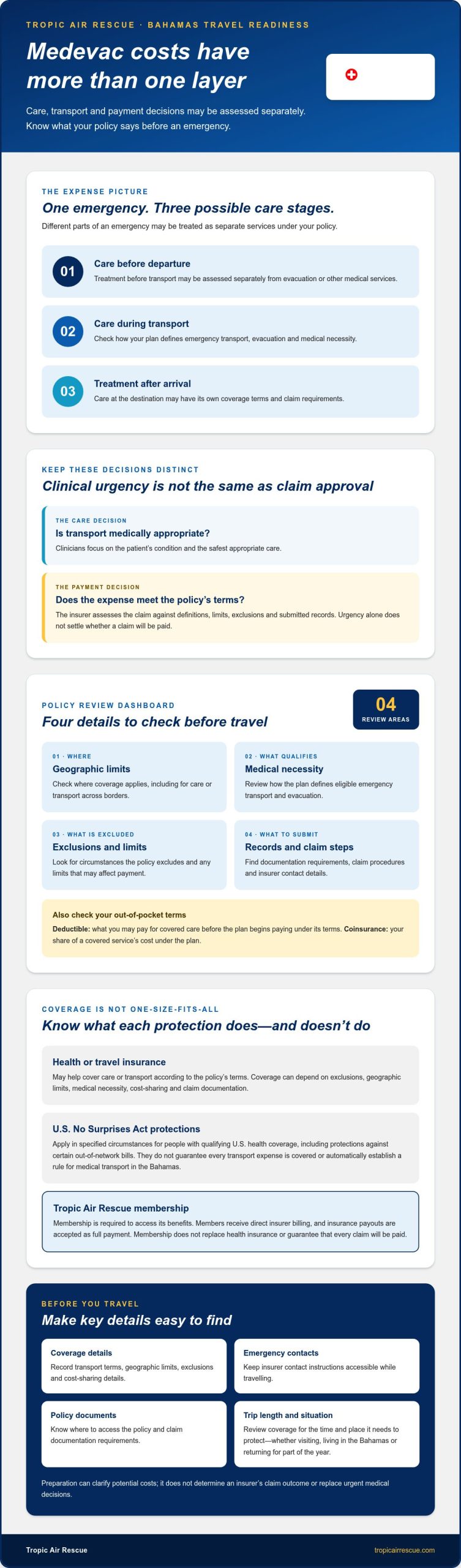
Concern about an unexpected transport bill is reasonable, especially when you’re travelling or living away from your usual healthcare network. In an emergency, clinicians focus on the patient’s condition and the safest appropriate care. An insurer separately decides whether a transport or treatment expense meets the policy’s terms. Urgency alone doesn’t settle whether a claim will be paid.
Medevac financial readiness means planning coverage, contacts, and documents before an emergency makes decisions time-critical. That preparation won’t determine the outcome of a claim, but it can help you understand your potential costs and act with greater clarity. For background on the aircraft and operations involved, Air ambulance services vary according to the patient’s needs and transport circumstances.
What can make a medevac bill difficult to predict?
Transport is only one part of an emergency. Medical care before departure, care during transport, and treatment after arrival may be separate services assessed under different policy terms. A plan might define eligible transport narrowly, exclude certain circumstances, or require specific documentation for a claim. Deductibles and other cost-sharing terms can also affect what the insured person pays. An emergency doesn’t automatically make every related expense covered.
The transport decision and payment review have different purposes. A clinical team may determine that moving a patient is medically appropriate, while an insurer later assesses the claim against its definitions, limits, and exclusions. The result can depend on details such as the purpose of transport, the destination, and the records submitted. That’s why a general statement like “I have health insurance” may not answer whether a particular medevac expense is covered.
Why advance planning matters for Bahamas travel
Visitors, residents, second-home owners, and people spending different lengths of time in the Bahamas can have different coverage arrangements. A visitor may rely on a travel policy alongside health insurance. A resident may have a longer-term plan, while someone returning for part of the year may need to consider how coverage applies during that stay. Review the policy for the time and place it needs to protect.
Read the policy wording before travel and identify the right insurer contacts, rather than trying to interpret exclusions during a stressful event. Look for how the plan describes emergency transport, geographic limits, medical necessity, and claim documentation. Record where those details are stored and how to reach the insurer. This is practical preparation, not a reason to delay urgent medical decisions.
Separate the questions: what care might be needed, what transport could involve, and how each expense is evaluated under your coverage. That distinction is the first step in avoiding catastrophic medevac bills. It also gives you a useful basis for comparing insurance protections with any additional financial preparation you choose.
What insurance and surprise-billing protections may, and may not, cover
Insurance language can make a difficult situation harder to assess. Start by distinguishing a rule that limits certain bills from a policy decision about whether a service is covered. They’re related, but they aren’t the same. Understanding the terms helps you identify what to review before travelling in the Bahamas.
What the No Surprises Act does and does not establish
The U.S. No Surprises Act provides protections in specified circumstances for people with qualifying U.S. health coverage. U.S. Department of Labor guidance explains protections against certain out-of-network bills, including some air ambulance bills. The law doesn’t make every transport expense covered, guarantee that an insurer will approve a claim, or establish a universal rule for medical transport in the Bahamas. Its relevance depends on the coverage and circumstances involved. Review the Department of Labor’s No Surprises Act guidance, and don’t assume U.S. federal protections automatically govern a cross-border transport or service received in the Bahamas.
Here, “surprise billing” generally means an unexpected bill from an out-of-network provider in circumstances where a patient may not have had a meaningful choice. “Balance billing” is a provider’s attempt to bill the patient for the difference between its charge and the amount an insurer pays. Legal protections may limit certain balance bills, but they don’t settle every question about coverage or payment.
Which insurance terms deserve a close review?
Read the policy’s emergency transport and evacuation language, including geographic limits, exclusions, documentation requirements, and claim procedures. Check whether it distinguishes medical evacuation, transport to another facility, and travel back to a home country. Those terms can define different benefits. Keep the policy and emergency contact instructions accessible, not only in an inbox or account you may struggle to reach while travelling.
- Deductible: the amount you may need to pay for covered care before the plan begins paying under its terms.
- Coinsurance: your share of the cost of a covered service, usually calculated as a percentage after applicable plan rules.
- Claim denial: the insurer’s decision not to pay all or part of a submitted claim, often because it considers a requirement unmet or the service outside the policy’s coverage.
A deductible or coinsurance amount can remain payable even when a service is covered. A denial is different: it means the insurer disputes payment under the policy, and the reason may be subject to a review or appeal process. Neither term, by itself, tells you whether a bill is legally protected from balance billing.
To prepare for avoiding catastrophic medevac bills, record the insurer’s contact details, the process for urgent transport claims, and where the relevant policy wording is stored. If you’re also considering membership, Tropic Air Rescue membership options provide another element to weigh alongside health or travel insurance. Membership is required to access its benefits, and it doesn’t replace health insurance.
Insurance, travel cover, and medevac membership: compare the roles
Existing insurance is an essential part of travel preparation, but it may not answer every question about emergency transport. Coverage can depend on policy wording, exclusions, claim requirements, and where care takes place. A medevac membership has a different role: it provides access to specified air-medical benefits under its terms. Comparing the tools side by side helps clarify what each is intended to do.
| Option | Purpose | Terms to review | Potential role in an emergency |
|---|---|---|---|
| Health insurance | Helps pay for eligible healthcare under the plan. | Geographic limits, emergency transport coverage, exclusions, deductibles, coinsurance, and claim requirements. | May contribute to eligible medical care or transport, subject to plan terms and claim review. |
| Travel insurance | Provides travel-related protections described in the policy. | Medical evacuation and repatriation definitions, coverage limits, exclusions, and required approvals or documentation. | May address eligible emergency costs during a trip, depending on the policy. |
| Medevac membership | Provides access to specified air-medical benefits under membership terms. | Eligibility, membership requirements, applicable benefits, and how insurance billing is handled. | Can form an additional layer of preparation alongside insurance. |
These options aren’t interchangeable. Insurance policies determine whether specified expenses qualify for payment; membership provides access to defined benefits according to its terms. For avoiding catastrophic medevac bills, the practical question isn’t simply whether you’re insured. Consider whether your coverage fits the transport risks you’re preparing for and what arrangements apply if a claim is limited or denied.
How medevac membership differs from insurance
Tropic Air Rescue requires membership to access its benefits. For members, it bills health insurers directly and accepts insurance payouts as full payment. This approach is intended to reduce members’ out-of-pocket exposure, but it doesn’t guarantee that every insurer will pay every claim. Membership complements health or travel insurance; it doesn’t replace either one.
Direct insurer billing describes how a claim is submitted, not the insurer’s decision. Review your coverage separately and read the membership terms to understand the applicable benefits and requirements. Keep both sets of documents accessible so you can see how the arrangements fit together without assuming one automatically resolves every potential expense.
Which membership duration fits your stay?
Match the membership option to your anticipated time in the Bahamas. Short-term membership suits a shorter stay, while annual membership may fit someone spending longer periods or returning throughout the year. Organizations arranging coverage for a group can consider B2B membership plans. Duration is one part of the decision; compare the applicable terms with your insurance before travel.
Think through your expected travel pattern, not just the next few days. A visitor, second-home owner, or resident may have different needs based on how long they expect to be in the Bahamas. Planning ahead gives you time to evaluate membership alongside existing insurance and review the details calmly.
A pre-travel checklist for reducing medevac bill uncertainty
A short preparation routine can make key information easier to find when time and attention are limited. Before travelling in the Bahamas, work through these five steps. Keep personal health information private; this checklist is for your own secure records, not public posts or shared travel updates.
Before travel: review and organize coverage
- Identify your coverage. List the health and travel insurance policies that may apply during your stay. Record the insurer’s contact details, policy number, and process for an emergency transport claim.
- Inspect exclusions. Read the definitions for evacuation, air ambulance, and emergency transport. Note geographic limits, exclusions, authorization rules, documentation requirements, and deadlines for notifying the insurer.
- Confirm contacts. Save insurer instructions and relevant emergency contacts in a secure place you can access while travelling. If you rely on a family member or travel companion, tell them where to find the information.
- Plan membership. Consider whether membership is part of your preparation, based on your expected length of stay and the applicable terms. Compare the membership duration with your travel dates and existing coverage.
- Store documents. Keep policy documents, membership details, and contact instructions together in a secure digital location, with an offline copy if practical. Record only what’s needed to identify coverage and reach the relevant organization. Don’t post policy numbers, medical records, or other sensitive details publicly.
This preparation is separate from decisions made during an emergency. It’s meant to make coverage and contact information easier to find, not to delay urgent care or transport. For avoiding catastrophic medevac bills, knowing where your documents are and what your policy says is a useful first step, even though it can’t determine how a future claim will be decided.
After transport: keep a clear record
If transport occurs, shift from preparation to documentation. Retain relevant transport and treatment records, insurer correspondence, claim submissions, and membership communications. Note dates, names, and reference numbers for calls or messages. Store the material securely and share it only through appropriate private channels.
If a claim decision is unclear, ask the insurer for a written explanation identifying the policy terms and information used in its decision. Keep the response with the claim file. Any review, appeal, or dispute process depends on the applicable plan and jurisdiction, so use the official guidance relevant to that coverage rather than assuming one country’s rules apply in the Bahamas.
If you’re considering membership as part of your pre-travel plan, review Tropic Air Rescue membership options alongside your insurance documents. Membership is required to access benefits, and options reflect anticipated stay duration.
How Tropic Air Rescue membership fits a financial-readiness plan
Once you’ve reviewed your insurance and identified possible gaps, you can decide whether another layer of preparation makes sense. Tropic Air Rescue provides concierge helicopter air-medical transport throughout the Bahamas. Membership is required to access its benefits, with options based on anticipated stay duration or group needs. It complements health or travel insurance rather than replacing it. Review the applicable terms as part of your planning.
What members can expect from the billing approach
For members, Tropic Air Rescue bills health insurers directly and accepts insurance payouts as full payment. This approach is intended to reduce members’ out-of-pocket exposure. It doesn’t guarantee that an insurer will pay every claim or that every emergency or transport is eligible. Consider the billing arrangement alongside your policy details, and keep your insurer information accessible. This helps clarify the roles each arrangement may play.
The distinction is practical: direct billing describes how Tropic Air Rescue handles the insurer claim for members; it doesn’t control the insurer’s coverage decision. Membership benefits apply under their terms. Keep your insurance documents and membership information together so they’re available if an emergency or later claim review requires them. This preparation doesn’t replace reading policy exclusions or understanding what your insurance covers.
Choose a next step before an emergency
Match the membership option to your circumstances. Short-term membership may suit a visitor planning a limited stay, while annual membership is an option for a longer or recurring presence in the Bahamas. Organizations arranging group coverage can consider B2B membership plans. Weigh the expected length of stay alongside your existing coverage.
For avoiding catastrophic medevac bills, the goal is to make informed arrangements before a crisis, not to assume any single policy or membership settles every financial question. Set aside time to review the relevant terms, understand how insurer billing works, and choose preparation that fits your expected stay or group needs. Then keep the information easy to retrieve. Explore Tropic Air Rescue membership as one part of a considered financial-readiness plan for travel in the Bahamas.
Make your next step a planned one
Before your next stay in the Bahamas, set aside time to turn your coverage information into a clear plan. Decide what you need to understand, where you’ll keep essential details, and who should be able to access them if you need support. Preparation won’t predict every outcome, but it can reduce uncertainty when decisions matter.
A medevac membership may be one part of that plan. Tropic Air Rescue offers options shaped around anticipated length of stay, and its member billing approach includes direct health-insurer billing and acceptance of insurance payouts as full payment for members. Membership is required to access benefits, and it complements rather than replaces health or travel insurance. Review how these arrangements fit your circumstances before travel.
Avoiding catastrophic medevac bills is not about expecting the worst. It’s about making informed choices while you have time to consider them. Explore Tropic Air Rescue membership options and take a calm, practical step toward greater financial readiness for your time in the Bahamas.
Frequently Asked Questions
Does the No Surprises Act protect every air ambulance bill connected to the Bahamas?
No. The U.S. No Surprises Act applies to specified circumstances and coverage, so a connection to the Bahamas doesn’t make every air-medical transport bill subject to its protections. It also doesn’t guarantee that an insurer will cover a claim. Review the Department of Labor’s official guidance and the terms of the plan involved. For cross-border situations, the relevant rules depend on the particular coverage and circumstances.
Can travel insurance cover a medical evacuation outside my home country?
It can, if the policy includes that benefit and the circumstances meet its terms. Before travel, look for the policy’s definition of medical evacuation, its geographic scope, exclusions, limits, and any notification or approval requirements. Also distinguish evacuation to appropriate medical care from repatriation to your home country. A policy may treat those as separate benefits, so don’t assume coverage for one automatically includes the other.
Is a medevac membership the same as health or travel insurance?
No. Health and travel insurance are policies that assess eligible expenses according to their coverage terms. A medevac membership provides access to specified air-medical benefits subject to membership terms. It isn’t a replacement for insurance, which may address medical care and other travel-related expenses. For avoiding catastrophic medevac bills, consider how each arrangement fits your needs, and review the membership terms and insurance documents separately.
What happens if my health insurer denies an air-medical transport claim?
A denial means the insurer has declined payment for all or part of the submitted claim, but the next step depends on the reason and your plan’s process. Request a written explanation, compare it with the policy wording, and note any appeal deadline or required documents. Keep transport records, claim correspondence, and relevant medical documentation together. Use the review or dispute process that applies to your specific plan and jurisdiction.
Can I arrange medevac membership for only part of my stay in the Bahamas?
Tropic Air Rescue offers short-term membership, with options tailored to anticipated length of stay. If you’ll be in the Bahamas for a limited period, consider the dates you expect to be there and review the applicable membership terms before travel. Membership is required to access benefits. Don’t assume protection begins immediately or continues beyond the membership period; use the terms to understand when membership applies.
Does Tropic Air Rescue bill a member directly for an emergency transport?
Tropic Air Rescue bills health insurers directly for members and accepts insurance payouts as full payment for members. This is not direct patient invoicing. The billing approach is intended to reduce members’ out-of-pocket exposure, but it doesn’t guarantee that an insurer will pay every claim or that every transport qualifies for benefits. Membership is required, and the applicable membership terms govern access to benefits.
Can a business arrange medevac membership for a group?
Yes. Tropic Air Rescue offers B2B membership plans for organizations arranging group coverage. This can be relevant for a business or organization planning for people who will spend time in the Bahamas. As a practical first step, identify who needs coverage and the expected length of stay, then review how the group arrangement fits alongside each person’s existing health or travel insurance. Membership terms apply to access to benefits.