

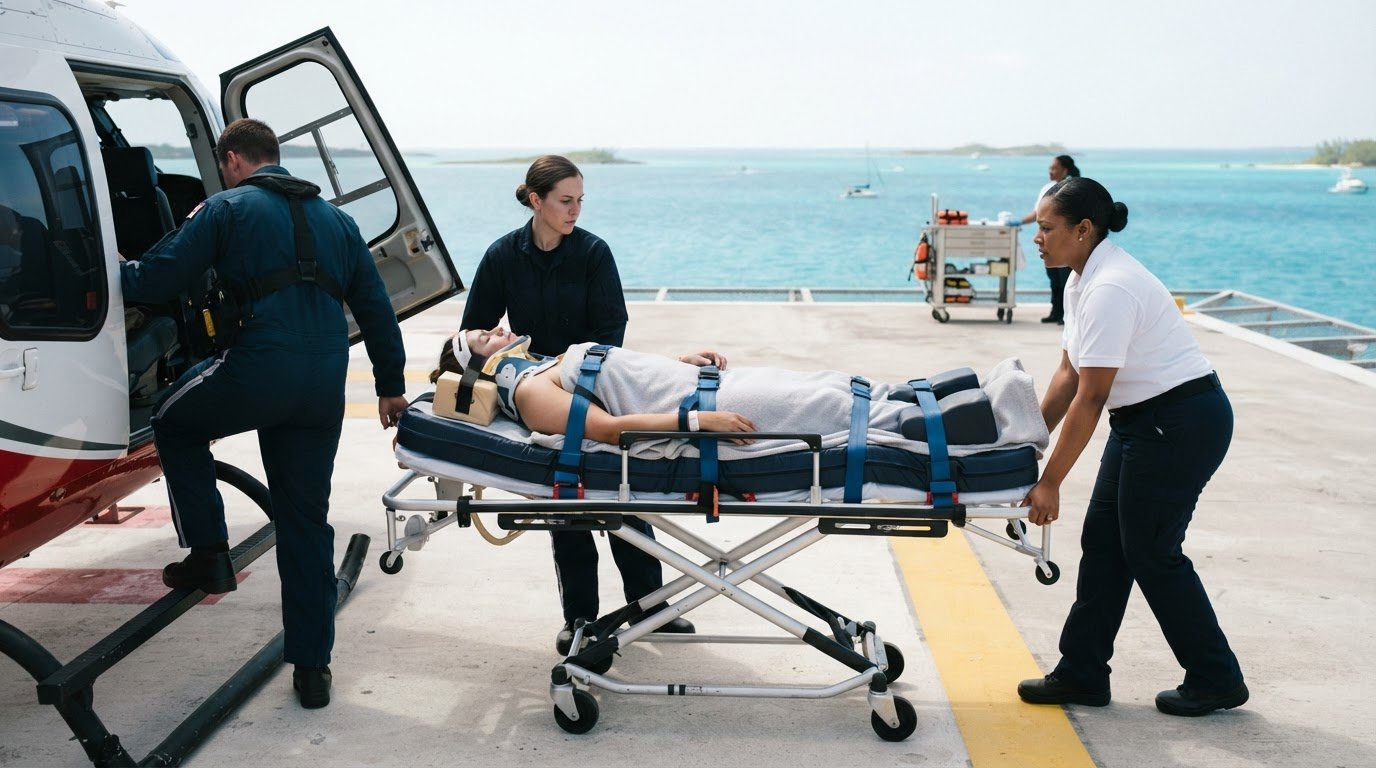
The cost of air transport for spinal cord injuries depends on factors such as flight distance, aircraft type, level of care and ground logistics. Health insurance may cover transport when medical necessity is established, particularly for trauma or medically supervised repatriation. There is no single cost for every transfer.
It’s reasonable to focus on the price, but the care plan matters just as much. A safe journey depends on matching the patient’s medical condition with appropriate positioning, specialist equipment and monitoring, then coordinating a clear handover to the receiving hospital.
This guide explains how clinical assessment, pressure and circulation risks, onboard equipment and hospital coordination shape air transport for spinal cord injuries. It also covers cost factors and insurance considerations for transfers in the Bahamas, so you can understand the key decisions before arranging medical transport.
Key Takeaways
- Plan for pressure relief and circulation risks during prolonged travel; positioning needs are part of the care plan.
- Spinal protection may require stretcher immobilization, monitoring and equipment suited to the patient’s condition.
- Medical assessment and a coordinated hospital handover help align the transfer with the patient’s needs. For certain accommodations on international flights, the U.S. Department of Transportation says airlines can request 72 hours’ advance notice.
- Transport costs depend on distance, aircraft type, care level and ground logistics; insurance may cover medically necessary transfers in some circumstances.
Pressure sores and circulation risks during long flights
People with spinal cord injuries may travel by medical air ambulance, commercial flight with a medical escort, or ground ambulance. An air ambulance can provide stretcher-based care and monitoring. Commercial travel uses airline seating and accommodations, while ground transport avoids flying. The suitable option depends on positioning needs, the required medical support, the route and the transfer plan.
In the Bahamas, helicopter medical transport is available for emergency and interhospital journeys. To plan a transfer, prepare the patient’s medical records, current condition, mobility needs, medications and destination hospital. This information helps the medical team assess care requirements and coordinate the journey.
Remaining in one position for long periods can increase pressure and circulation risks for people with spinal cord injuries. Reduced sensation may make discomfort or skin pressure harder to detect. Sitting upright for a prolonged journey can also contribute to pain and respiratory concerns, making positioning a central part of travel planning.
Pressure relief requires active planning. Anti-pressure mattresses and frequent micro-positioning are standard procedures on spinal injury medical flights. In-flight teams monitor motor response, sensation, blood pressure stability, and respiratory function. These checks help track changes during travel and inform clinical decisions about positioning and support.
Booking a commercial flight requires clear communication about assistance and equipment needs. Tell the airline about wheelchair or transfer assistance when booking, and provide the wheelchair’s length, height, width, and weight. For wheelchair assistance at the airport, arrange support with both the airline and airport at least 48 hours before travel. Powered wheelchair users should also identify the battery type.
For certain accommodations on international flights, airlines can request 72 hours’ advance notice, according to the U.S. Department of Transportation. Medical flights serve a different purpose: they support journeys requiring clinical monitoring or stretcher care, including emergency transfers and hospital-to-hospital transport. Ground ambulance can connect the patient with the airport or receiving hospital as part of that wider transfer.
Immobilization and specialist onboard equipment
For many spinal cord injuries, upright seating is not suitable for flight. Full immobilization on a stretcher helps protect the spine and reduce the risk of neurological deterioration. The care plan also accounts for pain management and monitoring during transport. Positioning is based on the injury and the patient’s clinical needs.
Medical transport differs from ordinary air travel because the patient may need to remain secured in a prescribed position. The onboard team uses appropriate support and monitoring equipment throughout the journey. This is especially relevant after trauma or surgery, when movement may affect spinal protection. The medical team coordinates positioning before transfer and maintains it during flight.
Mobility equipment needs separate planning. United Spinal reports that 1,000 wheelchairs, mobility devices, and scooters are lost, damaged, or destroyed on flights every month. Before commercial travel, photograph the wheelchair from several angles and keep the images accessible. A clear record of its condition can help document damage after the flight.
Manual wheelchairs are usually checked at the aircraft door. Travellers can request that the chair be returned at the gate rather than sent to baggage claim. After landing, inspect the frame, wheels, controls and removable parts before leaving the airport. Report visible damage promptly and keep photographs with the travel records.
Accessibility arrangements should account for the person’s transfer needs, not just the wheelchair. Airline transfers may use an aisle chair, sling or lifting equipment, depending on the passenger and airline. These methods differ from stretcher-based medical transport. For a powered wheelchair, the airline also needs to know the battery type before travel.
In the Bahamas, interhospital transfer planning is relevant when a patient needs clinical transport between facilities. For journeys requiring specialist coordination, interhospital transfer services connect the transport plan with the patient’s care needs.
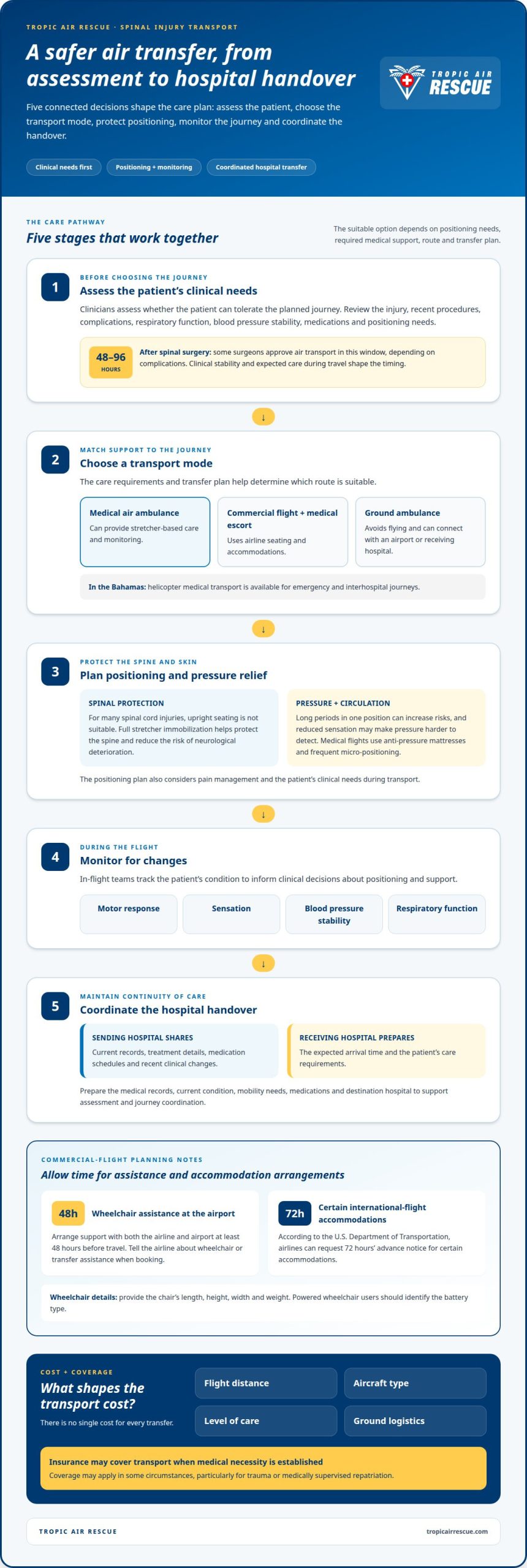
Medical assessment and hospital handover
Before a medical flight, clinicians assess whether the patient can tolerate the planned journey. They review the injury, recent procedures, complications, respiratory function, blood pressure stability, medications, and positioning needs. Some surgeons approve air transport 48-96 hours after spinal surgery, depending on complications. Clinical stability and the expected care during travel shape the timing.
Medical supervision continues throughout transport. The team monitors the patient’s condition and responds to changes. Before departure, the sending hospital should share current records, treatment details, medication schedules and recent clinical changes. The receiving hospital needs the expected arrival time and care requirements to prepare for continuity of treatment.
For certain accommodations on international flights, airlines can request 72 hours’ advance notice, according to the U.S. Department of Transportation. For a journey involving the Bahamas and another country, include accommodation needs in travel planning. Medical records also support assessment and handover, while the patient’s clinical circumstances determine what information is relevant.
Medication planning should account for flight duration and the destination’s local time. Keep medicines in carry-on luggage, clearly labelled and with the prescribed schedule. Crossing time zones can shift dosing times; ask the treating team about any adjustments. For example, a medicine taken at set intervals may need a schedule that accounts for both departure and local time.
Toileting also requires advance planning. Most aircraft toilets aren’t fully accessible, so consider the flight schedule, time difference and the passenger’s usual bladder and bowel routines. Discuss practical support with the medical team before departure, especially if the journey crosses time zones.
At handover, communicate the patient’s current condition, medication timing, recent treatment, and any changes during the journey. A written summary helps the receiving team continue care without relying only on verbal updates. In the Bahamas, clear coordination between the sending and receiving hospitals supports an organized interhospital transfer.
Air ambulance cost factors and insurance
In the Bahamas, the cost of a medical flight reflects the aircraft, clinical care and logistics required for the journey. Understanding these factors helps families prepare the medical and insurance information needed for planning.
Air Ambulance Cost Factors
Air ambulance costs are shaped by flight distance, aircraft type, level of care and ground logistics. Each factor affects the resources needed to transport a patient from the departure point to the receiving facility. A spinal injury requiring stretcher care and monitoring has different operational needs from a transfer requiring less support. The cost depends on the case and is provided after a quote request.
Distance influences flight planning, while the patient’s condition informs the level of care and equipment required. Ground logistics include coordinating access and transfers at both ends. For example, a ground ambulance may connect the patient with the aircraft or receiving hospital. A complete plan considers every leg, not just time in the air.
Insurance Coverage
Health insurance may cover transport when medical necessity is established. This is particularly relevant in trauma cases or medically supervised repatriation. Insurers assess whether the medical circumstances support air transport and whether the planned care matches the patient’s needs. The urgency or convenience of a flight alone does not establish medical necessity.
Prepare the clinical records, the treating team’s explanation of why air transport is needed, the transfer destination and the proposed level of care. These details help support an insurer’s review. Keep the transport plan consistent with the documented medical need, including why standard travel would not meet the patient’s requirements. Coverage decisions depend on the policy and circumstances.
For a prepared cost discussion, organize the route, medical summary, required level of care, and ground transfer details before requesting a quote. These specifics connect the clinical need to the aircraft and logistics required for the journey. Discuss medical air transport planning with the relevant coordination team.
Tropic Air Rescue: Short-term Membership
Tropic Air Rescue offers Short-term Membership for people who need access to its helicopter medical transport services. For a spinal cord injury patient moving between hospitals in the Bahamas, Interhospital Transfer Services can support the transfer as part of a coordinated medical journey.
Membership is required, and Tropic Air Rescue bills health insurers directly, so members incur no out-of-pocket costs. The medical team and receiving hospital remain central to planning the patient’s care, records, and handover. For ongoing needs, Annual Membership is another available option.
If an interhospital transfer is being considered, contact Tropic Air Rescue to discuss the next step. You can also visit tropicairrescue.com.
Plan the next move with confidence
The next step is to align the transfer decision with the patient’s current care plan and the receiving facility. A conversation with Tropic Air Rescue can help clarify the information needed for a transfer request and how the family can prepare for a change in care setting. A clear point of contact helps keep decisions organized.
For people planning ahead, Tropic Air Rescue offers Annual Membership. Its Short-term Membership may suit a different planning need, while Interhospital Transfer Services address medical journeys between hospitals. The right starting point depends on the patient’s circumstances and the transfer being considered.
Air transport for spinal cord injuries involves more than reaching a destination; it connects medical care across locations. For a practical discussion of the next step, contact Tropic Air Rescue. With the right people coordinating the plan, families can move forward with greater clarity.
Frequently Asked Questions
When is air ambulance transport medically necessary after a spinal cord injury?
Air transport may be medically necessary when a patient needs monitored, stretcher-based transport that ordinary travel cannot support. A serious trauma transfer or medically supervised repatriation can involve clinical needs beyond travel assistance. The treating team considers the patient’s stability, spinal protection, care needs during the journey and the receiving facility’s ability to continue treatment. Medical necessity also matters when an insurer assesses coverage.
How are patients with spinal cord injuries prepared for air transport?
Preparation starts with matching the transport plan to the patient’s current condition and care needs. The medical team reviews relevant records and identifies changes in movement, sensation or breathing that need attention during the journey. The sending facility should also coordinate with the receiving hospital, so staff are ready to continue care when the patient arrives.
What medical equipment and staffing are needed during air transport for spinal cord injuries?
Equipment depends on the patient’s clinical needs, but spinal protection may require a stretcher and full immobilization. Monitoring and life-support equipment support care during the flight. The medical crew must be suited to the level of care required; Tropic Air Rescue describes its crew as including a pilot and critical-care paramedic. The patient’s medical team determines the specific care plan.
What are the risks of flying with a spinal cord injury, including pressure sores and autonomic dysreflexia?
Risks can include pressure sores, circulation problems, pain and respiratory concerns, especially during prolonged positioning. Discuss autonomic dysreflexia with the treating team if it is relevant to the person’s injury or medical history. Share known triggers and the patient’s response plan with the transport team. Positioning, pressure relief and monitoring should reflect the individual’s needs.
How much does air ambulance transport for a spinal cord injury cost?
The cost depends on the case and is provided after a quote request. Key factors include flight distance, aircraft type, the level of care required and ground logistics. For example, the route and coordination between facilities affect the plan. A useful cost discussion starts with the patient’s medical requirements and the full journey, including ground connections.
Does health insurance cover air ambulance transport for spinal cord injuries?
Health insurance may cover transport when medical necessity is established, particularly for trauma or medically supervised repatriation. Coverage depends on the policy and circumstances. Tropic Air Rescue membership is not an insurance policy or secondary insurance coverage. Ask the insurer and transport provider to clarify coverage and any costs that may remain your responsibility. Review the policy’s transport provisions alongside the medical justification for the journey.