

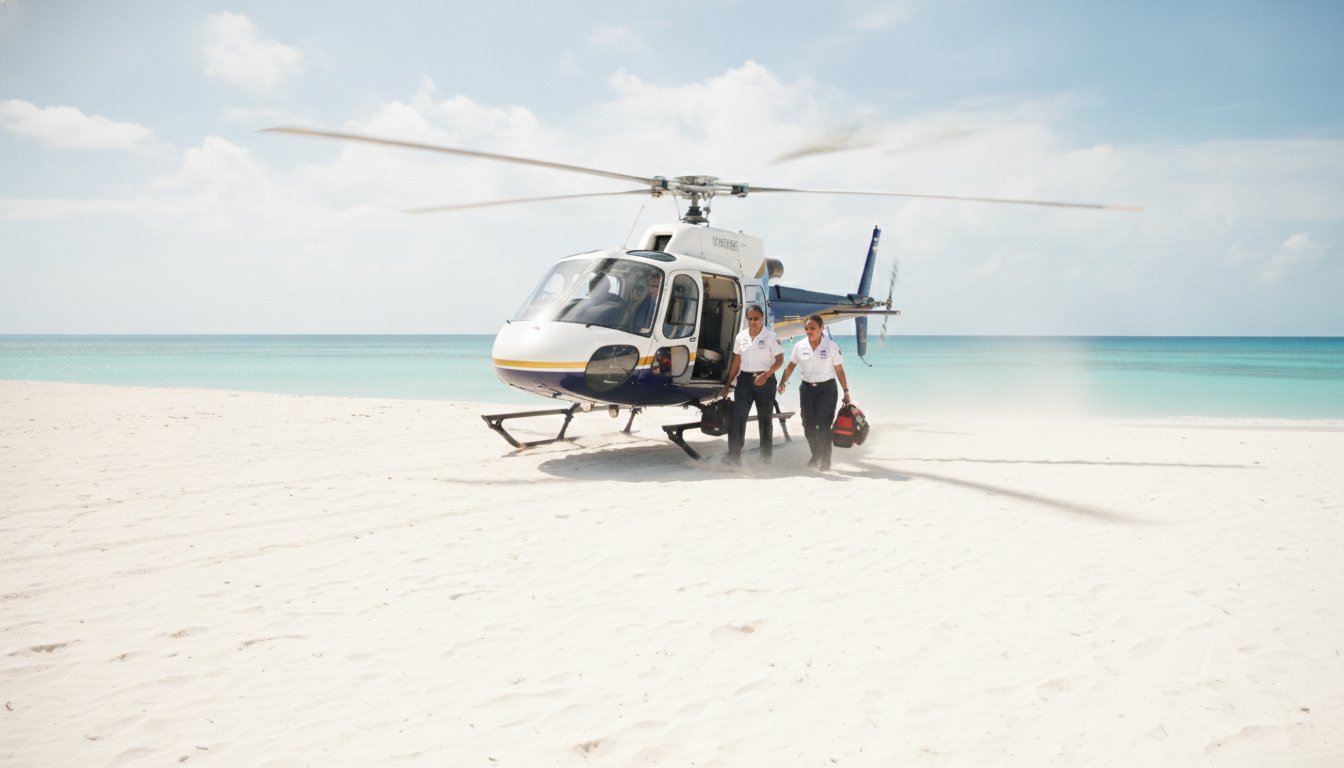
Imagine you’re on a remote beach in the Exumas when a sudden chest pain or a severe injury occurs. Do you know what to do in a medical emergency in the Bahamas? While the scenery is world-class, the medical infrastructure on the Out Islands is often limited to basic clinics that cannot manage critical trauma. You’re likely hours away from a specialized hospital, and standard US health insurance is rarely accepted for upfront payment. Waiting for a fixed-wing plane to locate a functional runway can cost you more than just money. It can cost you vital recovery time.
It’s natural to feel a sense of anxiety when considering the logistics of a remote evacuation or the potential for a $30,000 air ambulance bill. This guide provides the definitive protocol for navigating the Bahamian healthcare system with professional precision. You’ll learn how to distinguish between local stabilization and the necessity of US-level trauma care. We also detail a strategic membership solution that secures rapid helicopter transport directly to Florida centers with no out-of-pocket costs. From dialing the correct emergency digits to executing a seamless medevac, this is your blueprint for safety in the tropics.
Key Takeaways
- Dial 919 or 911 immediately and secure precise GPS coordinates to facilitate an accurate emergency response in remote island locations.
- Establish a definitive protocol for what to do in a medical emergency in the Bahamas to ensure a seamless transition from local stabilization to specialized care.
- Bypass the geographical constraints of the Out Islands with helicopter medevac capabilities that can land at private yachts and remote resorts.
- Secure a financial and medical safety net with membership options that provide direct insurance billing and eliminate high out-of-pocket evacuation costs.
- Understand the critical logistical differences between local Bahamian clinics and the advanced life-support capabilities available at Florida trauma centers.
Immediate Actions: Navigating a Medical Emergency in the Bahamas
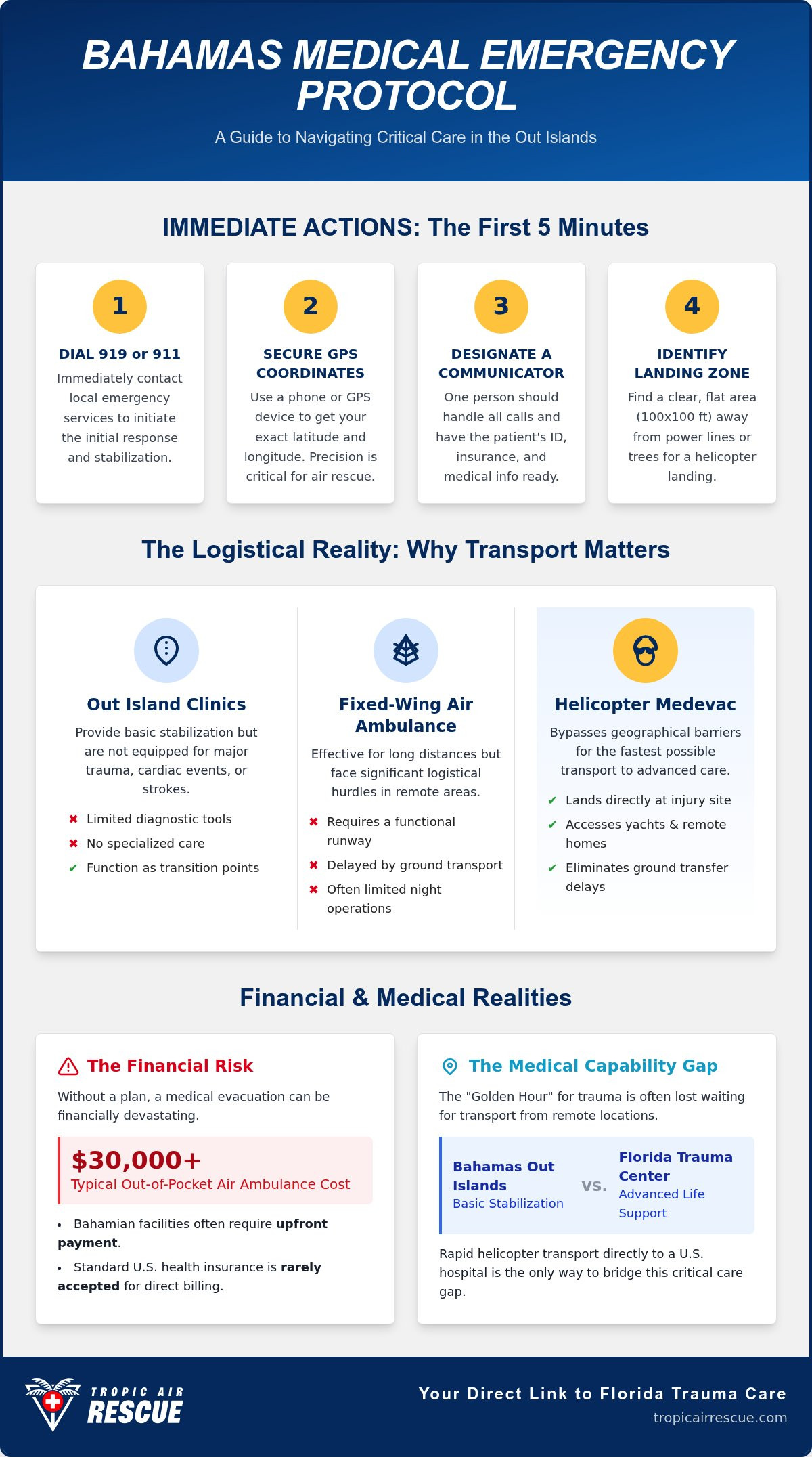
Speed is the primary factor in medical survival. If you are wondering what to do in a medical emergency in the Bahamas, your first action must be decisive and focused. Dial 919 or 911 immediately to activate local emergency services. While the local response provides a baseline for initial stabilization, it’s often a preliminary step in a more complex logistical chain. You must simultaneously secure your precise GPS coordinates. In island geography, vague descriptions delay rescue and can lead to catastrophic outcomes. Professional composure during these first few minutes is essential for the safety of the patient.
Initial Triage and Local Response
The healthcare system in the Bahamas relies on a network of government clinics and private facilities. On the Out Islands, these clinics focus on basic stabilization rather than definitive treatment for major trauma, strokes, or cardiac events. Understanding what to do in a medical emergency in the Bahamas means recognizing that local clinics are transition points, not final destinations. Don’t expect a local island clinic to have the same diagnostic capabilities as a US Level 1 trauma center. The objective is to keep the patient stable enough for immediate transit.
Communicate clearly with local first responders and provide a clinical summary of the patient’s status. Designate one person in your group to handle all medical records and outgoing communications. This individual should gather the patient’s identification, insurance cards, and a list of current medications. Having this data ready for the flight crew reduces the on-ground time significantly. Local responders will focus on airway management and circulation, but your secondary call to a private medevac service initiates the flight plan while the local team works on stabilization. This parallel processing is the professional standard for remote survival.
The Importance of Accurate Location Data
Precision saves lives. A pilot cannot find you based on a description like “the blue villa near the beach” or “the white yacht in the bay.” Use a smartphone app or a dedicated GPS device to pull exact latitude and longitude coordinates. This data is the most valuable information you can provide to an air rescue team. Identifying potential landing zones near your current position is equally critical. Look for flat, clear areas at least 100 feet by 100 feet that are free of power lines, tall trees, or loose debris.
Tropic Air Rescue helicopters are specifically designed to land at remote resorts, private homes, and even on the decks of large vessels. This capability eliminates the need for a ground ambulance transfer to a distant airstrip, which is often the slowest link in the survival chain. Providing high-resolution location data allows the flight crew to execute a direct approach, bypassing the logistical hurdles that often plague fixed-wing transport. When every minute counts, geographical precision is your most effective tool.
Bahamas Medical Infrastructure: Why Transport Logistics Matter
Geography is the ultimate arbiter of survival in the Caribbean. While Nassau and Freeport offer reliable primary care, the vast distances between the 700 islands create a logistical vacuum. If you are planning what to do in a medical emergency in the Bahamas, you must recognize that local facilities often function as stabilization points rather than definitive care centers. The “Golden Hour,” the critical window for trauma intervention, is frequently lost to slow boat transfers or ground ambulance transit through Nassau’s traffic. Speed is not a luxury; it’s a physiological requirement.
Fixed-wing aircraft serve a purpose for long-haul transport, but they are tethered to functional, lit runways. Many Out Islands lack the infrastructure for night operations or immediate departures. Helicopter medevac assets bypass these constraints by landing directly at the point of injury. This capability is essential for those staying at remote island rentals or private vessels where airport access is miles away.
Public vs. Private Care Facilities
Princess Margaret Hospital serves as the primary public facility, while Doctors Hospital provides private emergency care. U.S. Embassy guidance on medical emergencies notes that Bahamian facilities rarely accept U.S. health insurance and often require upfront payment. For instance, some private emergency rooms require a $500 deposit upon entry for certain membership levels. When a medical crisis exceeds local capacity, the trigger for international transfer must be pulled instantly. Logistical coordination includes clearing customs mid-flight, ensuring the patient moves directly from the aircraft to a Florida trauma bay without administrative delay.
The Critical Role of Helicopter Medevac
Helicopters provide a concierge, direct-to-bedside solution. They land at remote resorts, private villas, and even on the decks of yachts. This eliminates the inefficient double-transfer process where a patient is moved from a vessel to a ground ambulance before finally reaching an airstrip. Every aircraft in the fleet carries Advanced Life Support (ALS) equipment, maintaining ICU-level care throughout the flight. For travelers who value meticulous preparedness, securing a concierge medical safety net ensures that geography never dictates the outcome of a crisis. This specialized approach ensures that high-acuity patients receive US-level trauma care within the shortest possible timeframe.
Medevac Economics: Insurance, Costs, and Membership
Financial logistics often dictate the speed of rescue. In a crisis, the immediate barrier to care is rarely the availability of aircraft; it’s the method of payment. Without a pre-arranged plan, patients face a “pay-to-fly” scenario where transport remains grounded until a credit card is authorized or a wire transfer is confirmed. Standard air ambulance costs for a flight from the Bahamas to Florida typically exceed $30,000. In high-acuity cases or complex logistical scenarios, these costs can escalate rapidly. A 2025 review of Caribbean medical claims found that 10% of evacuation bills exceeded $90,000, with some extreme cases reaching far higher.
Understanding what to do in a medical emergency in the Bahamas requires a clear financial strategy. Many travelers rely on standard travel insurance, but these policies often operate on a reimbursement model. This means you must pay the five-figure sum upfront and petition the insurance company for repayment weeks or months later. This administrative burden adds unnecessary stress to an already high-stakes situation. Proactive travelers secure a membership that removes these financial hurdles entirely.
Reimbursement vs. Direct Billing
Most emergency transport providers require full payment before takeoff. This requirement can delay life-saving care by hours as families scramble to secure funds. U.S. Embassy guidance on medical emergencies confirms that Bahamian facilities and transport services rarely accept U.S. health insurance directly. This creates a dangerous gap in coverage for the unprepared traveler.
Tropic Air Rescue operates on a concierge membership model designed to eliminate this friction. For members, the service bills the health insurance provider directly and accepts their reimbursement as full payment. This “No Out-of-Pocket” benefit ensures that the focus remains on clinical excellence and rapid transit rather than financial negotiations. It transforms a complex international medical claim into a managed, professional service.
Membership Tiers for Different Travelers
Security should be tailored to your specific travel profile. A one-size-fits-all approach fails to account for the different ways people experience the Bahamas. Membership options are structured to provide elite protection for every type of visitor:
- Short-term Membership: Ideal for vacationers, yacht guests, and seasonal visitors who require a temporary safety net during a specific trip.
- Annual Membership: Designed for residents, frequent second-home owners, and regular boaters who spend significant time in the islands throughout the year.
- B2B Membership Plans: Specialized solutions for remote resorts, charter companies, and private clubs that want to provide their clients with a professional medical extraction protocol.
By selecting the appropriate tier, you ensure that a medical crisis does not become a financial disaster. These plans provide a disciplined, “always ready” response that prioritizes your health over logistical or monetary constraints.
Out Island Survival Guide: Remote Emergencies
Isolation defines the Out Island experience. Whether you are anchored in the Exumas or staying at a private estate in Eleuthera, you are physically separated from advanced medical care by miles of open water. Knowing what to do in a medical emergency in the Bahamas requires more than just dialing a number; it demands a pre-verified extraction plan. Meticulous preparation is the only way to ensure that your location does not become a barrier to survival. It’s the difference between a managed recovery and a logistical catastrophe.
Before arrival, conduct a medical briefing for your entire party. Identify the nearest clearing or helipad. Relying on local cellular networks is a common error. Infrastructure in remote areas can be inconsistent. Maintain communication redundancy with a satellite phone or a high-gain Wi-Fi system. These tools ensure that you can reach your medevac provider instantly without searching for a signal. Membership is the prerequisite for this “concierge” level response speed. It ensures your medical profile and precise location are already in the system.
Remote Location Landing Protocols
Preparing a site for a helicopter landing is a critical skill. Clear the area of all loose debris, including lawn furniture, umbrellas, or light equipment that could be displaced by rotor wash. If the emergency occurs at night, use vehicle headlights or high-intensity flashlights to mark the four corners of the landing zone. Don’t point lights directly at the pilot. This allows the flight crew to maintain night vision during the final approach.
For those on private vessels, yacht-to-Florida protocols are even more specialized. Ensure your crew knows how to clear the aft deck or coordinate with the pilot for a winch-based extraction if landing is not possible. Coordination with resort staff is equally vital. They should be briefed on your emergency plan so they can assist in securing the site and directing the flight crew upon arrival. This disciplined approach eliminates on-ground delays.
Medical Documentation and Readiness
Speed depends on information density. Keep digital copies of prescriptions, allergies, and medical histories on a secure cloud drive or a physical USB drive kept in your emergency kit. This kit should also include basic stabilization tools such as trauma shears, tourniquets, and hemostatic dressings. Having these items ready allows for immediate intervention while the aircraft is in transit.
Ensure your medevac provider has your insurance and identification on file before you depart. This allows for immediate flight activation without the delay of data entry during a crisis. A pre-authorized medical repatriation plan is the ultimate safety net for high-end travelers. It guarantees that the logistical and financial hurdles are cleared long before the first symptoms appear. Secure your safety net today by exploring our Annual Membership plans for comprehensive coverage throughout the islands.
Tropic Air Rescue: Your Direct Link to Florida Trauma Care
Tropic Air Rescue provides the definitive operational answer for what to do in a medical emergency in the Bahamas. Our elite helicopter fleet is engineered for the specific demands of Caribbean geography; bypassing the delays inherent in traditional island transport. We don’t just offer a flight. We deliver a comprehensive, concierge-level coordination of aviation and medical logistics. This disciplined approach ensures that a patient moves from a remote yacht deck or a private villa directly into a Florida trauma bay with zero administrative friction. Our “No Out-of-Pocket” guarantee provides the ultimate peace of mind, allowing you to focus entirely on recovery while we manage the financial complexities.
Every mission is executed with professional composure and technical precision. We maintain direct coordination with leading Florida trauma centers, ensuring that the receiving facility is fully briefed and ready for the patient’s arrival. This seamless link between the Out Islands and US-level care is the gold standard for high-end travelers and residents alike. By removing the “pay-to-fly” barrier through our membership model, we ensure that life-saving intervention is never delayed by a credit card authorization.
Advanced Life Support (ALS) in the Air
Clinical excellence is the core of our operation. Every aircraft is equipped with hospital-grade Advanced Life Support (ALS) technology, effectively turning the cabin into a mobile intensive care unit. Our onboard medical teams are trained to manage high-acuity cases, including cardiac events, strokes, and severe trauma. This capability is essential for maintaining the “Golden Hour” of treatment during the transit to Florida. Beyond emergency evacuations, we provide specialized Interhospital Transfer Services and Organ Transport, utilizing the same level of logistical precision required for high-stakes medical crises.
Securing Your Membership Today
Don’t leave your safety to chance or rely on the limited resources of local clinics. Secure a private, elite partner that values meticulous preparedness and proactive service. Whether you require a Short-term Membership for a single excursion or an Annual Membership for year-round protection, our team is always ready. Sign up today to ensure that your link to Florida trauma care is guaranteed before you ever leave the dock.
Secure Your Global Standard of Care
Survival in the islands is a matter of logistical precision. You’ve learned that local stabilization is only the first step and that geography often dictates the outcome of a crisis. By understanding what to do in a medical emergency in the Bahamas, you shift from reactive fear to proactive readiness. The combination of accurate GPS data, immediate triage, and a pre-verified extraction plan ensures you aren’t stranded when minutes count. This disciplined approach is the only way to guarantee a seamless transition to definitive care.
Our specialized helicopter fleet is engineered for remote Out Island landings, providing a direct link to top-tier Florida trauma centers. We handle the administrative burden through direct billing to major health insurers; this removes the financial stress from an already intense situation. Don’t leave your island safety to chance. Secure your Bahamas Medevac Membership today and gain the peace of mind that comes with elite, concierge-level protection. Your next adventure deserves a professional safety net that is always ready to respond.
Frequently Asked Questions
What is the primary emergency number in the Bahamas?
The primary emergency number in the Bahamas is 919. While this is the official local number, North American tourists can also dial 911 to reach emergency dispatchers. Activating these services is the first step in determining what to do in a medical emergency in the Bahamas. You should be prepared to provide precise GPS coordinates immediately, as local dispatchers may not be familiar with remote island landmarks or private villa names.
Will my US health insurance cover a medevac flight from the Bahamas?
Most US health insurance plans do not provide upfront payment for international medical evacuations. They typically function on a reimbursement basis, meaning you must pay the full cost of the flight out-of-pocket before the aircraft departs. Tropic Air Rescue members bypass this financial hurdle. We utilize a direct insurance billing model that accepts your insurance reimbursement as full payment, eliminating the need for a five-figure upfront expenditure during a crisis.
Can an air ambulance land at a remote resort without an airport?
Yes, our specialized helicopters are designed to land at remote resorts, private villas, and even on the decks of yachts. This capability is a significant advantage over fixed-wing aircraft, which are tethered to functional and lit runways. Point-to-point helicopter transport allows for a direct extraction from your specific location. This eliminates the dangerous delays associated with moving a critically ill patient via ground ambulance or boat to a distant airstrip.
What is the difference between fixed-wing and helicopter medical flights?
Fixed-wing aircraft are essentially flying ambulances that require a runway for takeoff and landing. They are ideal for long-distance repatriation but often require a slow ground transfer from the patient’s location to the airport. Helicopters provide direct, point-to-point response. They can land at the scene of an injury or a remote clinic, bypassing the logistical bottleneck of airport infrastructure. This makes helicopters the superior choice for time-sensitive emergencies in the Out Islands.
How long does it take to get a medical flight to Florida?
The total transit time depends on your specific island location, but helicopter transport is the fastest method for reaching Florida from the Bahamas. By landing directly at your resort or vessel, we eliminate the hours typically lost to ground transport and airport logistics. Our flight crews prioritize the “Golden Hour,” ensuring that trauma, stroke, or cardiac patients receive US-level care in the shortest possible timeframe. Professional coordination ensures a seamless transition to the receiving facility.
Do I need a membership to use Tropic Air Rescue services?
Membership is required to secure our concierge-level benefits and the “No Out-of-Pocket” guarantee. While we maintain a state of constant readiness, our membership plans are designed to pre-verify your medical and insurance data. This preparation allows for immediate flight activation without the administrative delays that often plague non-members. Securing a plan before you travel is the most disciplined way to manage what to do in a medical emergency in the Bahamas.
What happens if I have a medical emergency on a yacht in the Bahamas?
Yacht owners and guests benefit from specialized maritime extraction protocols. Our helicopters can land directly on suitable aft decks or coordinate with your crew for a rapid transfer from the vessel. This service is specifically designed for the unique geography of the Exumas and other remote chains. It provides a direct link to Florida trauma centers, ensuring that you never have to wait for a slow return to port or a ground ambulance transfer.
Are there specialized flights for organ transport in the region?
Yes, we provide professional Organ Transport services and Interhospital Transfer Services throughout the Bahamas and Florida. These missions require the same level of technical precision and speed as our emergency medevac operations. We utilize our elite fleet and specialized medical equipment to ensure that time-sensitive medical payloads are moved with absolute efficiency. Our team manages every logistical detail, maintaining a disciplined chain of custody from the donor facility to the receiving surgical team.