

The limitations of the Bahamas healthcare system matter most when care goes beyond primary services. NHI Bahamas provides enrolled residents with primary care at no cost at the point of service, but it does not cover emergency care, inpatient stays, specialist services or psychotherapy. For urgent or complex needs, access may also depend on your location in the archipelago and the care available nearby. Mental-health support is part of this access picture, not a separate concern.
It is reasonable to look beyond whether care is available and ask how quickly you can reach it, what you may have to pay and whether your needs are covered. These practical differences can shape decisions for residents, visitors and families preparing for a medical emergency.
This guide explains how healthcare costs and public-hospital access compare with your needs, what to expect when specialist or emergency care is required, and where gaps in mental-health coverage may matter. It also explains how island geography can affect access, helping you understand the system’s constraints before care becomes urgent.
Key Takeaways
- Separate NHI Bahamas primary-care benefits from hospital, emergency and specialist costs to understand where additional coverage may matter.
- Consider how island location and the availability of local services can affect access to public hospitals and specialist care.
- Understand what mental-health support falls outside NHI Bahamas coverage and how that may shape care planning.
- Learn when interhospital transfer support may be relevant if a patient needs care beyond what is accessible locally.
Health care costs compared with the United States
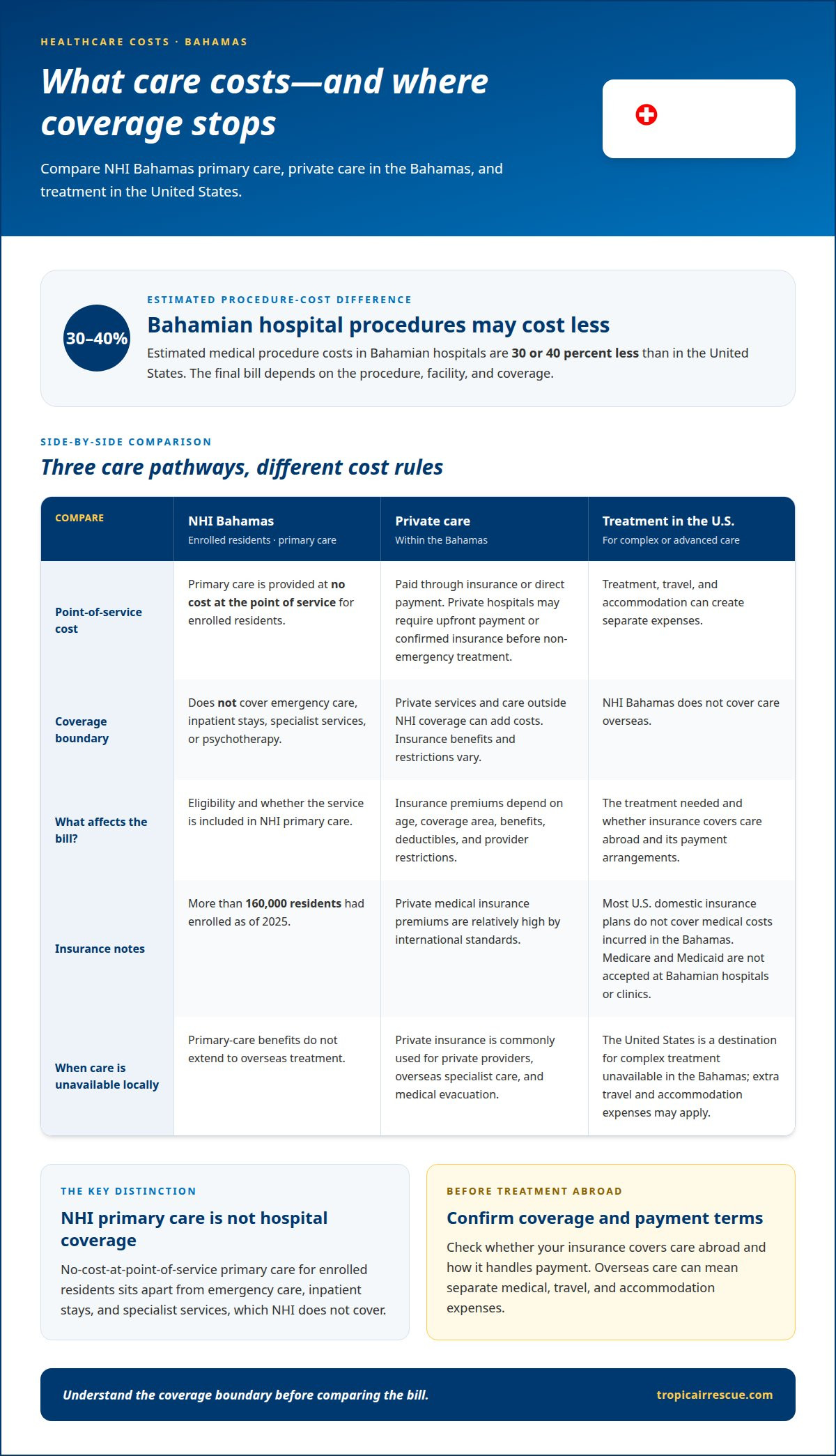
The cost comparison depends on the service, insurance and whether treatment is local or overseas. In the Bahamas, enrolled residents receive NHI Bahamas primary care at no cost at the point of service, and more than 160,000 residents had enrolled as of 2025, according to NHI Bahamas. Private care and services outside NHI coverage can create additional costs.
Public healthcare provides covered primary-care services, while private care is paid for through insurance or direct payment. Private medical insurance premiums are relatively high by international standards, and costs depend on age, coverage area, benefits, deductibles and provider restrictions.
Compared with the United States, estimated medical procedure costs in Bahamian hospitals are 30 or 40 percent less. That comparison does not mean every treatment costs less locally: the final bill depends on the procedure, facility and coverage. Across Caribbean countries, healthcare costs and coverage vary, so comparing covered services and private premiums is more useful than relying on a single regional ranking.
For complex or advanced treatment unavailable in the Bahamas, the United States is a destination. Overseas treatment can involve separate medical, travel and accommodation expenses. NHI Bahamas does not cover care overseas, and most U.S. domestic insurance plans do not cover medical costs incurred in the Bahamas. If you are seeking treatment in the United States, check whether your insurance covers care abroad and how it handles payment. Medicare and Medicaid are not accepted at Bahamian hospitals or clinics.
Before travelling for treatment, establish the destination, the expected care and the coverage terms. Private hospitals in the Bahamas may require upfront payment or confirmed insurance before non-emergency treatment. This differs from NHI primary care and helps explain why the limitations of the Bahamas healthcare system include both coverage boundaries and the cost of accessing care beyond them.
Public hospital limitations and wait times
The Bahamas combines publicly funded care with private health services, but access varies across the islands. Hospital wait times depend on urgency, available services and where care is needed.
Access Across the Islands
Access across the islands means the facilities and service schedules available in each location. Nassau has Princess Margaret Hospital, the country’s largest hospital, while Grand Bahama has different local options, including a Doctors Hospital facility opened in 2025. On the Family Islands, smaller clinics may open only one or two days a week. That makes location relevant when planning routine visits or reaching hospital care; travel between islands can add a practical access constraint.
Funding and Organization
The Ministry of Health and Wellness manages the public healthcare system through the Public Hospitals Authority. Government-funded services operate alongside private care. Legal residents are eligible for full public healthcare benefits, without limitations based on economic or health status. This mixed structure matters because private care can offer faster access and a broader choice of providers. Health insurance can help cover private services, while public facilities remain a central route to essential care.
Facilities and Healthcare Workforce
The Bahamas has three government hospitals and two private hospitals, Doctors Hospital and Lyford Cay. Its network also includes 55 health centers and 59 satellite clinics, alongside 288 privately owned health institutions. On the main inhabited islands, the network includes 28 health centers, 33 main clinics and 35 satellite clinics. The country has 1.85 physicians per 1,000 people. These figures describe a broad facility network, but they don’t mean every service is available on every island.
Waits can differ between emergency assessment, routine appointments and specialist care. A patient’s urgency, the type of service required and local facility capacity shape the route through public hospitals. For patients who need movement between hospitals, interhospital transfer services can support that transition when local access or treatment needs require it.
What Happens If You Need Specialist or Emergency Care?
NHI Bahamas supports primary care for eligible residents, but does not cover every urgent or advanced service. Your location on the islands and the level of care you need can shape the next step.
Limits on Specialist and Advanced Care
Specialist and advanced care may be limited locally because the Bahamas’ small population and archipelagic geography constrain the availability of some subspecialists and treatments. NHI Bahamas provides enrolled residents with primary care at no cost at the point of service, but specialist services, including dental care and psychotherapy, are not covered. The United States is a destination for complex treatment unavailable in the country. Private health insurance is commonly used for private providers, overseas specialist care and medical evacuation.
Emergency Care and Island Evacuations
For an emergency, call 919 or 911 for ambulance, police and fire services. Princess Margaret Hospital in Nassau handles general and emergency care. NHI Bahamas doesn’t cover emergency care or inpatient hospital stays, so the coverage route differs from primary care. If a patient on another island needs services unavailable locally, access may involve transfer to a facility able to provide that level of care. Insurance may help with medical evacuation, depending on its terms.
Shortages of Medicines, Equipment, and Staff
Access constraints can reflect island geography and limited availability of certain specialist services, rather than a uniform shortage at every facility. The Bahamas National Drug Agency and Central Directorate of Management are responsible for bulk purchases of disposable medical devices. This procurement role matters because equipment supply depends on coordinated purchasing and distribution. Residents and visitors may face challenges when urgent needs require services or advanced treatment that cannot be reached locally.
Maternity care also has coverage limits: NHI Bahamas doesn’t cover child delivery. Princess Margaret Hospital’s Neonatal Intensive Care Unit has 13 beds. These boundaries make the care required, island location and available insurance important factors in planning for specialist, emergency or maternity needs.
Mental-health services
Mental-health access in the Bahamas depends partly on whether someone needs primary care or specialist support. For residents, national health insurance covers primary care, but psychotherapy and other specialist services are outside that coverage. This distinction can affect how someone plans and pays for continuing support. The limitations of the Bahamas healthcare system are especially relevant when someone needs ongoing therapy rather than a primary-care appointment.
NHI Bahamas does not cover psychotherapy, so enrollment alone does not provide a payment route for therapy sessions. Someone seeking psychotherapy may need to consider private care and any applicable private health insurance. Coverage depends on the policy’s benefits and provider-access terms, so it is important to distinguish public primary care from specialist support before treatment begins. Understanding these boundaries can help residents identify the care pathway that applies to their needs.
Mental-health needs can involve different levels of support. A primary-care visit and psychotherapy are not interchangeable: one may fall within NHI’s primary-care scope, while the other is a specialist service excluded from its coverage. This is a central limitation for residents relying on national health insurance. Private hospitals form part of the country’s healthcare sector, but their presence alone does not establish which mental-health services a person can access.
Island geography adds another consideration. Access to a particular service depends on location and the local availability of the required care. For someone travelling between islands or seeking treatment beyond their community, distance can affect the practical route to care. Understanding the limitations of the Bahamas healthcare system means distinguishing coverage rules from local service availability, then considering both when planning continued support.
If a mental-health crisis requires hospital-level care and a transfer between hospitals is needed, explore interhospital transfer support as part of the transport plan.
Tropic Air Rescue
Tropic Air Rescue provides helicopter air-medical transport for emergencies and interhospital transfers throughout the Bahamas. When a patient needs urgent transport or a hospital transfer, its Interhospital Transfer Services can help bridge the gap between local access and required care. The company also provides Organ Transport.
Membership is required. Short-term Membership and Annual Membership offer ways to arrange membership, and Tropic Air Rescue bills health insurers directly, so members incur no out-of-pocket costs. The service can be relevant when island geography or the care available locally makes medical transport part of the plan.
For membership and medical transport details, contact Tropic Air Rescue.
Plan for the Care You May Need
Make your healthcare arrangements before an urgent decision is required. Consider where you will be, how you would communicate a change in medical needs, and who should coordinate essential information. A clear plan can reduce confusion when care involves several locations or a transfer between facilities.
Understanding the limitations of the Bahamas healthcare system does not mean expecting the same route for every patient. It means recognizing that access, coverage and transport needs differ, then identifying the support that fits your circumstances. If medical transport becomes part of your plan, Tropic Air Rescue can discuss membership options and interhospital transfer support.
Take the next step at your pace. Contact Tropic Air Rescue to discuss how its services may fit your medical transport planning. With a considered plan in place, you can approach care decisions with greater clarity and focus.
Frequently Asked Questions
What Is NHI Bahamas, and Does It Cover Expats?
NHI Bahamas is the national health programme that provides covered primary-care services to enrolled residents. Eligibility is based on legal residency, not simply on being an expatriate or visitor. If you live in the Bahamas, distinguish legal resident status from a temporary stay when considering eligibility. NHI coverage also has defined limits, so enrollment does not mean every hospital, specialist or overseas service is covered.
What Are the Main Limitations of Healthcare Services in The Bahamas?
The main constraints are uneven access across the islands, limited availability of some advanced care, and gaps between primary-care coverage and hospital or specialist needs. For example, someone may have access to primary care but need a separate plan for specialist treatment. The practical task is to match the required service, location and coverage route, rather than assume one arrangement covers every medical need.
What Medical Specialties, Treatments, and Diagnostic Services Are Unavailable or Limited Locally?
Some subspecialist services and advanced treatments have limited local availability, but that does not mean every such service is absent throughout the country. Availability depends on the treatment and location. Psychotherapy and dental specialist services are outside NHI Bahamas coverage, which is different from being unavailable locally. For complex care, the key question is whether treatment can be accessed locally or requires overseas care.
How Long Are Public Healthcare Waiting Times in The Bahamas?
There is no single wait time across public healthcare in the Bahamas. Timing depends on the urgency of the case, the service required, facility capacity and local specialist access. Emergency assessment and a routine appointment follow different pathways. Island location can also affect timing, especially when the required service is not available nearby and care involves travel or referral.
Does The Bahamas Have Universal Health Insurance or National Health Coverage, and Who Qualifies?
The Bahamas has national health coverage through NHI Bahamas, but it should not be treated as comprehensive coverage for every service. Legal residents are eligible for full healthcare benefits, and enrolled residents receive covered primary care. Eligibility does not remove service exclusions: emergency care, inpatient stays and specialist treatment fall outside NHI coverage. The key distinction is between qualifying for the programme and the services it covers.