

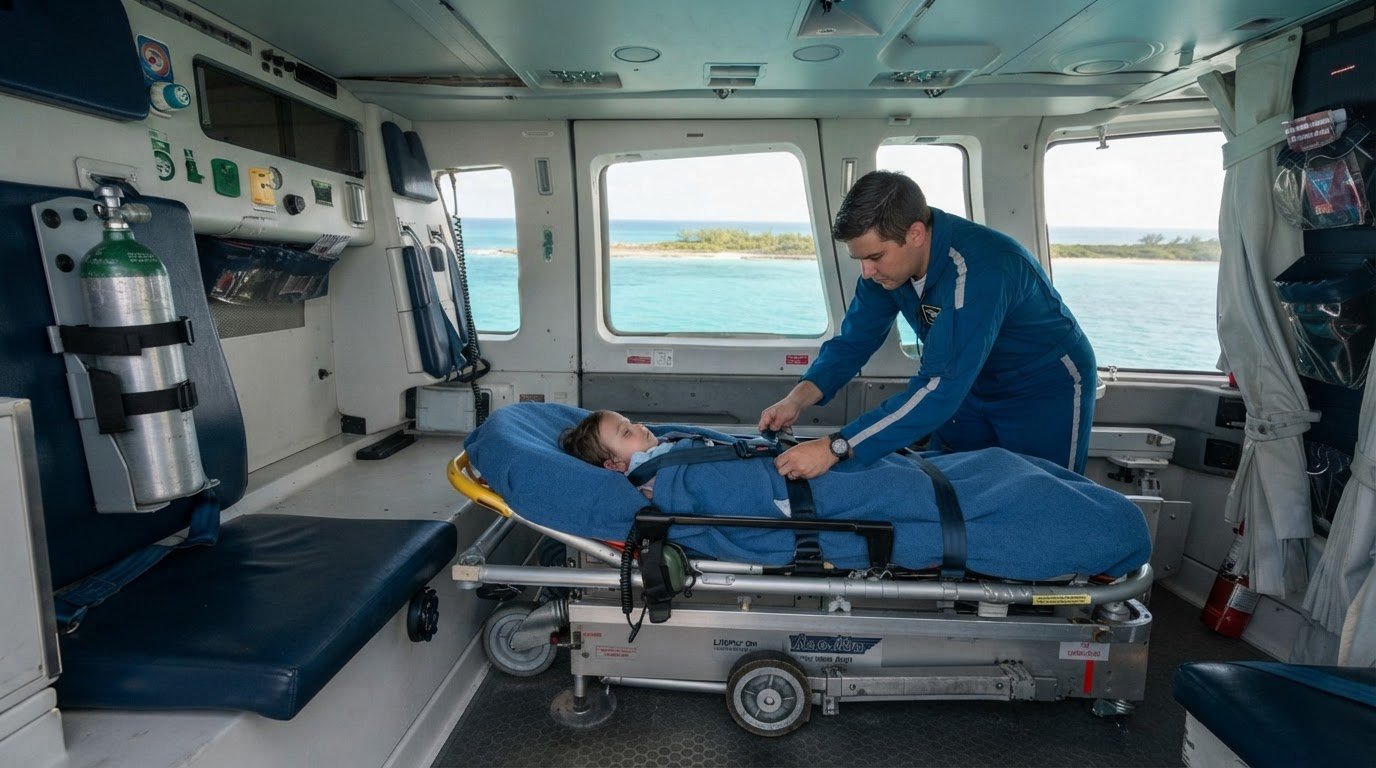
In Nassau, an aircraft and medical crew can typically be en route within 2 to 6 hours of mission confirmation, according to EMS. That is a dispatch milestone, not a completed transfer. A family medevac membership in the Bahamas is one part of planning for the costs and coordination an emergency evacuation can involve.
Families are right to look beyond the membership fee. Eligibility rules determine who qualifies, while travel insurance may cover different expenses under separate limits. The practical question is how these arrangements work together before an emergency, and what happens if a patient needs an inter-island transfer or onward care.
This guide explains family eligibility, short-term and annual membership options, travel insurance, and key cost considerations in the Bahamas. It also clarifies what membership does and does not replace, helping you assess your household’s travel and medical needs before deciding.
Key Takeaways
- Understand how transfer distance, medical needs, and coordination can affect international evacuation costs, and where advance planning may help manage them.
- Review who a membership covers and how family eligibility can shape the protection available to each traveler.
- Separate evacuation membership from travel insurance by examining the role and limits each may have in a medical emergency.
- Compare short-term and annual membership options against your travel pattern, then consider which arrangement fits your household’s needs.
Options for reducing international medical flight costs
In the Bahamas, the cost of an international medical flight depends on the destination, distance, clinical needs, and coordination required. Planning also means understanding insurance terms and the steps involved in a safe transfer.
Destination and Distance Conditions
Destination and distance affect flight planning, aircraft requirements, and the ground transport needed at each end. Miami is approximately 320 kilometres northwest of Nassau, and a medical jet flight there or to Fort Lauderdale typically takes 45 to 75 minutes. A European transfer takes approximately 9-11 hours with a fuel stop. Longer routes require more flight time and coordination.
The Bahamas spans more than 700 islands, so reaching Nassau or another departure point may require a separate ambulance transfer. A patient’s condition and medical necessity also shape the plan: the receiving hospital must accept the patient before an air ambulance arrives. That coordination helps align the flight, clinical team, and ground transport.
Insurance Reimbursement and Travel Medical Coverage
Travel medical insurance and evacuation benefits may help with eligible expenses, but coverage depends on policy limits, exclusions, and authorization terms. Some plans require approval before transport; reimbursement may also require medical records, itemized bills, and proof of medical necessity. Check the benefit limit, especially when an international mission involves both air and ground transfers.
Keep policy details accessible with the patient’s identification and emergency contacts. Ask the insurer about pre-authorization, direct payment, and required claim documents. Membership and travel insurance are separate arrangements, so do not assume either replaces the other.
In an emergency, seek immediate local medical care. The treating team can then share the patient’s condition and records with the transport coordinator. Coordination brings together clinical staff, flight logistics, ground ambulance transfers, and acceptance by the receiving facility. This helps shape a medically appropriate plan rather than treating flight booking as the only step.
Exclusions, waiting periods, and pre-existing-condition rules are set by the relevant policy or membership terms. Those terms determine whether a condition, trip, or requested transport qualifies. A membership does not guarantee admission to a hospital or clinic: the receiving facility must agree to accept the patient before the air ambulance arrives.
Family membership eligibility
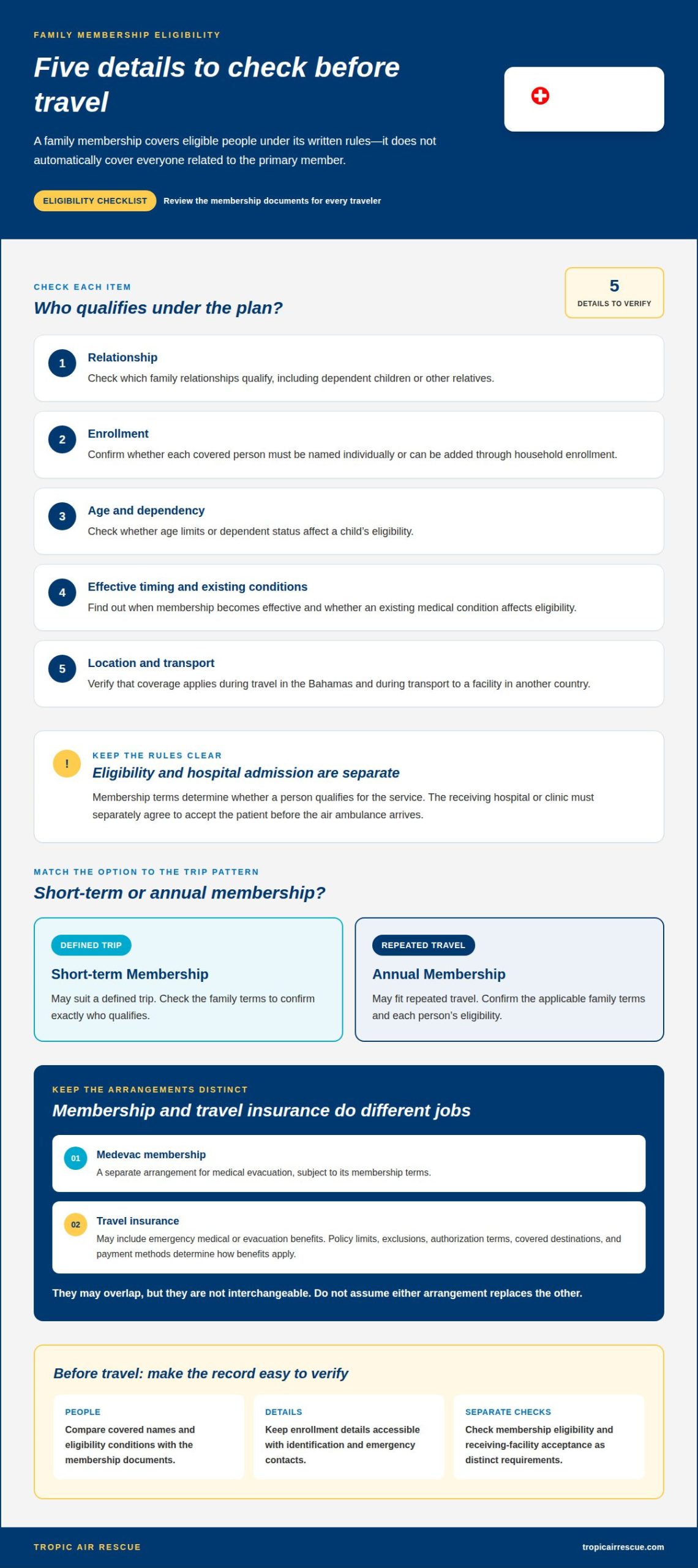
A family membership covers eligible people under its written rules. It does not automatically cover everyone related to the primary member. In the Bahamas, check the membership’s definition of family, each person’s enrollment status, and the coverage effective date.
Review how the plan treats spouses, children, adult dependents, and relatives living at another address. For example, a child traveling with one parent may need to be enrolled separately from a spouse staying at home. A family medevac membership in the Bahamas should clearly identify covered people, so the emergency team can match the patient to the membership record.
Before travel, compare the names and eligibility conditions in the membership documents. Focus on:
- Relationship: Which family relationships qualify, including dependent children or other relatives.
- Enrollment: Whether each covered person must be named individually or added through a household enrollment.
- Age and dependency: Whether age limits or dependent status affect a child’s eligibility.
- Timing: When membership becomes effective and whether an existing medical condition affects eligibility.
- Location: Whether coverage applies during travel in the Bahamas and during transport to a facility in another country.
These details matter if an injured parent, visiting grandparent, or student needs medical transport. Hospital admission and membership eligibility are separate questions. The receiving facility must accept the patient, while the membership terms determine whether the person qualifies for the service.
Keep enrollment details accessible with identification and emergency contacts. A Short-term Membership may suit a defined trip, while an Annual Membership may fit repeated travel; the applicable family terms determine who qualifies. Clear records can help coordinators identify the member and organize the appropriate response. Eligibility does not itself permit an air ambulance to bypass clinical assessment or facility acceptance.
Travel insurance and evacuation coverage
Before traveling in the Bahamas, distinguish evacuation coverage from treatment benefits. A policy may cover eligible medical expenses, while a medevac membership provides access to medical transport under its terms. Health insurance relates to medical care, but may not cover an international flight. This distinction helps clarify which arrangement applies to each part of an emergency.
Travel insurance is designed for trip-related risks and may include emergency medical or evacuation benefits. Health insurance covers medical treatment according to its plan. Medevac membership is a separate arrangement for medical evacuation. These protections may overlap, but they are not interchangeable: the policy’s evacuation benefit, covered destination, approval process, and payment method determine how it applies.
For example, a patient receiving care in the Bahamas may need both hospital treatment and onward transport. The hospital bill, air transport, and ground ambulance may involve different benefits and documentation. Understand how the policy handles medical necessity, pre-authorization, exclusions, pre-existing conditions, and reimbursement. Those terms shape the financial role of each arrangement.
- Medical care: Identify whether health insurance applies to treatment in the Bahamas or another country.
- Evacuation: Find the policy’s definition of emergency transport and its covered destinations.
- Approval: Understand who authorizes an evacuation and what happens if urgent care comes first.
- Payment: Distinguish direct payment from reimbursement, which can require records and itemized bills.
During an emergency, the treating team’s clinical information helps establish medical necessity. The receiving facility must accept the patient before an air ambulance arrives, and ground transport may also be part of the plan. Keep insurance details, identification, and emergency contacts together. These records give the family and care team a practical starting point for coordinating treatment, clearance, and evacuation, without assuming one policy covers every expense.
Individual and family medevac membership plans
Plan structure determines whether one traveler or several household members qualify for medical evacuation. For Bahamas travel, compare who is enrolled, when coverage applies, and how an emergency medical transport is coordinated.
Individual and Family Plan Options
An individual membership is for one member. A family arrangement applies to eligible enrolled relatives under its terms. The distinction matters if a parent, child, or spouse needs air ambulance transport during the same trip or on separate travel.
Start with the household’s travel pattern. Someone traveling alone may need individual membership; relatives traveling together may prefer a family arrangement. Read the terms for eligible relationships, effective dates, and any dependent limits. Sharing an address does not automatically enroll every relative.
Membership and aircraft capability are separate considerations. Medical teams determine whether an air ambulance is appropriate based on the patient’s condition, destination, and transfer requirements. An aircraft equipped with life-support equipment may support a different level of care than ordinary transport. The receiving facility’s acceptance also affects the mission plan.
Enrolling in a Bahamas Medevac Membership
Enrollment means selecting the relevant membership and recording each person who needs coverage. This helps dispatch coordinators identify the patient as an enrolled member during an emergency.
Begin by listing each intended member, their relationship to the primary applicant, and expected travel dates. Then review the plan’s eligibility terms, effective date, and covered transport conditions. Keep enrollment confirmation and member details with travel documents, so a family member can locate them quickly in Nassau or another Bahamian island.
For a household, clarify whether each eligible relative must be named and whether membership applies to separate trips. These details help determine whether individual or family enrollment better suits the travel pattern. They also make it easier to identify who is enrolled if medical evacuation is considered.
Review family membership options to explore an arrangement suited to your household’s Bahamas travel.
Tropic Air Rescue
Tropic Air Rescue provides a concierge helicopter air-medical service for emergency and interhospital transport throughout the Bahamas. For families considering membership, the practical next step is to match the household’s travel needs with the membership terms and understand how medical transport is coordinated.
Short-term Membership and Annual Membership offer different durations of membership. Tropic Air Rescue also provides Interhospital Transfer Services and Organ Transport. Membership is required for its service, and the company bills health insurers directly, so members incur no out-of-pocket costs.
For an emergency or interhospital transfer, clinical needs and receiving-facility acceptance shape the transport plan. Contact Tropic Air Rescue to discuss membership and medical transport.
Make preparedness part of your travel plan
Choose membership before traveling, while you have time to consider who needs coverage and how often your household visits the Bahamas. A family medevac membership in the Bahamas should suit your travel pattern and complement, not replace, a clear understanding of your insurance terms.
Tropic Air Rescue offers Short-term Membership and Annual Membership, as well as Interhospital Transfer Services. These are practical starting points for planning membership and medical transport. Contact Tropic Air Rescue to discuss the option that best fits your circumstances and needs.
Contact Tropic Air Rescue to discuss membership or interhospital transfer needs. A considered plan can help your family approach future travel with greater clarity and purpose.
Frequently Asked Questions
How quickly can an air ambulance be arranged from Nassau?
EMS says an aircraft and medical crew can typically be en route to Nassau within 2 to 6 hours of mission confirmation. That is not the time to complete a transfer. Medical assessment, receiving-facility acceptance, and ground transport also affect coordination. Aircraft use, maintenance, regulations, patient condition, and weather can limit flight availability, including under FAA restrictions on inclement-weather operations.
Can a family member accompany the patient on the flight to or from Bahamas?
Whether a family member can travel aboard a medical flight depends on the transport plan, aircraft capacity, and the patient’s clinical needs. Tropic Air Rescue’s medical command physician and attending medical professionals determine whether the patient will fly; a companion’s travel is a separate consideration. Provide the companion’s details during coordination, and do not assume a seat is included or available.
Can a patient be transported directly from a Nassau hospital to a hospital abroad?
Yes. An interhospital transfer may connect a patient in the Bahamas with an accepting hospital abroad. The treating team provides clinical information, and the receiving facility must accept the patient before the air ambulance arrives. Tropic Air Rescue’s medical command physician and attending medical professionals determine whether air transport is appropriate. The destination, patient’s condition, and operational limits shape the transfer plan.
Paying for an air ambulance without insurance: what are your options?
Tropic Air Rescue membership is not a substitute for medical insurance, nor does it provide secondary insurance coverage. Members must maintain current medical insurance and are responsible for costs that insurance does not cover. If you do not have active coverage, understand how medical treatment and transport expenses would be handled before relying on membership. Membership does not erase uncovered charges or guarantee payment beyond insurance reimbursement.
What does family medevac membership cover in the Bahamas?
Tropic Air Rescue membership provides access to its helicopter air-medical service for emergency and interhospital transport in the Bahamas. It is not an insurance policy or secondary insurance. Membership activates 48 hours after purchase, so purchase must be completed at least 2 days before arrival for coverage. The medical command physician and attending professionals determine whether a patient is flown.
Which air ambulance membership programs serve families in the Bahamas?
Tropic Air Rescue offers Short-term Membership and Annual Membership to natural-person applicants. These are membership options, not a separate insurance policy for a household. Each applicant must certify they are not a Medicaid beneficiary. Families should understand how enrollment identifies covered individuals; relatives should not assume one person’s membership automatically extends to everyone traveling with them.