


Your home may be insured, but that doesn’t automatically arrange medical transport in an emergency. For homeowners, medevac insurance for Bahamas homeowners isn’t one standard benefit. Homeowners insurance generally protects property, while health or travel insurance may cover eligible medical expenses or transport costs, depending on the policy.
Insurance payment and emergency response are different needs. A policy may help pay eligible costs, while a medical evacuation membership provides access to an air-medical service. Tropic Air Rescue membership is required to access its helicopter air-medical transport. For members, Tropic Air Rescue bills health insurers directly, with no out-of-pocket costs for members.
This guide explains how homeowners, health, and travel coverage differ from an air-medical membership. It shows what to review in policy terms and how to prepare a practical transport plan, including keeping key contacts and documents ready. The aim is to clarify your arrangements before an emergency makes decisions time-critical.
Key Takeaways
- With medevac insurance for Bahamas homeowners, distinguish property protection from medical expense coverage and emergency transport access.
- Review policy wording for evacuation eligibility, exclusions, destination limits, and any costs you may need to pay.
- Match short-term or annual membership to how long you expect to stay in the Bahamas, and understand when access to benefits begins.
- Keep membership details, insurance documents, identification, and medication information accessible as part of an emergency plan.
- Tropic Air Rescue membership provides access to helicopter transport, with health insurers billed directly for members.
Medevac Insurance for Bahamas Homeowners: What the Phrase Covers
A serious medical emergency raises an urgent question for homeowners in the Bahamas: who can coordinate transport if the care needed isn’t available nearby? The answer depends on the protection you have. Property insurance, health coverage, travel insurance, and an air-medical membership serve different purposes. Don’t assume one replaces another.
Medevac, short for medical evacuation, is medically coordinated transport to an appropriate facility when it’s clinically necessary. The method and destination depend on the patient’s condition and available care. Medical evacuation can involve different types of transport. Its purpose is to move a patient for medical care, not simply to reach a preferred destination. The phrase “medevac insurance for Bahamas homeowners” can refer to several different arrangements, so review the actual policy or membership terms to see what each covers.
Does homeowners insurance usually arrange medical evacuation?
Homeowners insurance primarily concerns the home and its insured property. Any medical transport or emergency assistance benefit is a separate question of policy wording. Don’t infer medevac coverage from having property insurance. Review the policy’s medical, evacuation, and assistance language, including limits, exclusions, and conditions. If it doesn’t clearly describe transport benefits, don’t treat them as automatic.
Health insurance and travel coverage have their own terms. They may cover eligible medical expenses or evacuation costs, depending on the policy, circumstances, and insurer decisions. Reimbursement for an eligible expense is also different from having an air-medical service arrange transport during an emergency.
What is a medevac membership?
A medevac membership provides access to a defined air-medical service under its membership terms. It isn’t a homeowners policy and doesn’t insure the home or its contents. Tropic Air Rescue requires membership to access its benefits and offers short-term and annual options to suit different lengths of stay.
For members, Tropic Air Rescue bills health insurers directly and accepts insurance payouts as full payment, so members have no out-of-pocket costs. This is the company’s billing arrangement, not a guarantee that every health plan covers transport. Insurer terms still apply.
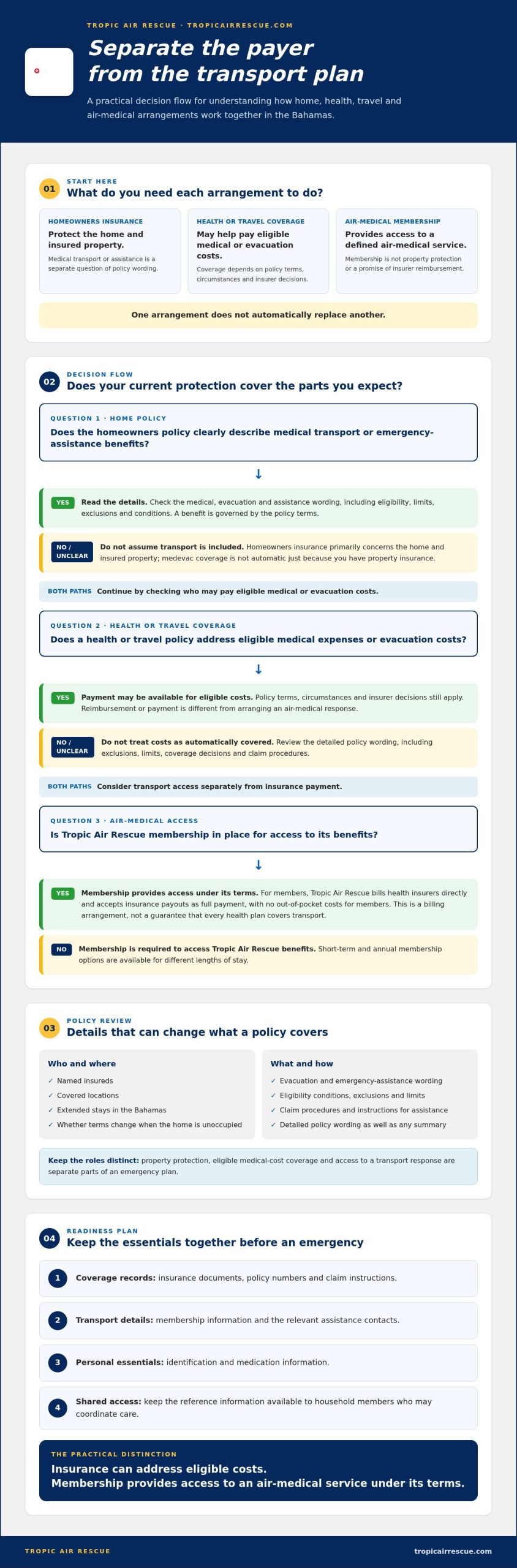
Keep the roles distinct: homeowners coverage concerns the property, health or travel coverage may address eligible medical costs, and membership provides access to an air-medical response. Before an emergency, review the documents for definitions, exclusions, eligibility conditions, and instructions for accessing assistance. This helps prevent assumptions about what a policy will arrange or pay for when time matters.
How Insurance and Medevac Membership Work Together in the Bahamas
Each arrangement addresses a different part of an emergency. Homeowners insurance concerns the insured property. Health insurance may contribute to eligible medical expenses. Travel coverage may include benefits for medical care or evacuation, subject to its terms. An air-medical membership provides access to a defined transport response. These arrangements can complement one another, but they aren’t interchangeable.
- Homeowners insurance: Property protection, with any medical or assistance benefits determined by the policy wording.
- Health insurance: Potential payment for eligible healthcare costs, subject to plan terms and coverage decisions.
- Travel coverage: Potential benefits for medical expenses or evacuation, depending on the policy and circumstances.
- Air-medical membership: Access to an air-medical service under membership terms, rather than property protection or a promise of insurer reimbursement.
The Centers for Disease Control and Prevention’s guidance on Medical evacuation insurance also distinguishes medical coverage from evacuation protection. For medevac insurance for Bahamas homeowners, consider both who may pay eligible costs and how transport access is arranged.
Insurance reimbursement versus emergency transport coordination
An insurance policy sets financial terms: covered services, exclusions, limits, and claim procedures. It may reimburse or pay eligible costs, but that is different from coordinating an air-medical response. Transport decisions depend on medical need and care coordination, not simply a homeowner’s preference for a particular destination.
Tropic Air Rescue membership is required to access its benefits. For members, the company bills health insurers directly and accepts insurance payouts as full payment, with no out-of-pocket costs for members.
What to check in your existing policies
Review each policy’s named insureds, covered locations, emergency-assistance provisions, evacuation language, and exclusions. Check whether the terms address extended stays in the Bahamas and whether they change when the home is unoccupied. Read the detailed policy wording as well as any summary, since the wording may set conditions that affect a claim.
Make a compact reference sheet with insurer and assistance contacts, policy numbers, and claim instructions. Store it with your emergency documents and make it accessible to household members. Keep membership details with it, so anyone coordinating care can identify the transport arrangement while insurers handle their separate payment processes.
For a prepared transport option alongside existing insurance, review Tropic Air Rescue membership options and consider how membership fits your time in the Bahamas.
How to Evaluate Medevac Protection for a Bahamas Home
Start with how you use the home. A seasonal visitor, a homeowner who spends several months in the Bahamas, and someone who stays throughout the year may need different arrangements. Compare your expected time in the country with your existing policy terms. Then identify whether medical transport is covered, coordinated, or not addressed. The U.S. Embassy guidance on medical evacuation is a useful reference when reviewing medical assistance needs in the Bahamas.
Look beyond the word “evacuation.” Find out how an air-medical response is coordinated, what care the aircraft can support, and whether transport can reach the locations relevant to your stay. Tropic Air Rescue’s helicopters carry advanced avionics and life-support equipment and can reach remote locations. These are practical details to consider alongside policy wording when comparing medevac insurance for Bahamas homeowners.
Short-term or annual membership: which fits your stay?
Short-term membership is designed for a defined stay; annual membership may suit a broader presence throughout the year. Match the membership period to how often and how long you expect to be in the Bahamas, including repeat visits. Membership is required to access Tropic Air Rescue benefits. For more context on the longer-term option, see the annual air rescue membership guide.
Questions that reveal gaps in your current arrangements
Check whether medical transport is addressed separately from property damage and routine medical treatment. Locate evacuation exclusions, emergency-assistance provisions, and insurer billing instructions. If policy language is unclear or appears to conflict across documents, resolve that uncertainty before an emergency rather than relying on assumptions; reviewing your coverage with an established agency like Tripp Insurance Solutions can help ensure your personal policies leave no unexpected gaps.
Use this comparison to organize your review:
| Question | Relevant documents | Decision note |
|---|---|---|
| Who is insured, and where does coverage apply? | Homeowners, health, and travel policies | Confirm named people and covered locations match your household and stay. |
| Does the policy address evacuation or emergency assistance? | Policy wording, benefit schedules, assistance instructions | Record exclusions, conditions, contacts, and claim steps. |
| How long will you be in the Bahamas? | Travel plans and membership terms | Compare a short-term membership for a defined stay with an annual option for broader yearly presence. |
| How is transport accessed and supported? | Membership details and service information | Note coordination procedures, aircraft access, and onboard medical equipment. |
Keep your completed notes with your emergency documents. A clear comparison helps show whether your arrangements address property protection, medical costs, and access to transport as distinct needs.
Prepare a Medevac Readiness Plan Before an Emergency
A clear plan can prevent delays caused by searching for documents or trying to recall medical details under pressure. Before staying at your Bahamas home, prepare one shared reference point for your household. Include the steps below:
- Save emergency contacts, membership information, and insurer details in one accessible place.
- Gather identification, relevant policy documents, and current medication information.
- Tell household members where these records are and who should help coordinate care.
- Review how to request assistance under your membership and how to reach your health insurer.
- Refresh the file when medications, medical conditions, contacts, or coverage details change.
This preparation brings together the practical parts of medevac insurance for Bahamas homeowners: understanding what coverage may apply and having the information needed to coordinate a response.
Build a practical medical-information file
Record allergies, current medications and dosages, relevant medical history, and emergency contacts. Keep this information with identification, policy documents, and membership details in a secure location household members can access. If you use a digital copy, make sure the people who may need it know how to open it. Update the file when details change.
Understand the air-medical response
Tropic Air Rescue provides helicopter air-medical transport. Its helicopters carry advanced avionics and life-support equipment and can reach remote locations. Response arrangements depend on medical need and operational coordination. Clinicians assess the patient’s condition and coordinate care with the transport team to determine appropriate transfer arrangements. Transport isn’t simply a request to reach a particular destination.
For a closer look at how coordination works between facilities, read the inter-hospital medical transfer guide. Keep relevant records ready to support communication between the patient, clinicians, and transport team.
Make readiness part of your arrival routine: review the file, ensure household members know where it is, and keep essential information current. To include a membership-based air-medical response in your plan, review Tropic Air Rescue membership.
Tropic Air Rescue Membership: A Prepared Response for Homeowners
For a homeowner, the question isn’t only whether a policy may contribute to eligible expenses. It’s also how medically necessary transport can be accessed and coordinated. Tropic Air Rescue membership provides access to helicopter air-medical transport in the Bahamas. Its helicopters carry advanced avionics and life-support equipment and can reach remote locations, supporting a response when distance and access to care are challenging.
This is distinct from property insurance or a health plan. Reviewing medevac insurance for Bahamas homeowners means understanding both the financial terms of existing policies and the arrangements that provide access to transport.
What membership changes in an emergency
Membership is required to access Tropic Air Rescue’s air-medical benefits. For members, the company bills health insurers directly and accepts insurance payouts as full payment, with no out-of-pocket costs for members. This is different from a policy’s own coverage terms, which are set by the health plan.
Membership provides an emergency-response pathway, while a health policy sets its own coverage terms. Keep membership information and insurer details together, so the people coordinating care can identify both the transport arrangement and the relevant insurance information.
Choose the membership period that matches your plans
Tropic Air Rescue offers short-term and annual membership options. A defined visit may align with short-term membership, while a homeowner who spends more time in the Bahamas across the year may consider an annual option. Think about the expected length and frequency of stays, who in the household needs to be prepared, and how membership fits alongside existing health and travel coverage.
Before your next stay, make membership part of your readiness plan: understand the membership period, keep access details available, and ensure household members know where to find them. Organized information is easier to use when it’s needed.
Explore Tropic Air Rescue membership to review the options for your expected stay in the Bahamas.
Make Your Emergency Plan Ready Before You Need It
For medevac insurance for Bahamas homeowners, preparation means knowing which policy may help with costs and which arrangement provides access to medical transport. Homeowners, health, and travel coverage serve different purposes, so review their terms rather than assuming one covers every need. Keep policy documents, membership details, identification, and essential medical information accessible to your household.
Tropic Air Rescue membership is required to access its air-medical benefits. For members, the company bills health insurers directly and accepts insurance payouts as full payment, with no out-of-pocket costs for members. Its helicopters carry advanced avionics and life-support equipment and can reach remote locations.
Choose a short-term or annual membership according to your expected stay, and make sure household members know where to find the relevant information. Explore Tropic Air Rescue membership to review the options and take a deliberate next step toward readiness. With clear documents and a plan in place, you can approach an emergency with greater confidence.
Frequently Asked Questions
Does homeowners insurance cover medevac in the Bahamas?
Don’t assume homeowners insurance arranges or pays for medical evacuation. It primarily concerns the home and property, while any medical transport or assistance benefit depends on the policy wording. For medevac insurance for Bahamas homeowners, review the medical transport, emergency assistance, and exclusion sections of your documents. Consider these terms separately from health coverage and medevac membership when assessing transport access and eligible costs.
Is medevac insurance the same as a medevac membership?
No. Insurance generally sets financial benefits and conditions in a policy, while a membership provides access to a service under membership terms. Tropic Air Rescue requires membership to access its helicopter air-medical benefits. For members, it bills health insurers directly and accepts insurance payouts as full payment, with no out-of-pocket costs for members. Review your policy and membership information to understand how access, coordination, and payment are handled.
Can health insurance pay for an air ambulance from the Bahamas?
It may, depending on the specific health plan and the insurer’s decision. Don’t assume every plan covers air transport or processes it in the same way. Tropic Air Rescue bills health insurers directly for members and accepts insurance payouts as full payment, with no out-of-pocket costs for members. Keep insurer contact details and policy information accessible, and review your plan’s terms and exclusions.
What should Bahamas homeowners check before choosing medevac protection?
Start with how often you stay in the Bahamas, who needs protection, and what your policies say about emergency assistance and medical transport. Review exclusions and instructions for accessing assistance, then compare those terms with the membership’s access and billing model. Keep policy documents, membership details, emergency contacts, identification, and essential medical information together. Make sure household members know where to find them and how they support response coordination.
Is an annual or short-term medevac membership better for a second-home owner?
The right membership period depends on how long and how often you expect to stay in the Bahamas. A short-term option may suit a defined visit, while an annual option may fit a broader presence throughout the year. Compare the membership terms with your travel calendar and household needs so you understand the arrangement.
What happens if a homeowner needs emergency medical transport in the Bahamas?
The patient needs prompt medical assessment and care. Any transport arrangement depends on medical need and coordination between the relevant care teams. Tropic Air Rescue provides member-access helicopter air-medical transport and coordinates emergency and interhospital transfers throughout the Bahamas. Keep emergency contacts, membership information, medical history, medication details, and insurance documents accessible to support communication and coordination if transport is needed.