

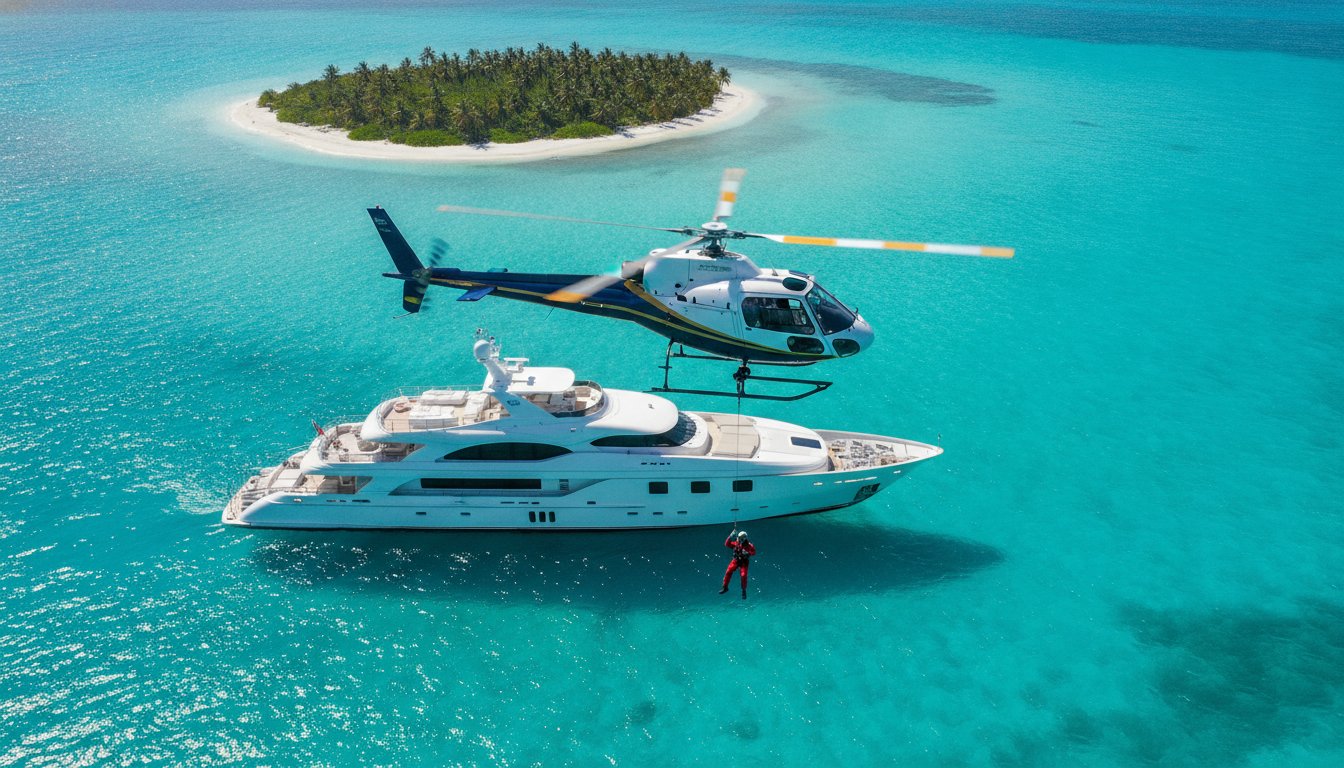
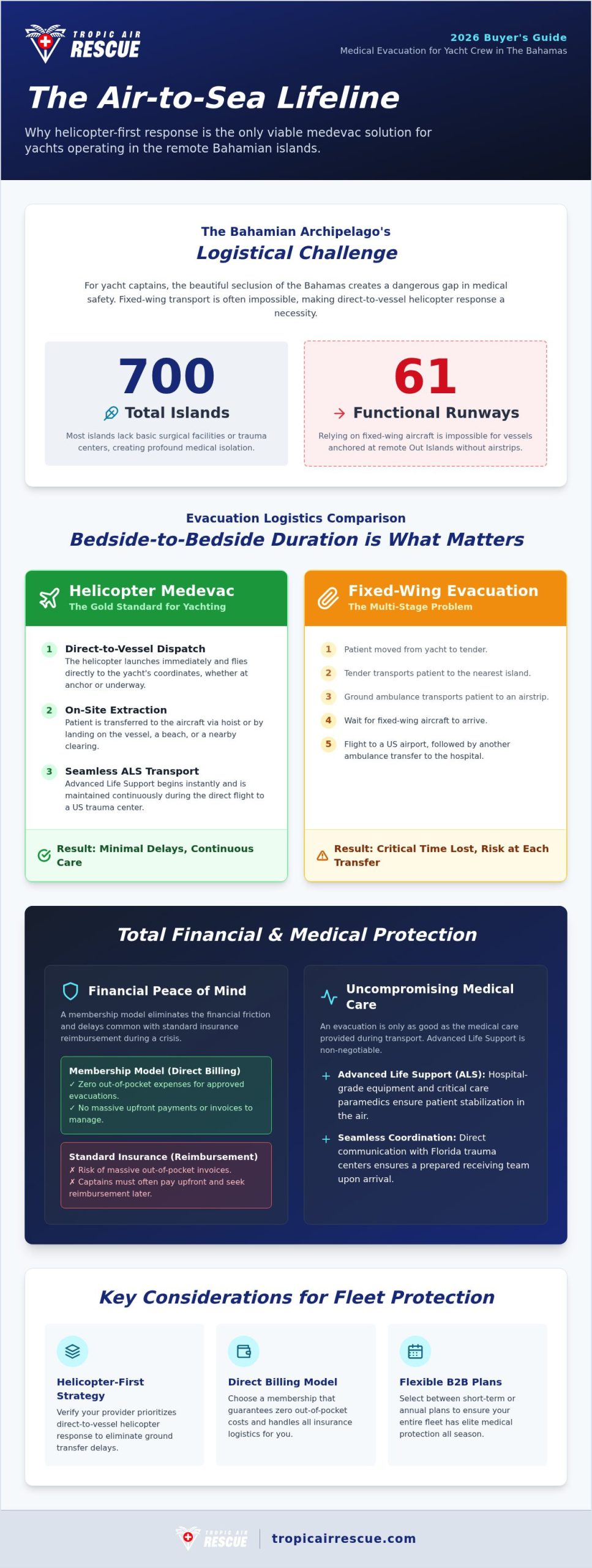
Only 61 of the 700 islands in the Bahamas possess functional runways. For a yacht captain, this statistic represents a dangerous logistical gap. If a crew member faces a life-threatening emergency at a remote anchorage, relying on fixed-wing transport isn’t just slow; it’s often impossible. You need a response plan that doesn’t depend on an airstrip. Securing reliable medical evacuation for yacht crew Bahamas requires a shift from reactive logistics to proactive, helicopter-first protection.
It’s stressful to manage the threat of massive out-of-pocket invoices or insurance delays while a crew member’s life is on the line. You expect elite care and immediate action, not administrative friction. This 2026 buying guide explores how to achieve total financial protection and guaranteed helicopter response directly to your vessel. We’ll examine the benefits of membership-based models, direct insurance billing, and the critical role of Advanced Life Support (ALS) equipment in ensuring seamless transfers to US trauma centers.
Key Takeaways
- Understand why helicopter-based response is the only reliable solution for vessels at anchor where runways are unavailable.
- Secure medical evacuation for yacht crew Bahamas with zero out-of-pocket expenses by leveraging a direct-billing membership model.
- Differentiate between standard insurance reimbursement and concierge memberships that eliminate the need for massive upfront payments.
- Choose between short-term and annual B2B plans to ensure your fleet maintains elite medical protection throughout the charter season.
- Ensure your crew has access to Advanced Life Support (ALS) and seamless coordination with Florida trauma centers during critical emergencies.
The Reality of Medical Emergencies in Bahamian Waters
The Bahamas offers the ultimate paradox for the yachting industry. While the Out Islands provide the seclusion and privacy that owners demand, they also create profound medical isolation. Most of the 700 islands in the archipelago lack basic surgical facilities or trauma centers. When a crew member suffers a critical injury at a remote anchorage, your distance from shore is no longer a luxury; it’s a liability. Securing professional medical evacuation for yacht crew Bahamas is the only way to bridge this gap between a remote deck and a life-saving operating room.
Common maritime emergencies range from deep lacerations and compound fractures to cardiac events and neurological trauma. In these high-stakes moments, the “Golden Hour” remains the most critical metric for survival. This window defines the period where prompt medical intervention is most likely to prevent death or permanent disability. For a yacht captain, managing this timeline is difficult when the nearest functional runway is miles away and local clinics are unequipped for high-acuity stabilization. You need an evacuation strategy that initiates the moment a distress call is placed.
The Logistical Gap in Maritime Safety
Standard emergency response systems often struggle with the fluid nature of maritime coordinates. Relying on local island resources frequently leads to significant delays. Communication barriers and limited transport assets can turn a treatable condition into a catastrophe. The captain’s role is to act as the primary medical decision-maker, identifying when a situation exceeds the ship’s medical kit capabilities. Effective response requires a partner who understands maritime logistics and can navigate directly to a vessel’s position without the need for a transfer to a secondary island airstrip.
Defining High-Acuity Care at Sea
A medevac-level emergency is defined by any condition that threatens life, limb, or long-term function. These situations require more than just a fast flight; they demand Advanced Life Support (ALS) during the entire transit. The integration of specialized air medical services ensures that the patient receives hospital-grade care while still in the air. Preparing the crew for an extraction protocol is essential. This includes clear communication of the patient’s vitals, securing the landing zone or hoist area, and having all medical documentation ready for the flight crew. Precision in these steps reduces on-deck time and accelerates the transition to a Florida trauma center.
Comparing Evacuation Logistics: Helicopter vs. Fixed-Wing
Speed in a medical emergency is often measured by air speed, but for a yacht captain, the only metric that matters is “bedside-to-bedside” duration. Fixed-wing aircraft, while fast in flight, are tethered to infrastructure. In the Bahamas, only 61 of the 700 islands possess functional runways. If your crew is anchored in the remote Out Islands, a medical jet is geographically irrelevant until the patient is transported to an airstrip. This logistical gap requires a secondary transfer via tender and ambulance, which consumes critical minutes during the “Golden Hour.”
Helicopters eliminate these secondary transfers by providing direct access to the patient. Whether landing on a certified helipad, a nearby beach, or a remote clearing, a helicopter brings Advanced Life Support (ALS) directly to the vessel’s location. This versatility is essential in regions where ground infrastructure is non-existent. While Emergency Medical Evacuation Insurance is a vital financial tool, the choice of aircraft determines the physiological outcome. For medical evacuation for yacht crew Bahamas, the ability to bypass island logistics is the primary advantage of rotor-wing assets.
Why Helicopter Medevac is the Yachting Standard
The yachting industry operates on the premise of mobility and privacy, often taking vessels far from established ports. Helicopter medevac provides the only direct-to-vessel extraction capability for yachts at anchor in the remote Bahamas, bypassing the delays of ground and sea transfers. This capability ensures that the patient remains under continuous medical supervision from the moment of extraction until they reach a Florida trauma center. By removing the need for a mid-emergency ambulance ride on unpaved island roads, you minimize the risk of patient instability during transit.
Fixed-Wing as a Secondary Transport Phase
Fixed-wing aircraft serve a specific purpose in the broader medical landscape, primarily for long-distance repatriation or stable inter-hospital transfers. If a crew member requires transport back to their home country after initial stabilization, a jet becomes the appropriate tool. However, using a jet for the initial rescue phase in the Out Islands introduces unnecessary risk through multiple patient transfers. Each time a patient is moved from a boat to a car, and then from a car to a plane, the risk of clinical complications increases. Captains who prioritize operational excellence often rely on B2B membership plans that prioritize direct helicopter response for the initial, high-stakes rescue phase.
Financial Protection from Medical Evacuation Costs
The financial consequences of a maritime medical emergency are often as severe as the clinical trauma itself. Industry data reveals that a single medical evacuation mission in the region can cost between $20,000 and $100,000. In 2025, one documented claim reached $142,000; specialized helicopter missions have even exceeded $180,000. For most providers, the standard protocol involves a mandatory upfront payment of $20,000 or more before the aircraft leaves the tarmac. This “payment first” hurdle creates a dangerous delay during a life-threatening crisis. Securing medical evacuation for yacht crew Bahamas through a membership model eliminates this friction. It transforms a reactive, high-cost event into a managed operational expense.
Understanding Direct Insurance Billing
A membership-based approach serves as a financial shield for the yacht and its crew. Unlike traditional reimbursement models where the captain or owner must pay upfront and fight for recovery later, concierge services coordinate directly with health insurance providers. This model facilitates direct billing. It removes the administrative burden of filing international medical claims from the vessel’s management. It results in zero out-of-pocket expenses for the crew member. By handling the complexities of insurance coordination, the service allows the captain to focus on vessel safety rather than financial logistics. It’s a professional solution that ensures care isn’t delayed by a credit card limit.
The Risk of Standard Yacht Insurance Policies
Captains often assume that a comprehensive hull policy or standard P&I coverage is sufficient for medical emergencies. This is a risky assumption. There is a critical distinction between Search and Rescue (SAR) and a medical evacuation. SAR services are typically government-led and focus on locating a missing vessel or person. They don’t provide the Advanced Life Support (ALS) or the private transport required for medical evacuation for yacht crew Bahamas. Many standard policies operate strictly on a reimbursement basis. This leaves the owner vulnerable to secondary liability if a crew member’s care is delayed due to payment issues. A specialized B2B membership plan fills these gaps. It provides a proactive layer of protection that standard maritime insurance lacks, ensuring the fleet is covered regardless of the medical urgency.
How to Choose a Medevac Membership for Your Fleet
Selecting a partner for medical evacuation for yacht crew Bahamas is a critical command decision. It requires a rigorous evaluation of operational assets and financial structures. You aren’t just buying a policy; you’re securing a professional lifeline. The first step involves assessing your operational tempo. Seasonal charters benefit from short-term memberships, which typically accommodate the three-month minimums common in the industry. For year-round vessels, an annual membership offers a more efficient, permanent financial shield. Coverage should activate quickly; elite providers ensure protection begins 48 hours after enrollment.
National coverage is a mandatory requirement. Your provider must be capable of responding to any coordinate across the entire Bahamas archipelago, from the northern reaches to the remote southern islands. Verification of medical equipment is equally vital. Ensure the aircraft are outfitted with Advanced Life Support (ALS) technology and staffed by certified flight paramedics. This transforms the helicopter into a mobile intensive care unit, providing a level of care that local island clinics cannot match.
Critical Selection Criteria for Captains
Operational reliability depends on dedicated assets. You must verify if the provider owns their fleet or relies on third-party charters. A dedicated fleet of helicopters ensures immediate availability without the delays of sub-leasing. Demand a 24/7 concierge dispatch system that offers a single point of contact for activation. This eliminates the confusion of multiple phone calls during a crisis. Additionally, review the protocol for inter-hospital transfer services. A professional partner coordinates every phase of the movement, ensuring a seamless transition from a remote island clinic to a high-level US trauma center.
Membership Tiers and Coverage Details
Fleet management requires scalable solutions. B2B membership plans allow captains and management companies to cover multiple vessels under a single administrative umbrella. This simplifies billing and ensures that all crew members are protected, regardless of their nationality. In the global yachting industry, having a plan that covers international crew is a non-negotiable requirement. For captains managing high-value assets, the goal is to eliminate the “payment first” hurdle. Choosing a membership that facilitates direct billing to insurers provides the ultimate layer of protection for both the crew and the owner’s liability. To secure your fleet for the upcoming season, explore our B2B Membership Plans for comprehensive maritime coverage.
Tropic Air Rescue: The Gold Standard for Yacht Crew
Tropic Air Rescue is the first FAA-certified helicopter air ambulance service specifically dedicated to the Bahamas. We provide an elite concierge air medical service tailored to the specific needs of the global yachting community. Our operation bridges the gap between the isolation of the Out Islands and the advanced care of Florida trauma centers. We don’t wait for a patient to reach a functional airstrip. We bring the ICU directly to the vessel’s coordinates, ensuring that geography never dictates the quality of medical care.
Our “Zero Friction” financial model removes the primary barrier to emergency response. While traditional operators often demand significant upfront payments before launching, we prioritize immediate activation through our membership-led insurance coordination. This professional framework ensures that medical evacuation for yacht crew Bahamas is a managed operational process rather than a logistical crisis. We handle the complex insurance billing directly, allowing the captain to focus on vessel safety while we manage the patient’s transition to a high-acuity facility.
Operational Excellence in the Bahamas
Every mission is a demonstration of precision and technical expertise. Our helicopters are outfitted with advanced avionics and comprehensive life-support systems. The medical crews are highly trained specialists in flight physiology, prepared to manage critical trauma in a maritime environment. We maintain a proven track record of successful extractions from remote island locations that are inaccessible to fixed-wing aircraft. This specialized capability makes us the definitive partner for medical evacuation for yacht crew Bahamas, providing a level of reliability that matches the standards of the world’s most elite fleets.
Securing Your Vessel Today
Meticulous preparedness is the only effective defense against maritime medical isolation. Captains and fleet managers can enroll their team in an annual air rescue membership to secure permanent, year-round protection. Coverage activates within 48 hours of enrollment, offering immediate peace of mind for the upcoming charter season. Our membership plans are designed to scale with your fleet, covering all crew members regardless of nationality. Don’t leave your crew’s safety to the limitations of local island infrastructure. Protect your crew with Tropic Air Rescue and ensure they have a guaranteed lifeline to the best medical care available.
Secure Your Fleet’s Medical Readiness
The safety of your crew shouldn’t depend on the availability of a remote island runway. Effective medical evacuation for yacht crew Bahamas requires a proactive strategy that prioritizes direct-to-vessel helicopter response and sophisticated clinical care. Rotor-wing assets equipped with Advanced Life Support provide the only viable solution for high-acuity emergencies in the Out Islands.
Preparation is the definitive mark of professional maritime command. By choosing a membership-led model, you eliminate the threat of massive upfront flight costs and the administrative burden of international insurance claims. Our 24/7 concierge medical dispatch and direct insurance billing ensure that your team receives immediate stabilization and transport without financial friction. You can operate in the most remote corners of the archipelago with the confidence that an elite medical lifeline is always standing by.
Secure Financial Protection for Your Crew Today and ensure your vessel is ready for the challenges of the 2026 season.
Frequently Asked Questions
Is medical evacuation for yacht crew covered by standard yacht insurance?
Standard yacht insurance, including hull and P&I coverage, often operates on a reimbursement basis rather than providing immediate payment for services. These policies frequently lack the specific triggers required for private helicopter dispatch and may focus more on vessel salvage than clinical extraction. A dedicated membership ensures that medical evacuation for yacht crew Bahamas is treated as a clinical priority with immediate activation rather than a secondary insurance claim process.
What is the cost of a medical evacuation flight in the Bahamas without a membership?
Unprotected flights represent a significant financial liability. Non-members typically face invoices ranging from $20,000 to over $100,000 depending on mission complexity and patient acuity. Most operators require a minimum upfront payment of $20,000 before an aircraft launches. This financial hurdle can cause life-threatening delays during a crisis. Membership models eliminate these high out-of-pocket costs by managing the financial logistics through direct insurance coordination from the moment of dispatch.
Can a medical helicopter land directly on a yacht?
Yes, provided the vessel has a certified helipad that meets specific safety requirements for weight and clearance. For yachts without helipads, helicopters offer the distinct advantage of landing at the nearest remote island clearing or beach. This capability is far superior to fixed-wing aircraft which are tethered to functional runways. Our fleet is specifically designed for remote landings, ensuring the fastest possible transition from the vessel to a specialized trauma center.
How does direct insurance billing work for air ambulance services?
Direct billing involves the service provider coordinating directly with your health insurance carrier to secure payment. For members, the provider accepts the insurance payout as full compensation for the flight. This removes the administrative burden from the yacht captain and eliminates out-of-pocket expenses for the crew. It is a concierge approach to medical finance that ensures care is delivered based on clinical need rather than immediate credit card authorization or bank transfers.
What medical equipment is typically available on a medevac helicopter?
Every flight is outfitted with Advanced Life Support (ALS) technology to manage critical trauma during transit. This equipment typically includes:
- Cardiac monitors and defibrillators
- Advanced ventilators and oxygen systems
- Intravenous pumps and emergency medications
These systems allow highly trained medical crews to function as a mobile intensive care unit. They provide continuous stabilization and monitoring until the patient reaches a high-acuity facility in Florida.
How long does it take to coordinate a transfer from the Bahamas to a US hospital?
Coordination begins immediately upon receiving a dispatch call. Our 24/7 concierge center handles flight logistics, customs clearance, and hospital admission protocols simultaneously. While flight times depend on your specific maritime coordinates, the objective is always the “Golden Hour.” Membership ensures that activation is instantaneous. This bypasses the multi-hour delays often associated with securing upfront payments or searching for available third-party aircraft in the region.
Do I need a membership if I already have travel insurance?
Travel insurance often lacks the specialized maritime logistics required for yacht extractions. Many policies require you to use their preferred providers, who may only operate fixed-wing aircraft. This creates a dangerous “last mile” problem if you are at a remote anchorage. A dedicated membership guarantees a helicopter response directly to your location. It ensures that the financial coordination for medical evacuation for yacht crew Bahamas is handled without the friction of reimbursement delays.
Does the membership cover international crew members in the Bahamas?
Yes, our membership plans are built for the global nature of the yachting industry. We protect crew members regardless of their nationality or home country. This is a critical component of our B2B membership plans for fleet managers. It ensures that every person on the vessel has access to the same elite level of medical protection and financial coverage while operating throughout the Bahamian archipelago, regardless of where their primary insurance is based.